| 1 |
# unitn-bimrep |
| 2 |
|
| 3 |
A LaTeX class for the Bimonthly report for the University of Trento. The class formats the document in order to |
| 4 |
obtain the typical aspect required by the bimonthly report. |
| 5 |
|
| 6 |
## Installation |
| 7 |
|
| 8 |
If you want to use it for now, you have to put `unitn-bimrep.cls` and `unitn-bimrep.jpg` in the same directory |
| 9 |
of your main LaTeX file. |
| 10 |
|
| 11 |
## Usage |
| 12 |
|
| 13 |
There are some very simple step to complete a document: |
| 14 |
|
| 15 |
1. Use `unitn-bimrep` as your `\documentclass` |
| 16 |
1. In the preamble: |
| 17 |
* Define the `\author` (your name) |
| 18 |
* Define the `\advisor` (name of your advisor, or comma separated list of advisors) |
| 19 |
* Define the `\title` (the title of your thesis) |
| 20 |
* Define the `\cycle` (your school cycle) |
| 21 |
3. In your document (exactly in this order): |
| 22 |
1. Insert the `research` (or `research*`) environment |
| 23 |
2. Insert the `school` (or `school*`) environment |
| 24 |
3. Insert the `production` (or `production*`) environment |
| 25 |
|
| 26 |
If one of the above element is missing, the class will raise an error. |
| 27 |
|
| 28 |
### Environments |
| 29 |
|
| 30 |
#### Research |
| 31 |
|
| 32 |
The `research` enviroment should contain a sequence of `\item` that describe your work. Inside the environment you can use directly the `\item` macro, |
| 33 |
that is interpreted as in a `itemize`. The environment can also be empty. |
| 34 |
|
| 35 |
If you prefer to write a small paragraph, you should use the `research*` environment instead. |
| 36 |
|
| 37 |
`research` (or in alterntive `research*`) can be used **only once**. |
| 38 |
|
| 39 |
#### School |
| 40 |
|
| 41 |
The `school` enviroment should contain a sequence of `\item` that describe the courses you have attended. Inside the environment you can use directly the `\item` macro, |
| 42 |
that it is slightly different with respect to the standard one. This `\item` can take upto 3 arguments: |
| 43 |
|
| 44 |
```latex |
| 45 |
\item{Title of the course}{Teacher or Organization}{Duration in hours or ECTS credit} |
| 46 |
``` |
| 47 |
|
| 48 |
If you prefer to write a small paragraph, you should use the `school*` environment instead. |
| 49 |
|
| 50 |
`school` (or in alterntive `school*`) can be used **only once**, after the `research` environment. |
| 51 |
|
| 52 |
#### Production |
| 53 |
|
| 54 |
The `production` enviroment should contain a sequence of `\item` that describe The course you have attended. Inside the environment you can use directly the `\item` macro, |
| 55 |
that it is slightly different with respect to the standard one. This `\item` can take upto 3 arguments: |
| 56 |
|
| 57 |
```latex |
| 58 |
\item{List of Authors}{Title of the publication}{More information about the paper} |
| 59 |
``` |
| 60 |
|
| 61 |
If you prefer to write a small paragraph, you should use the `production*` environment instead. This opens tothe usage of more advanced function, such as list of publication generated by `bibtex`. |
| 62 |
|
| 63 |
`production` (or in alterntive `production*`) can be used **only once**, after the `research` and `school` environments. |
| 64 |
|
| 65 |
|
| 66 |
### Examples |
| 67 |
|
| 68 |
#### Normal Mode |
| 69 |
|
| 70 |
The code: |
| 71 |
|
| 72 |
```latex |
| 73 |
\documentclass{unitn-bimrep} |
| 74 |
|
| 75 |
\author{Student Name Surname} |
| 76 |
\title{An awesome thesis for a PhD student} |
| 77 |
\advisor{Advisor Name Surname} |
| 78 |
\cycle{XXX} |
| 79 |
|
| 80 |
\begin{document} |
| 81 |
|
| 82 |
\begin{research*} |
| 83 |
For my ctivities I usually prefer to write a small paragraph. Since I used the |
| 84 |
\texttt{research*} environment, I cannot use the \texttt{research} after. |
| 85 |
\end{research*} |
| 86 |
|
| 87 |
\begin{school} |
| 88 |
\item{Interesting course}{A. Einstein}{20h} |
| 89 |
\end{school} |
| 90 |
|
| 91 |
\begin{production} |
| 92 |
\item{Student Name Surname, Advisor Name Surname}{An awesome publication}{Awesome journal (in review)} |
| 93 |
\end{production} |
| 94 |
|
| 95 |
|
| 96 |
\end{document} |
| 97 |
``` |
| 98 |
|
| 99 |
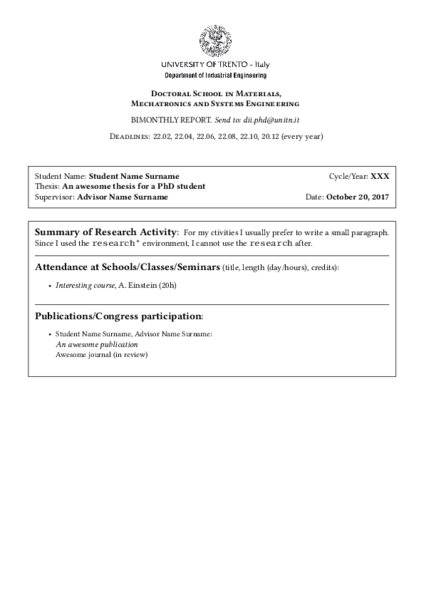
produces: |
| 100 |
|
| 101 |
 |
| 102 |
|
| 103 |
#### With Biblatex |
| 104 |
|
| 105 |
The code: |
| 106 |
|
| 107 |
```latex |
| 108 |
\documentclass[bib]{unitn-bimrep} |
| 109 |
|
| 110 |
\addbibresource{ref.bib} % Define here the bibliography file to use |
| 111 |
|
| 112 |
\author{Student Name Surname} |
| 113 |
\title{An awesome thesis for a PhD student} |
| 114 |
\advisor{Advisor Name Surname} |
| 115 |
\cycle{XXX} |
| 116 |
|
| 117 |
\begin{document} |
| 118 |
|
| 119 |
\begin{research*} |
| 120 |
For my ctivities I usually prefer to write a small paragraph. Since I used the |
| 121 |
\texttt{research*} environment, I cannot use the \texttt{research} after. |
| 122 |
\end{research*} |
| 123 |
|
| 124 |
\begin{school} |
| 125 |
\item{Interesting course}{A. Einstein}{20h} |
| 126 |
\end{school} |
| 127 |
|
| 128 |
\begin{production*} |
| 129 |
\nocite{ref:1,ref:2} % Import the citations with \nocite |
| 130 |
\printbibliography % and print the bibliography. |
| 131 |
\end{production*} |
| 132 |
|
| 133 |
\end{document} |
| 134 |
``` |
| 135 |
|
| 136 |
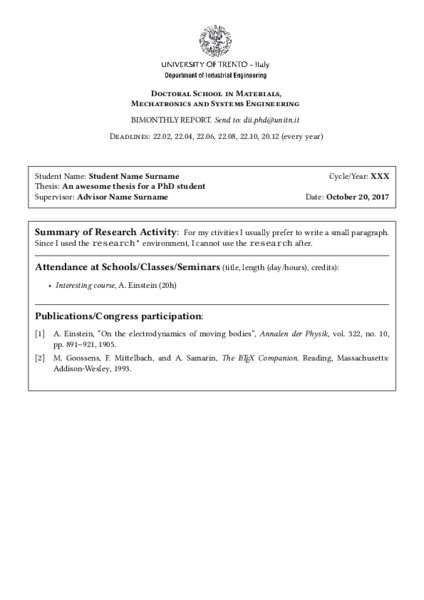
produces: |
| 137 |
|
| 138 |
 |