| 1 |
# tikz-nef |
| 2 |
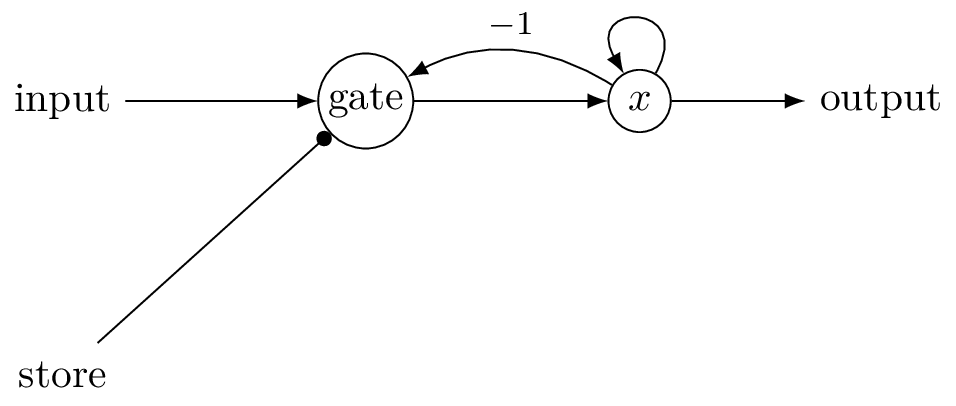
The *nef* TikZ library provides predefined styles and shapes to create diagrams |
| 3 |
for neural networks constructed with the methods of the Neural Engineering |
| 4 |
Framework (NEF) [1]. |
| 5 |
|
| 6 |
 |
| 7 |
|
| 8 |
The example above was generated with this code: |
| 9 |
|
| 10 |
```latex |
| 11 |
\begin{tikzpicture}[nef] |
| 12 |
\graph { |
| 13 |
input [ext] -> gate [ens] -> integrator/$x$ [ens] -> output [ext]; |
| 14 |
integrator -> [bend right, "$-1$"] gate; |
| 15 |
integrator -> [recurrent] integrator; |
| 16 |
store -> [inhibit] gate; |
| 17 |
}; |
| 18 |
\end{tikzpicture} |
| 19 |
``` |
| 20 |
|
| 21 |
The following styles are supported: |
| 22 |
|
| 23 |
* ea: ensemble array |
| 24 |
* ens: ensemble |
| 25 |
* ext: external input or output |
| 26 |
* inhibt: inhibitory connection |
| 27 |
* net: network |
| 28 |
* pnode: pass-through node |
| 29 |
* rect: rectification ensemble |
| 30 |
* recurrent: recurrent connection |
| 31 |
|
| 32 |
## Installation |
| 33 |
|
| 34 |
While this package is not available in [CTAN](https://ctan.org/) follow these |
| 35 |
instruction: |
| 36 |
|
| 37 |
1. Create the required installation directory (if not already existing): |
| 38 |
`mkdir -p "$(kpsewhich -var-value TEXMFHOME)/tex/generic"` |
| 39 |
2. `cd "$(kpsewhich -var-value TEXMFHOME)/tex/generic"` |
| 40 |
3. `git clone https://github.com/jgosmann/tikz-nef.git` |
| 41 |
|
| 42 |
## References |
| 43 |
|
| 44 |
[1]: Chris Eliasmith and Charles H. Anderson. Neural engineering: Computation, |
| 45 |
representation, and dynamics in neurobiological systems. MIT Press, |
| 46 |
Cambridge, MA, 2003. |