| 1 |
# Allow Location Descriptions on the DWARF Expression Stack <!-- omit in toc --> |
| 2 |
|
| 3 |
```{contents} |
| 4 |
--- |
| 5 |
local: |
| 6 |
--- |
| 7 |
``` |
| 8 |
|
| 9 |
# 1. Extension |
| 10 |
|
| 11 |
In DWARF 5, expressions are evaluated using a typed value stack, a separate |
| 12 |
location area, and an independent loclist mechanism. This extension unifies all |
| 13 |
three mechanisms into a single generalized DWARF expression evaluation model |
| 14 |
that allows both typed values and location descriptions to be manipulated on the |
| 15 |
evaluation stack. Both single and multiple location descriptions are supported |
| 16 |
on the stack. In addition, the call frame information (CFI) is extended to |
| 17 |
support the full generality of location descriptions. This is done in a manner |
| 18 |
that is backwards compatible with DWARF 5. The extension involves changes to the |
| 19 |
DWARF 5 sections 2.5 (pp 26-38), 2.6 (pp 38-45), and 6.4 (pp 171-182). |
| 20 |
|
| 21 |
The extension permits operations to act on location descriptions in an |
| 22 |
incremental, consistent, and composable manner. It allows a small number of |
| 23 |
operations to be defined to address the requirements of heterogeneous devices as |
| 24 |
well as providing benefits to non-heterogeneous devices. It acts as a foundation |
| 25 |
to provide support for other issues that have been raised that would benefit all |
| 26 |
devices. |
| 27 |
|
| 28 |
Other approaches were explored that involved adding specialized operations and |
| 29 |
rules. However, these resulted in the need for more operations that did not |
| 30 |
compose. It also resulted in operations with context sensitive semantics and |
| 31 |
corner cases that had to be defined. The observation was that numerous |
| 32 |
specialized context sensitive operations are harder for both producers and |
| 33 |
consumers than a smaller number of general composable operations that have |
| 34 |
consistent semantics regardless of context. |
| 35 |
|
| 36 |
First, section [2. Heterogeneous Computing Devices](#heterogeneous-computing-devices) |
| 37 |
describes heterogeneous devices and the features they have that are not addressed by DWARF 5. |
| 38 |
Then section [3. DWARF5](#dwarf-5) presents a brief simplified overview of the DWARF 5 expression |
| 39 |
evaluation model that highlights the difficulties for supporting the |
| 40 |
heterogeneous features. Next, section [4. Extension |
| 41 |
Solution](#extension-solution) provides an overview of the proposal, using |
| 42 |
simplified examples to illustrate how it can address the issues of heterogeneous |
| 43 |
devices and also benefit non-heterogeneous devices. Then overall conclusions are |
| 44 |
covered in section [5. Conclusion](#conclusion). |
| 45 |
Appendix [A. Changes to DWARF Debugging Information Format Version 5](#changes-to-dwarf-debugging-information-format-version-5) gives changes |
| 46 |
relative to the DWARF Version 5 standard. Finally, appendix |
| 47 |
[B. Further Information](#further-information) has references to further information. |
| 48 |
|
| 49 |
# 2. Heterogeneous Computing Devices |
| 50 |
|
| 51 |
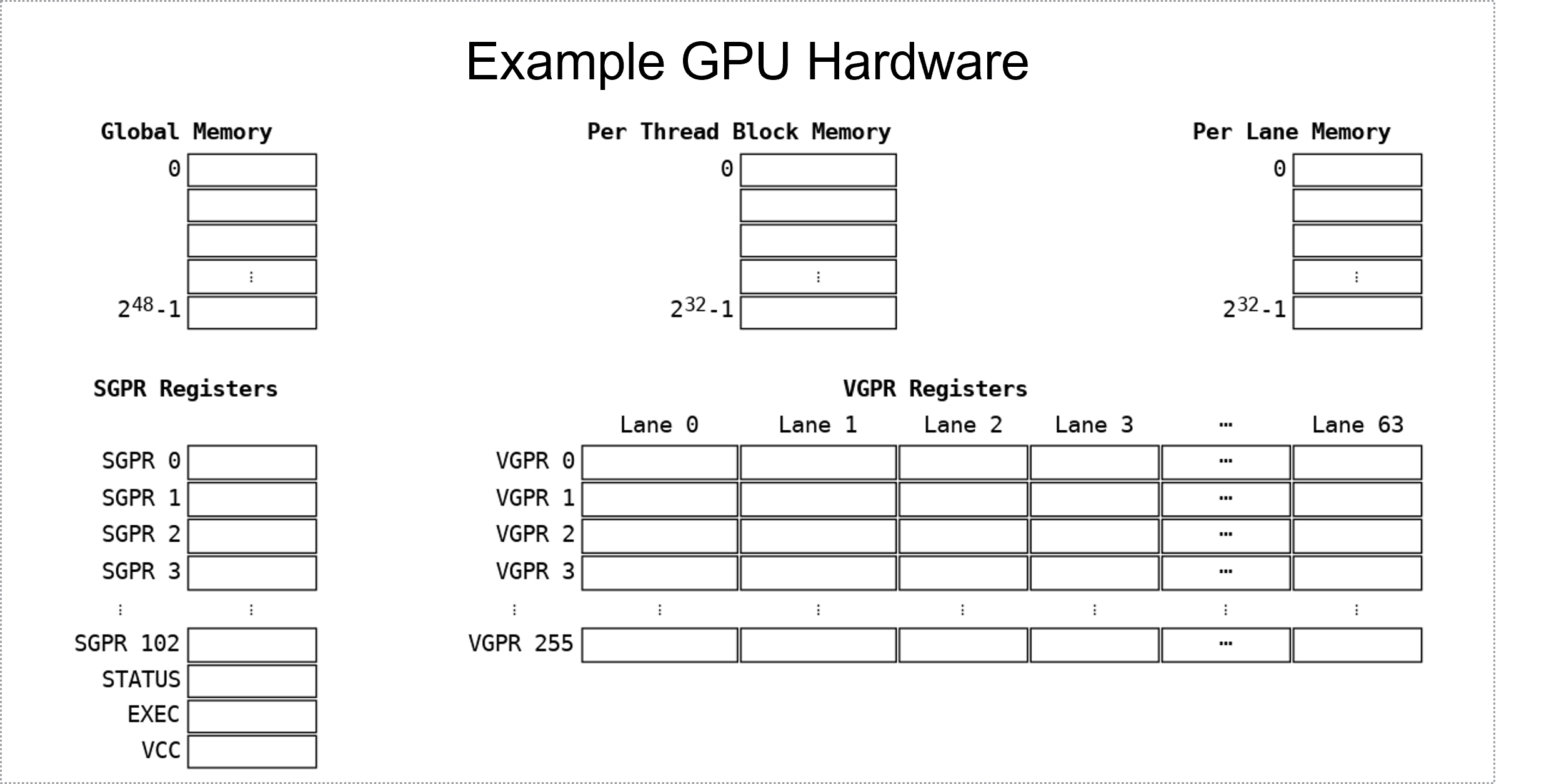
GPUs and other heterogeneous computing devices have features not common to CPU |
| 52 |
computing devices. |
| 53 |
|
| 54 |
These devices often have many more registers than a CPU. This helps reduce |
| 55 |
memory accesses which tend to be more expensive than on a CPU due to the much |
| 56 |
larger number of threads concurrently executing. In addition to traditional |
| 57 |
scalar registers of a CPU, these devices often have many wide vector registers. |
| 58 |
|
| 59 |
 |
| 60 |
|
| 61 |
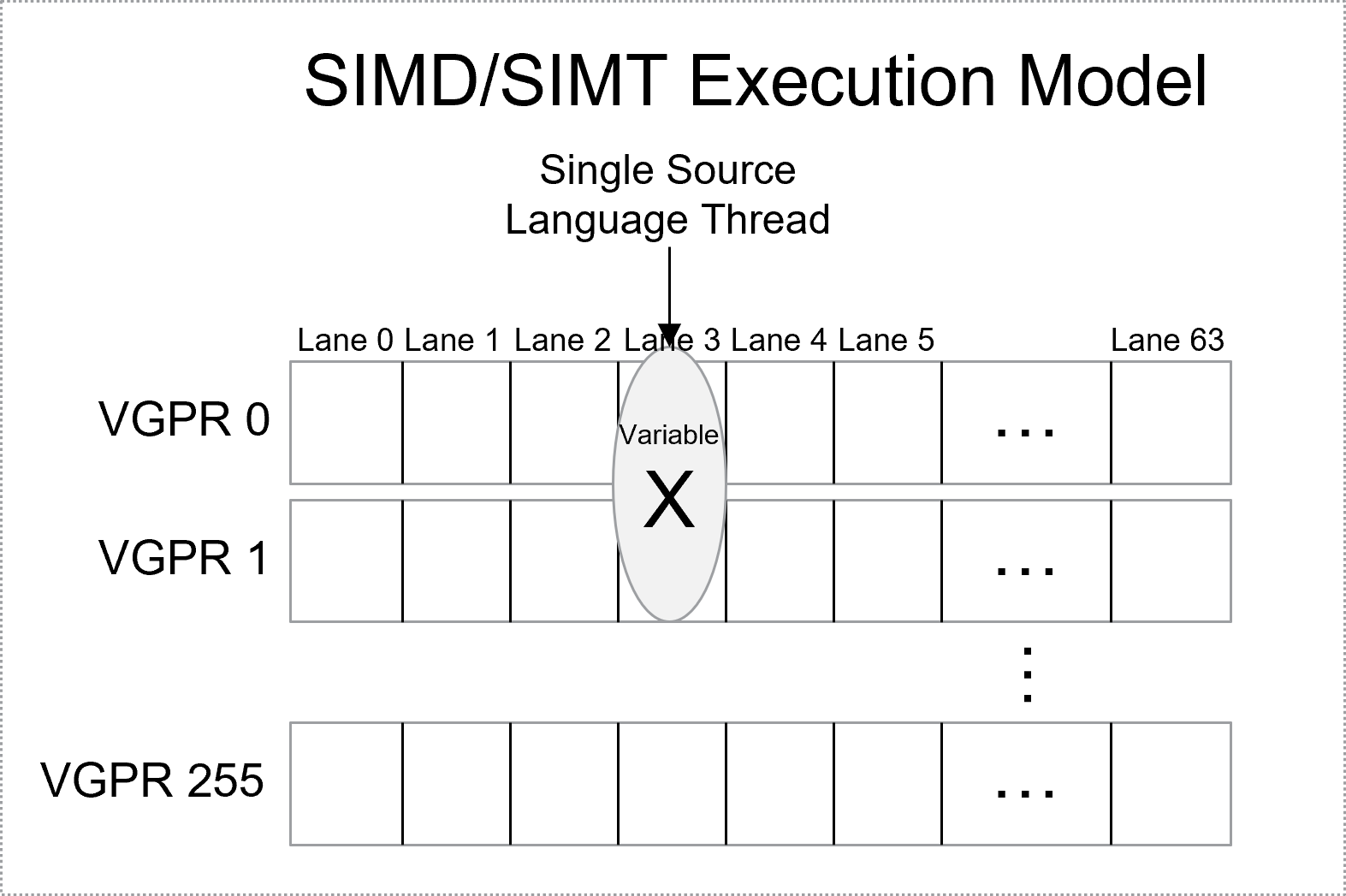
They may support masked vector instructions that are used by the compiler to map |
| 62 |
high level language threads onto the lanes of the vector registers. As a |
| 63 |
consequence, multiple language threads execute in lockstep as the vector |
| 64 |
instructions are executed. This is termed single instruction multiple thread |
| 65 |
(SIMT) execution. |
| 66 |
|
| 67 |
 |
| 68 |
|
| 69 |
GPUs can have multiple memory address spaces in addition to the single global |
| 70 |
memory address space of a CPU. These additional address spaces are accessed |
| 71 |
using distinct instructions and are often local to a particular thread or group |
| 72 |
of threads. |
| 73 |
|
| 74 |
For example, a GPU may have a per thread block address space that is implemented |
| 75 |
as scratch pad memory with explicit hardware support to isolate portions to |
| 76 |
specific groups of threads created as a single thread block. |
| 77 |
|
| 78 |
A GPU may also use global memory in a non linear manner. For example, to support |
| 79 |
providing a SIMT per lane address space efficiently, there may be instructions |
| 80 |
that support interleaved access. |
| 81 |
|
| 82 |
Through optimization, the source variables may be located across these different |
| 83 |
storage kinds. SIMT execution requires locations to be able to express selection |
| 84 |
of runtime defined pieces of vector registers. With the more complex locations, |
| 85 |
there is a benefit to be able to factorize their calculation which requires all |
| 86 |
location kinds to be supported uniformly, otherwise duplication is necessary. |
| 87 |
|
| 88 |
# 3. DWARF 5 |
| 89 |
|
| 90 |
Before presenting the proposed solution to supporting heterogeneous devices, a |
| 91 |
brief overview of the DWARF 5 expression evaluation model will be given to |
| 92 |
highlight the aspects being addressed by the extension. |
| 93 |
|
| 94 |
## 3.1 How DWARF Maps Source Language To Hardware |
| 95 |
|
| 96 |
DWARF is a standardized way to specify debug information. It describes source |
| 97 |
language entities such as compilation units, functions, types, variables, etc. |
| 98 |
It is either embedded directly in sections of the code object executables, or |
| 99 |
split into separate files that they reference. |
| 100 |
|
| 101 |
DWARF maps between source program language entities and their hardware |
| 102 |
representations. For example: |
| 103 |
|
| 104 |
- It maps a hardware instruction program counter to a source language program |
| 105 |
line, and vice versa. |
| 106 |
- It maps a source language function to the hardware instruction program counter |
| 107 |
for its entry point. |
| 108 |
- It maps a source language variable to its hardware location when at a |
| 109 |
particular program counter. |
| 110 |
- It provides information to allow virtual unwinding of hardware registers for a |
| 111 |
source language function call stack. |
| 112 |
- In addition, it provides numerous other information about the source language |
| 113 |
program. |
| 114 |
|
| 115 |
In particular, there is great diversity in the way a source language entity |
| 116 |
could be mapped to a hardware location. The location may involve runtime values. |
| 117 |
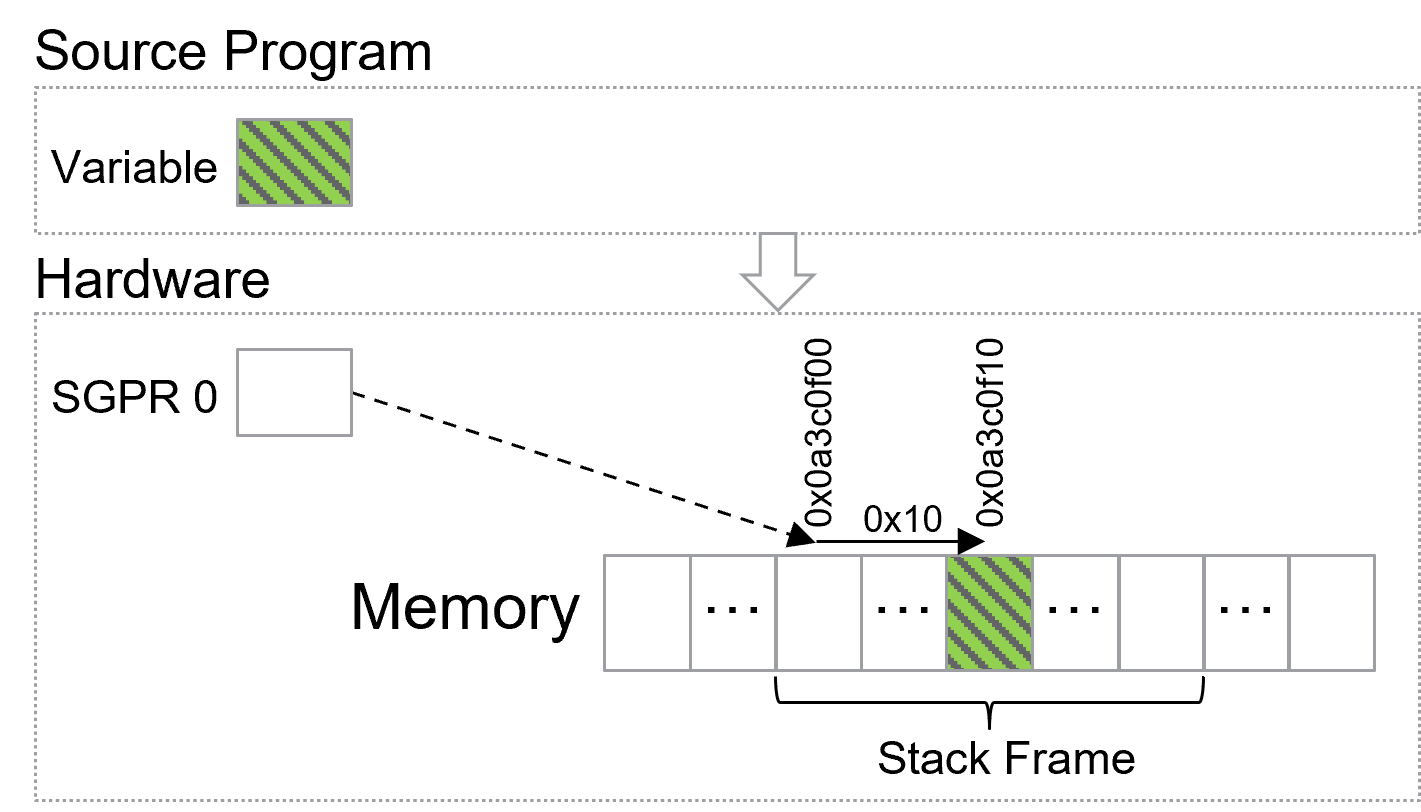
For example, a source language variable location could be: |
| 118 |
|
| 119 |
- In register. |
| 120 |
- At a memory address. |
| 121 |
- At an offset from the current stack pointer. |
| 122 |
- Optimized away, but with a known compiler time value. |
| 123 |
- Optimized away, but with an unknown value, such as happens for unused |
| 124 |
variables. |
| 125 |
- Spread across combination of the above kinds of locations. |
| 126 |
- At a memory address, but also transiently loaded into registers. |
| 127 |
|
| 128 |
To support this DWARF 5 defines a rich expression language comprised of loclist |
| 129 |
expressions and operation expressions. Loclist expressions allow the result to |
| 130 |
vary depending on the PC. Operation expressions are made up of a list of |
| 131 |
operations that are evaluated on a simple stack machine. |
| 132 |
|
| 133 |
A DWARF expression can be used as the value of different attributes of different |
| 134 |
debug information entries (DIE). A DWARF expression can also be used as an |
| 135 |
argument to call frame information information (CFI) entry operations. An |
| 136 |
expression is evaluated in a context dictated by where it is used. The context |
| 137 |
may include: |
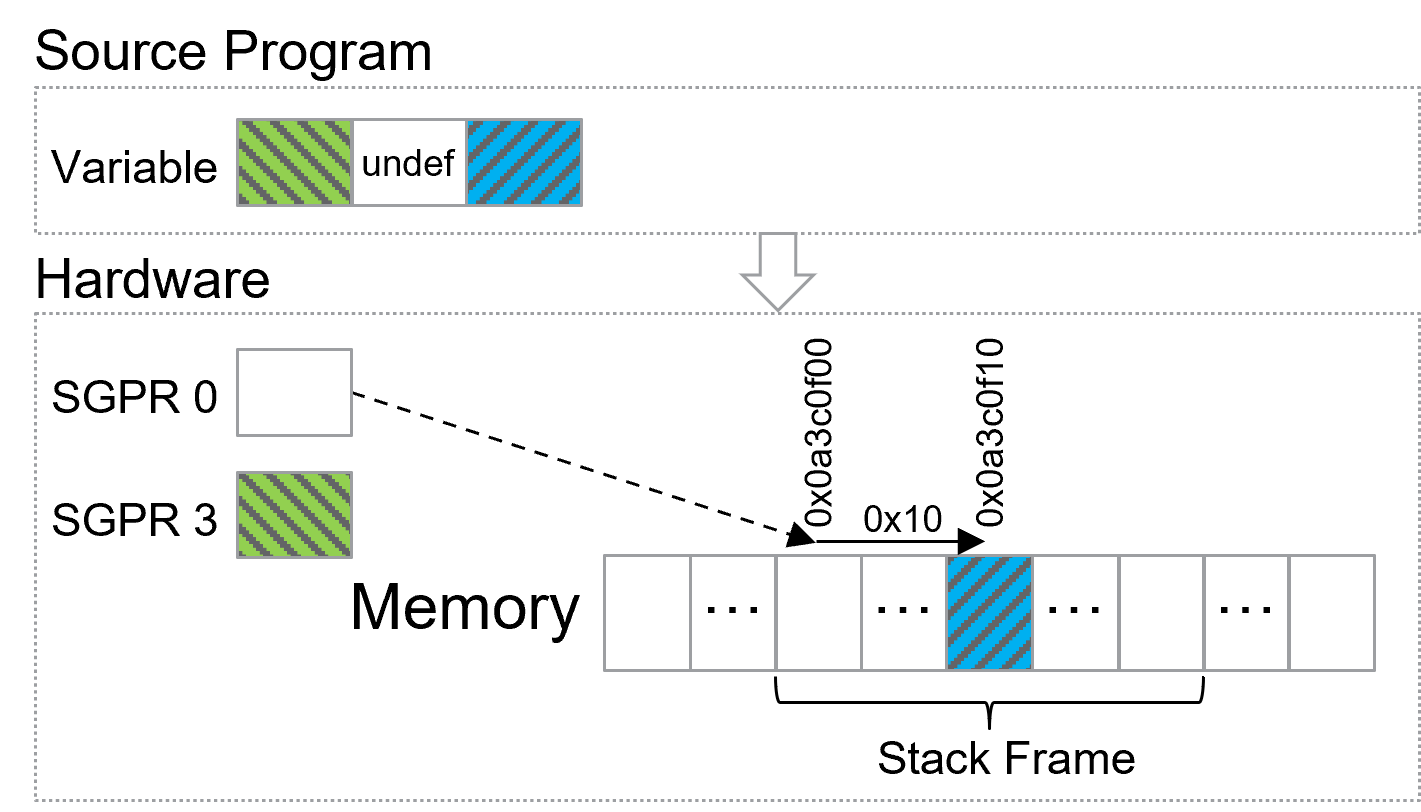
| 138 |
|
| 139 |
- Whether the expression needs to produce a value or the location of an entity. |
| 140 |
- The current execution point including process, thread, PC, and stack frame. |
| 141 |
- Some expressions are evaluated with the stack initialized with a specific |
| 142 |
value or with the location of a base object that is available using the |
| 143 |
DW_OP_push_object_address operation. |
| 144 |
|
| 145 |
## 3.2 Examples |
| 146 |
|
| 147 |
The following examples illustrate how DWARF expressions involving operations are |
| 148 |
evaluated in DWARF 5. DWARF also has expressions involving location lists that |
| 149 |
are not covered in these examples. |
| 150 |
|
| 151 |
### 3.2.1 Dynamic Array Size |
| 152 |
|
| 153 |
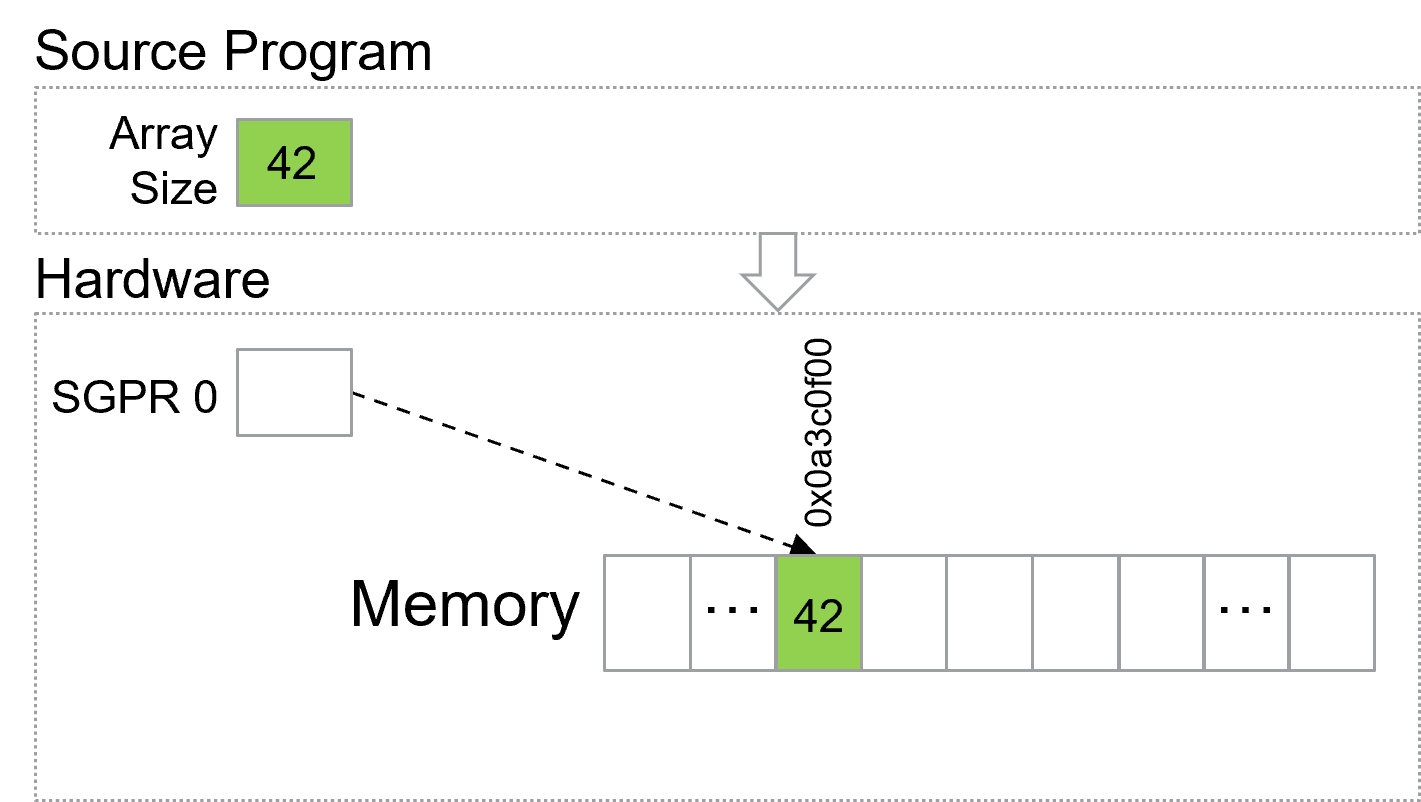
The first example is for an operation expression associated with a DIE attribute |
| 154 |
that provides the number of elements in a dynamic array type. Such an attribute |
| 155 |
dictates that the expression must be evaluated in the context of providing a |
| 156 |
value result kind. |
| 157 |
|
| 158 |
 |
| 159 |
|
| 160 |
In this hypothetical example, the compiler has allocated an array descriptor in |
| 161 |
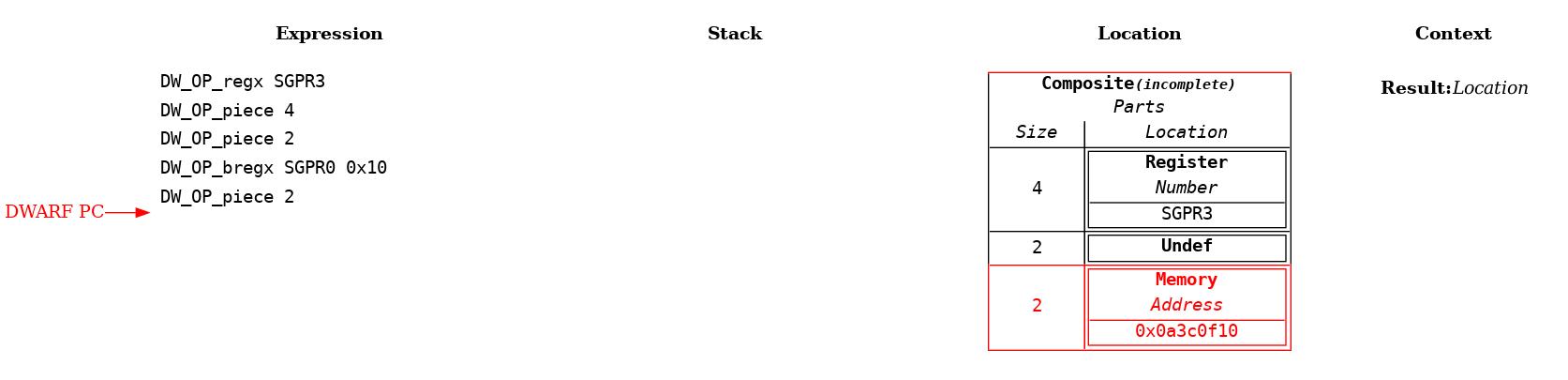
memory and placed the descriptor's address in architecture register SGPR0. The |
| 162 |
first location of the array descriptor is the runtime size of the array. |
| 163 |
|
| 164 |
A possible expression to retrieve the dynamic size of the array is: |
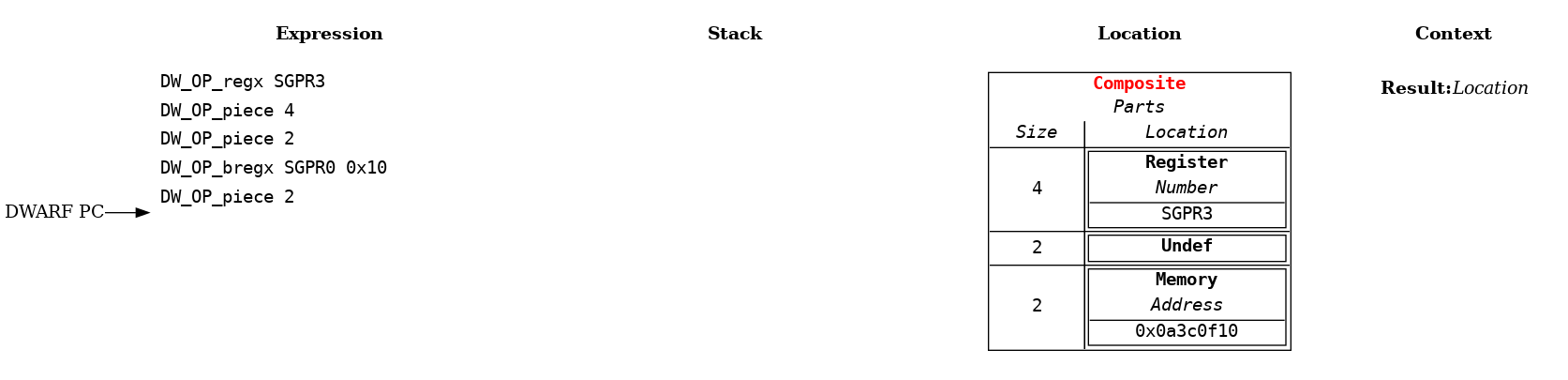
| 165 |
|
| 166 |
DW_OP_regval_type SGPR0 Generic |
| 167 |
DW_OP_deref |
| 168 |
|
| 169 |
The expression is evaluated one operation at a time. Operations have operands |
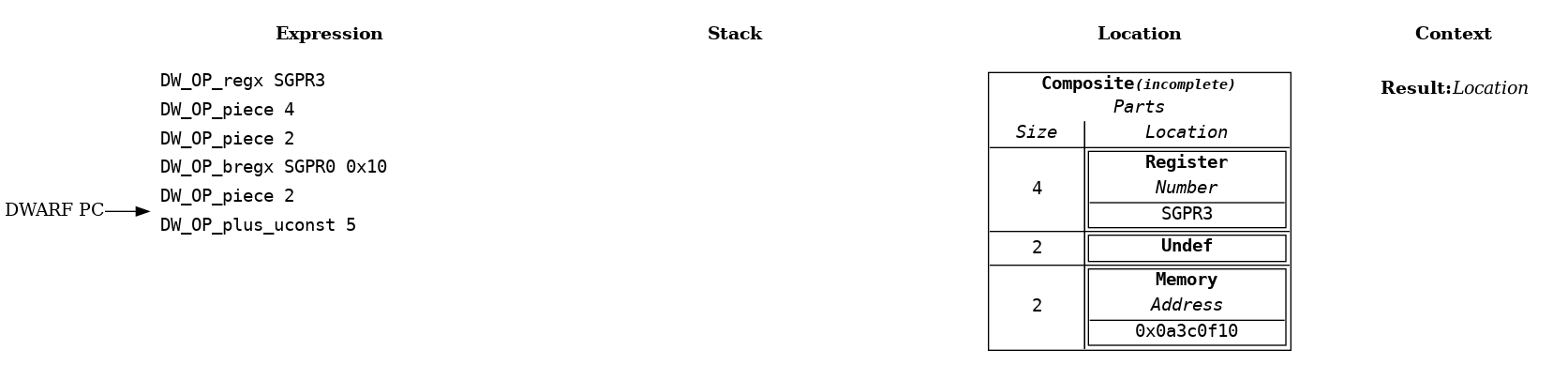
| 170 |
and can pop and push entries on a stack. |
| 171 |
|
| 172 |
 |
| 173 |
|
| 174 |
The expression evaluation starts with the first DW_OP_regval_type operation. |
| 175 |
This operation reads the current value of an architecture register specified by |
| 176 |
its first operand: SGPR0. The second operand specifies the size of the data to |
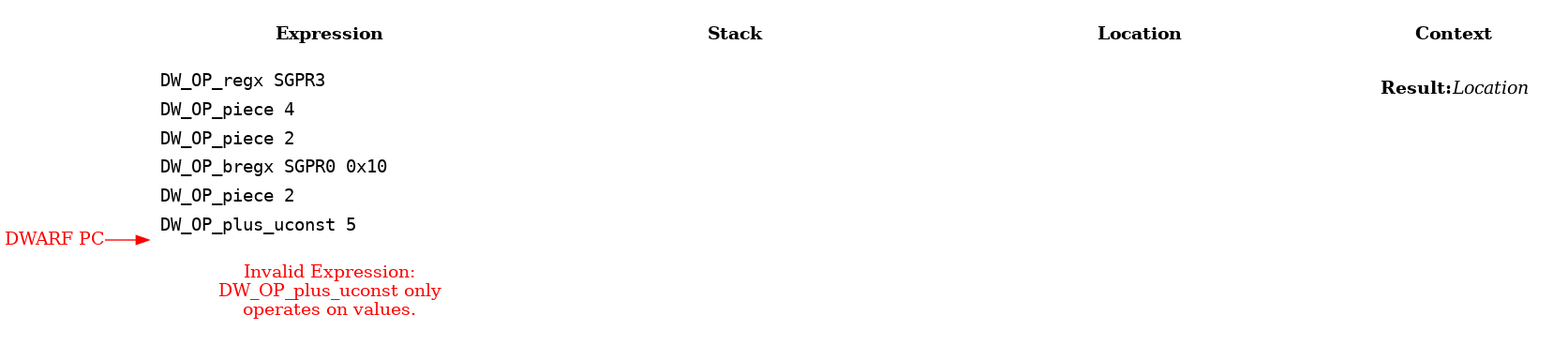
| 177 |
read. The read value is pushed on the stack. Each stack element is a value and |
| 178 |
its associated type. |
| 179 |
|
| 180 |
 |
| 181 |
|
| 182 |
The type must be a DWARF base type. It specifies the encoding, byte ordering, |
| 183 |
and size of values of the type. DWARF defines that each architecture has a |
| 184 |
default generic type: it is an architecture specific integral encoding and byte |
| 185 |
ordering, that is the size of the architecture's global memory address. |
| 186 |
|
| 187 |
The DW_OP_deref operation pops a value off the stack, treats it as a global |
| 188 |
memory address, and reads the contents of that location using the generic type. |
| 189 |
It pushes the read value on the stack as the value and its associated generic |
| 190 |
type. |
| 191 |
|
| 192 |
 |
| 193 |
|
| 194 |
The evaluation stops when it reaches the end of the expression. The result of an |
| 195 |
expression that is evaluated with a value result kind context is the top element |
| 196 |
of the stack, which provides the value and its type. |
| 197 |
|
| 198 |
### 3.2.2 Variable Location in Register |
| 199 |
|
| 200 |
This example is for an operation expression associated with a DIE attribute that |
| 201 |
provides the location of a source language variable. Such an attribute dictates |
| 202 |
that the expression must be evaluated in the context of providing a location |
| 203 |
result kind. |
| 204 |
|
| 205 |
DWARF defines the locations of objects in terms of location descriptions. |
| 206 |
|
| 207 |
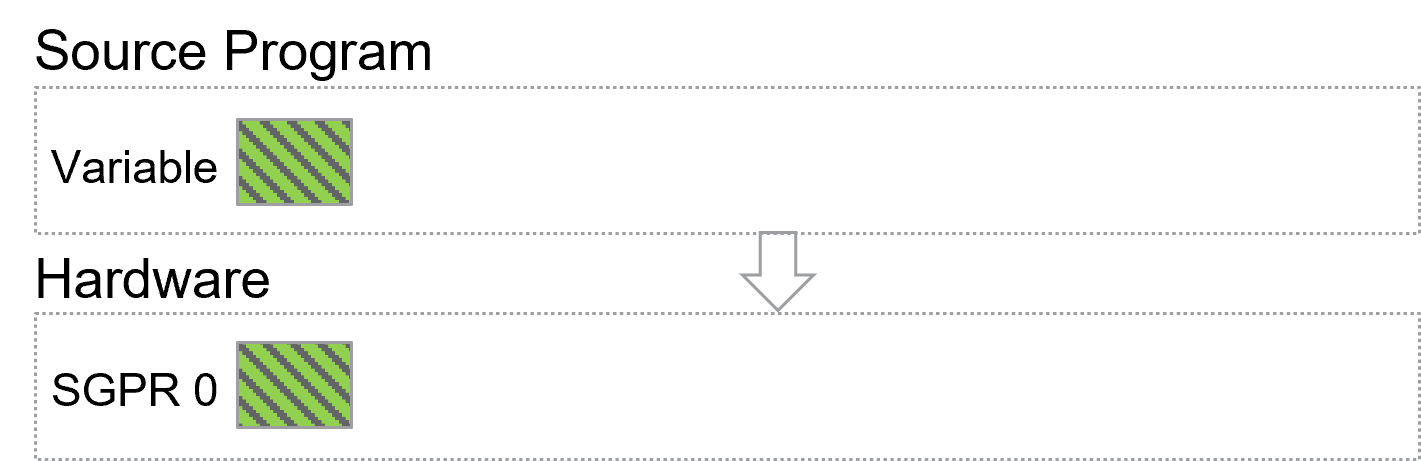
In this example, the compiler has allocated a source language variable in |
| 208 |
architecture register SGPR0. |
| 209 |
|
| 210 |
 |
| 211 |
|
| 212 |
A possible expression to specify the location of the variable is: |
| 213 |
|
| 214 |
DW_OP_regx SGPR0 |
| 215 |
|
| 216 |
 |
| 217 |
|
| 218 |
The DW_OP_regx operation creates a location description that specifies the |
| 219 |
location of the architecture register specified by the operand: SGPR0. Unlike |
| 220 |
values, location descriptions are not pushed on the stack. Instead they are |
| 221 |
conceptually placed in a location area. Unlike values, location descriptions do |
| 222 |
not have an associated type, they only denote the location of the base of the |
| 223 |
object. |
| 224 |
|
| 225 |
 |
| 226 |
|
| 227 |
Again, evaluation stops when it reaches the end of the expression. The result of |
| 228 |
an expression that is evaluated with a location result kind context is the |
| 229 |
location description in the location area. |
| 230 |
|
| 231 |
### 3.2.3 Variable Location in Memory |
| 232 |
|
| 233 |
The next example is for an operation expression associated with a DIE attribute |
| 234 |
that provides the location of a source language variable that is allocated in a |
| 235 |
stack frame. The compiler has placed the stack frame pointer in architecture |
| 236 |
register SGPR0, and allocated the variable at offset 0x10 from the stack frame |
| 237 |
base. The stack frames are allocated in global memory, so SGPR0 contains a |
| 238 |
global memory address. |
| 239 |
|
| 240 |
 |
| 241 |
|
| 242 |
A possible expression to specify the location of the variable is: |
| 243 |
|
| 244 |
DW_OP_regval_type SGPR0 Generic |
| 245 |
DW_OP_plus_uconst 0x10 |
| 246 |
|
| 247 |
 |
| 248 |
|
| 249 |
As in the previous example, the DW_OP_regval_type operation pushes the stack |
| 250 |
frame pointer global memory address onto the stack. The generic type is the size |
| 251 |
of a global memory address. |
| 252 |
|
| 253 |
 |
| 254 |
|
| 255 |
The DW_OP_plus_uconst operation pops a value from the stack, which must have a |
| 256 |
type with an integral encoding, adds the value of its operand, and pushes the |
| 257 |
result back on the stack with the same associated type. In this example, that |
| 258 |
computes the global memory address of the source language variable. |
| 259 |
|
| 260 |
 |
| 261 |
|
| 262 |
Evaluation stops when it reaches the end of the expression. If the expression |
| 263 |
that is evaluated has a location result kind context, and the location area is |
| 264 |
empty, then the top stack element must be a value with the generic type. The |
| 265 |
value is implicitly popped from the stack, and treated as a global memory |
| 266 |
address to create a global memory location description, which is placed in the |
| 267 |
location area. The result of the expression is the location description in the |
| 268 |
location area. |
| 269 |
|
| 270 |
 |
| 271 |
|
| 272 |
### 3.2.4 Variable Spread Across Different Locations |
| 273 |
|
| 274 |
This example is for a source variable that is partly in a register, partly undefined, and partly in memory. |
| 275 |
|
| 276 |
 |
| 277 |
|
| 278 |
DWARF defines composite location descriptions that can have one or more parts. |
| 279 |
Each part specifies a location description and the number of bytes used from it. |
| 280 |
The following operation expression creates a composite location description. |
| 281 |
|
| 282 |
DW_OP_regx SGPR3 |
| 283 |
DW_OP_piece 4 |
| 284 |
DW_OP_piece 2 |
| 285 |
DW_OP_bregx SGPR0 0x10 |
| 286 |
DW_OP_piece 2 |
| 287 |
|
| 288 |
 |
| 289 |
|
| 290 |
The DW_OP_regx operation creates a register location description in the location |
| 291 |
area. |
| 292 |
|
| 293 |
 |
| 294 |
|
| 295 |
The first DW_OP_piece operation creates an incomplete composite location |
| 296 |
description in the location area with a single part. The location description in |
| 297 |
the location area is used to define the beginning of the part for the size |
| 298 |
specified by the operand, namely 4 bytes. |
| 299 |
|
| 300 |
 |
| 301 |
|
| 302 |
A subsequent DW_OP_piece adds a new part to an incomplete composite location |
| 303 |
description already in the location area. The parts form a contiguous set of |
| 304 |
bytes. If there are no other location descriptions in the location area, and no |
| 305 |
value on the stack, then the part implicitly uses the undefined location |
| 306 |
description. Again, the operand specifies the size of the part in bytes. The |
| 307 |
undefined location description can be used to indicate a part that has been |
| 308 |
optimized away. In this case, 2 bytes of undefined value. |
| 309 |
|
| 310 |
 |
| 311 |
|
| 312 |
The DW_OP_bregx operation reads the architecture register specified by the first |
| 313 |
operand (SGPR0) as the generic type, adds the value of the second operand |
| 314 |
(0x10), and pushes the value on the stack. |
| 315 |
|
| 316 |
 |
| 317 |
|
| 318 |
The next DW_OP_piece operation adds another part to the already created |
| 319 |
incomplete composite location. |
| 320 |
|
| 321 |
If there is no other location in the location area, but there is a value on |
| 322 |
stack, the new part is a memory location description. The memory address used is |
| 323 |
popped from the stack. In this case, the operand of 2 indicates there are 2 |
| 324 |
bytes from memory. |
| 325 |
|
| 326 |
 |
| 327 |
|
| 328 |
Evaluation stops when it reaches the end of the expression. If the expression |
| 329 |
that is evaluated has a location result kind context, and the location area has |
| 330 |
an incomplete composite location description, the incomplete composite location |
| 331 |
is implicitly converted to a complete composite location description. The result |
| 332 |
of the expression is the location description in the location area. |
| 333 |
|
| 334 |
 |
| 335 |
|
| 336 |
### 3.2.5 Offsetting a Composite Location |
| 337 |
|
| 338 |
This example attempts to extend the previous example to offset the composite |
| 339 |
location description it created. The [3.2.3 Variable Location in |
| 340 |
Memory](#variable-location-in-memory) example conveniently used the DW_OP_plus |
| 341 |
operation to offset a memory address. |
| 342 |
|
| 343 |
DW_OP_regx SGPR3 |
| 344 |
DW_OP_piece 4 |
| 345 |
DW_OP_piece 2 |
| 346 |
DW_OP_bregx SGPR0 0x10 |
| 347 |
DW_OP_piece 2 |
| 348 |
DW_OP_plus_uconst 5 |
| 349 |
|
| 350 |
 |
| 351 |
|
| 352 |
However, DW_OP_plus cannot be used to offset a composite location. It only |
| 353 |
operates on the stack. |
| 354 |
|
| 355 |
 |
| 356 |
|
| 357 |
To offset a composite location description, the compiler would need to make a |
| 358 |
different composite location description, starting at the part corresponding to |
| 359 |
the offset. For example: |
| 360 |
|
| 361 |
DW_OP_piece 1 |
| 362 |
DW_OP_bregx SGPR0 0x10 |
| 363 |
DW_OP_piece 2 |
| 364 |
|
| 365 |
This illustrates that operations on stack values are not composable with |
| 366 |
operations on location descriptions. |
| 367 |
|
| 368 |
### 3.2.6 Pointer to Member |
| 369 |
|
| 370 |
> NOTE: Without loss of generality, DWARF 4 is used in this example as full |
| 371 |
> support for DWARF 5 is not present in the versions of the tools used. No |
| 372 |
> feature of DWARF 5 provides a remedy for this issue. |
| 373 |
|
| 374 |
This example highlights the inability of DWARF 5 to describe C++ |
| 375 |
pointer-to-member use semantics. |
| 376 |
|
| 377 |
The mechanism DWARF 5 provides for describing pointer-to-member use is |
| 378 |
`DW_AT_use_location`, which is defined as encoding a location description which |
| 379 |
computes the address of the member pointed to by a pointer-to-member, given the |
| 380 |
pointer-to-member object and the address of the containing object. |
| 381 |
|
| 382 |
That is, when a debug agent wishes to evaluate a pointer-to-member access |
| 383 |
operation, it first pushes two values onto the DWARF expression stack: |
| 384 |
|
| 385 |
* The pointer-to-member object |
| 386 |
* The address of the containing object |
| 387 |
|
| 388 |
It then evaluates the location description associated with the |
| 389 |
`DW_AT_use_location` of the pointer-to-member type, and interprets the result |
| 390 |
as the address of the member pointed to by the pointer-to-member. |
| 391 |
|
| 392 |
Consider the following C++ source file `s.cc`: |
| 393 |
|
| 394 |
```cpp |
| 395 |
struct s { |
| 396 |
int m; |
| 397 |
int n; |
| 398 |
}; |
| 399 |
int s::* p; |
| 400 |
``` |
| 401 |
|
| 402 |
When compiled with GCC and inspected with dwarfdump: |
| 403 |
|
| 404 |
``` |
| 405 |
$ g++ -gdwarf-5 -O3 -c s.cc |
| 406 |
$ dwarfdump s.o |
| 407 |
< 1><0x0000001e> DW_TAG_structure_type |
| 408 |
DW_AT_name s |
| 409 |
DW_AT_byte_size 0x00000008 |
| 410 |
DW_AT_sibling <0x0000003c> |
| 411 |
< 2><0x00000029> DW_TAG_member |
| 412 |
DW_AT_name m |
| 413 |
DW_AT_type <0x0000003c> |
| 414 |
DW_AT_data_member_location 0 |
| 415 |
< 2><0x00000032> DW_TAG_member |
| 416 |
DW_AT_name n |
| 417 |
DW_AT_type <0x0000003c> |
| 418 |
DW_AT_data_member_location 4 |
| 419 |
< 1><0x0000003c> DW_TAG_base_type |
| 420 |
DW_AT_byte_size 0x00000004 |
| 421 |
DW_AT_encoding DW_ATE_signed |
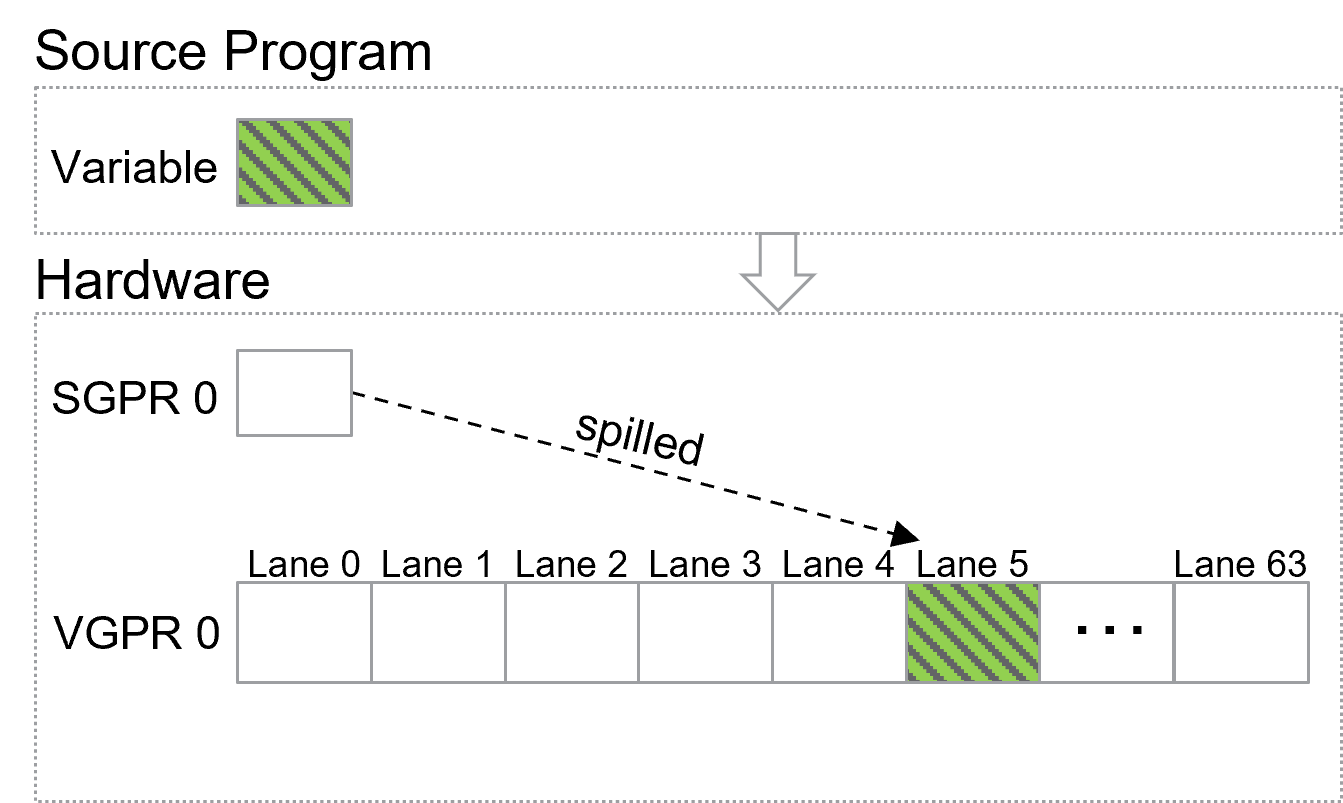
| 422 |
DW_AT_name int |
| 423 |
< 1><0x00000043> DW_TAG_ptr_to_member_type |
| 424 |
DW_AT_containing_type <0x0000001e> |
| 425 |
DW_AT_type <0x0000003c> |
| 426 |
DW_AT_use_location len 0x0001: 22: DW_OP_plus |
| 427 |
< 1><0x0000004e> DW_TAG_variable |
| 428 |
DW_AT_name p |
| 429 |
DW_AT_type <0x00000043> |
| 430 |
DW_AT_external yes(1) |
| 431 |
DW_AT_location len 0x0009: 030000000000000000: DW_OP_addr 0x00000000 |
| 432 |
``` |
| 433 |
|
| 434 |
Note the location description for `DW_AT_use_location` is `DW_OP_plus`, which |
| 435 |
reflects the GCC implementation of the pointer-to-member as an integral byte |
| 436 |
offset within the containing object. For example, the value of `&s::m` in this |
| 437 |
implementation is `offsetof(s, m)` and the value of `&s::n` is `offsetof(s, n)`: |
| 438 |
|
| 439 |
```cpp |
| 440 |
struct s { |
| 441 |
int m; // offsetof(s, m) == 0 |
| 442 |
int n; // offsetof(s, n) == 4 |
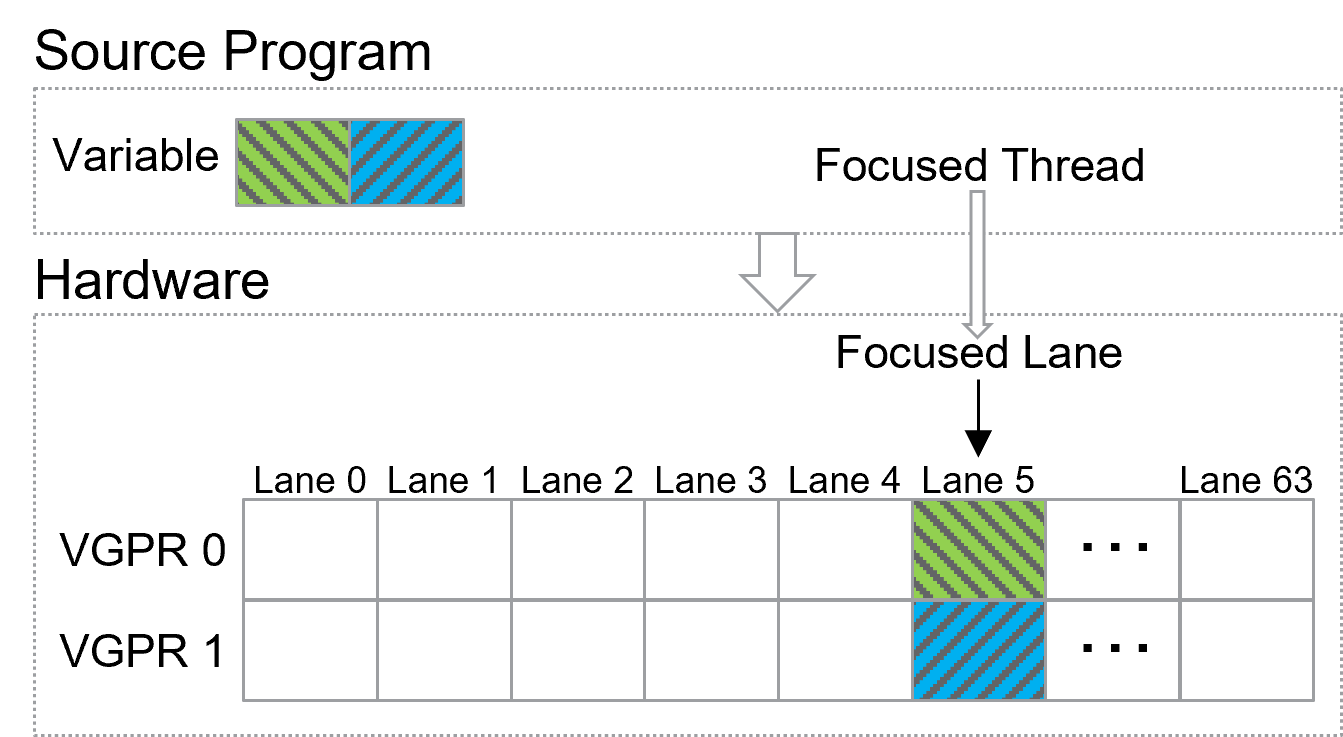
| 443 |
} o; // &o == 0xff00 |
| 444 |
int s::* p; |
| 445 |
int *i; |
| 446 |
|
| 447 |
p = &s::m; // p == 0 |
| 448 |
i = &(o.*p); // i == 0xff00 + 0 |
| 449 |
p = &s::n; // p == 4 |
| 450 |
i = &(o.*p); // i == 0xff00 + 4 |
| 451 |
``` |
| 452 |
|
| 453 |
The expression `DW_OP_plus` accurately describes this implementation so long as |
| 454 |
the entire containing object resides in memory in the default address space. |
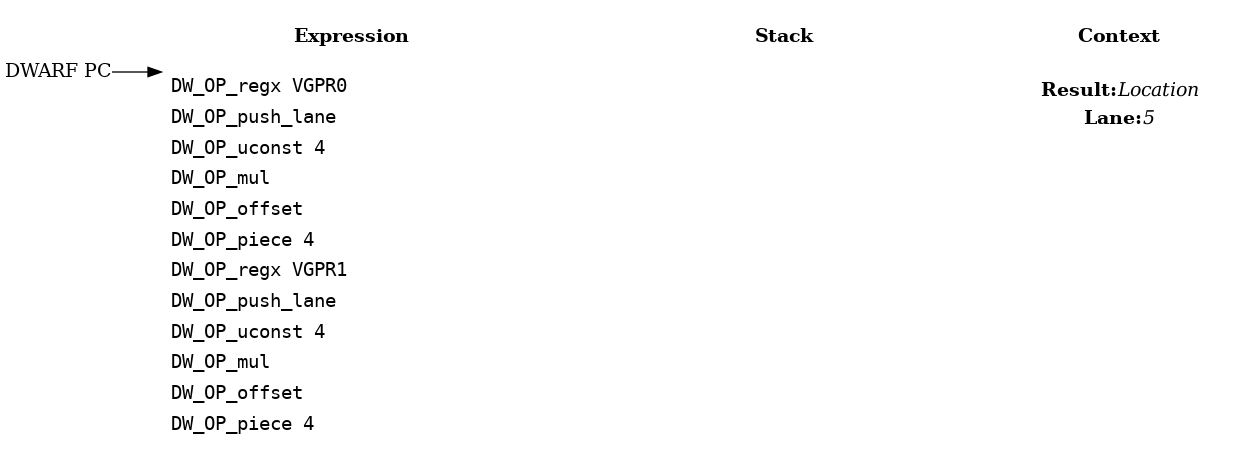
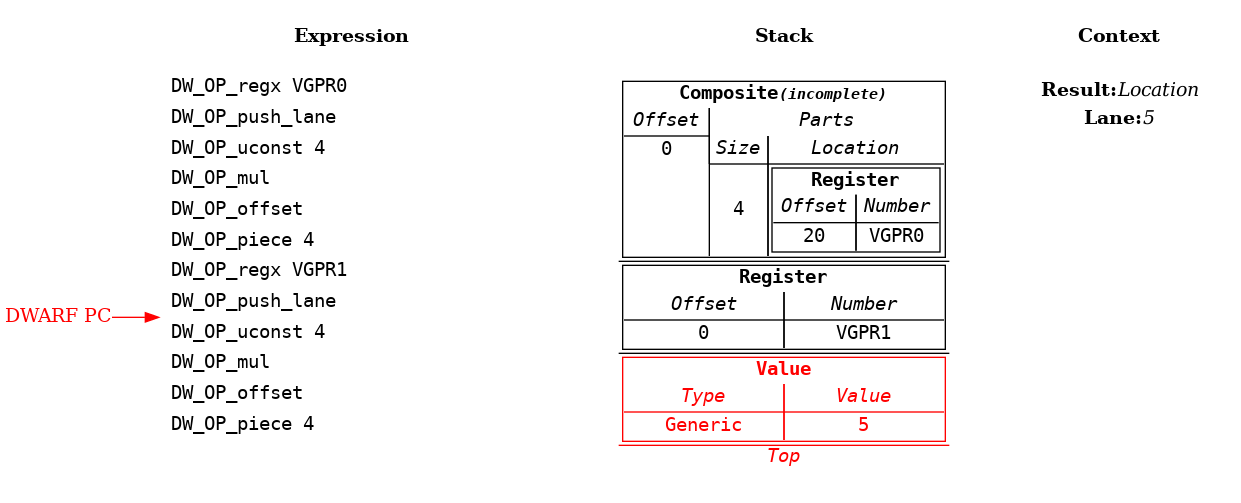
| 455 |
|
| 456 |
However, what if the containing object or the member pointed to are not at any |
| 457 |
default address space address? |
| 458 |
|
| 459 |
The compiler may store the containing object in memory in any address space, |
| 460 |
in a register, recompute its value at each use, or compose any of these in |
| 461 |
arbitrary ways. |
| 462 |
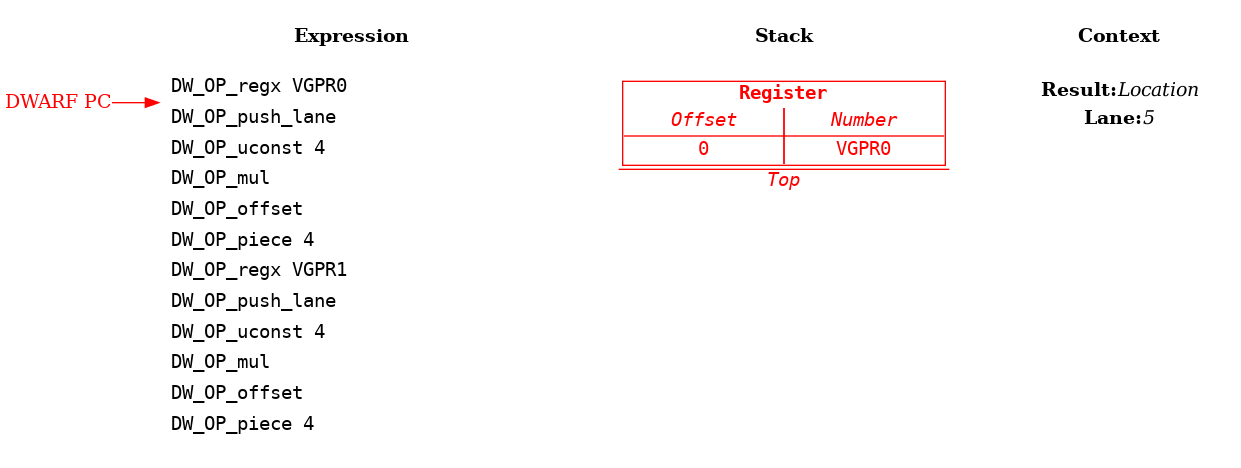
|
| 463 |
The richness of the existing DWARF 5 expression language is a reflection of the |
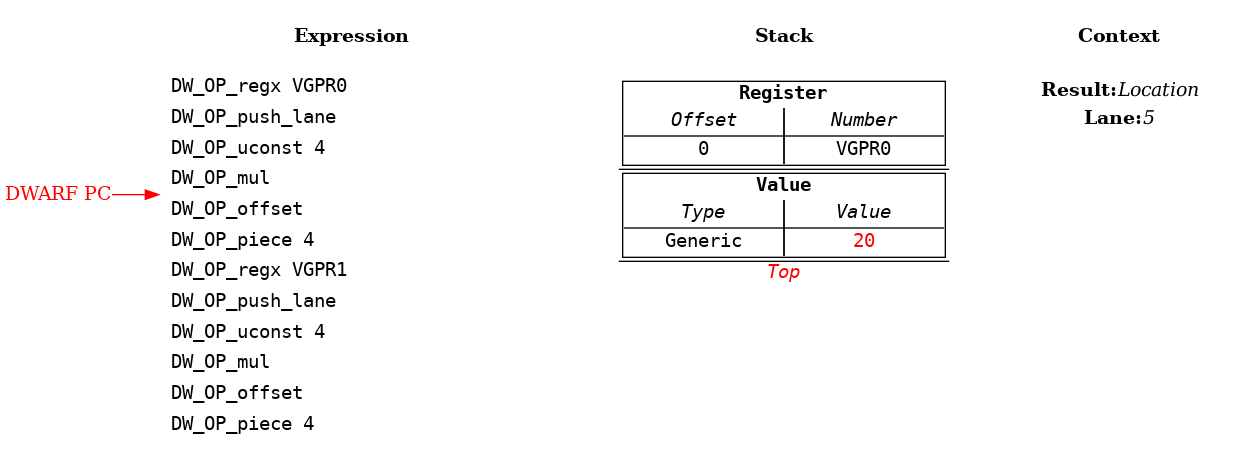
| 464 |
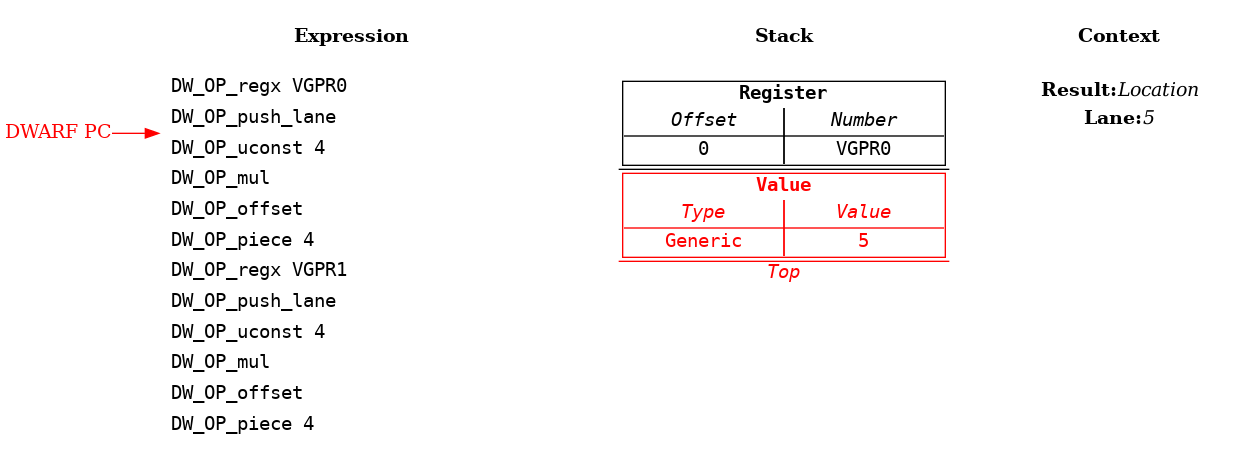
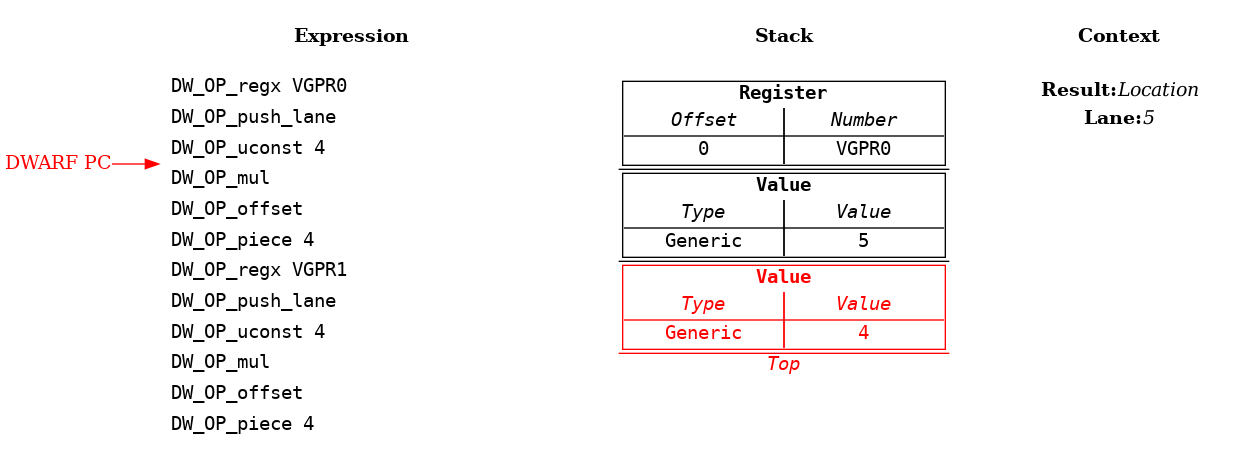
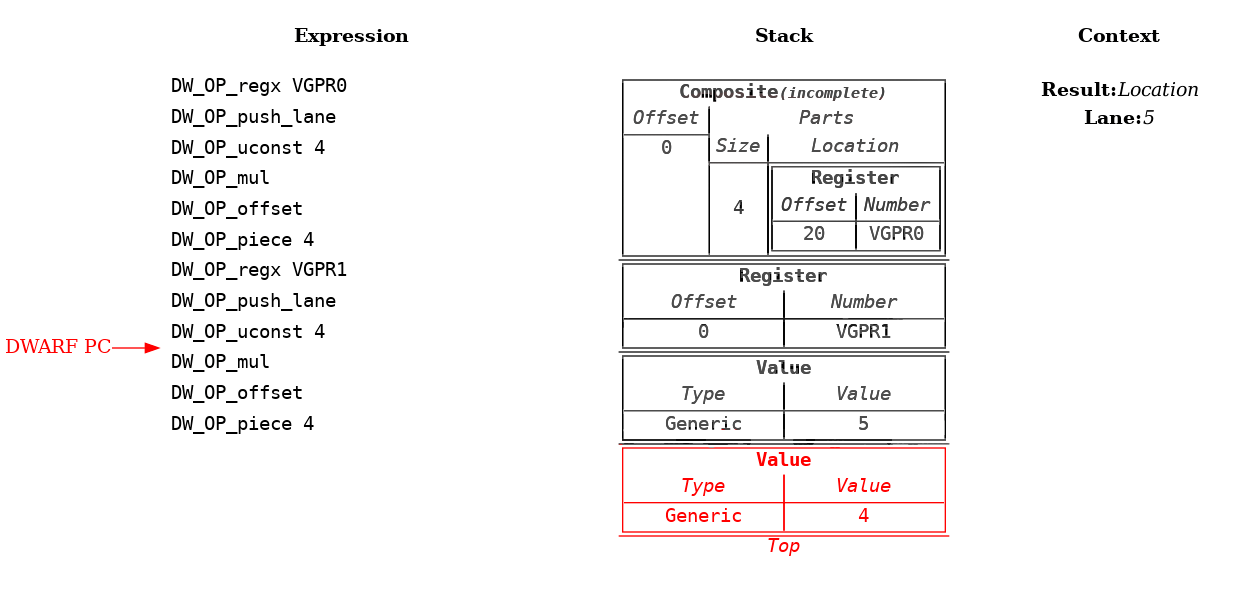
diversity of possible implementation strategies and optimization choices |
| 465 |
affecting the location of an object in a program, and (modulo address spaces) |
| 466 |
it can describe all of these locations for variables. However, the moment we |
| 467 |
look at a pointer-to-member use we are restricted to only objects residing in a |
| 468 |
contiguous piece of memory in the default address space. |
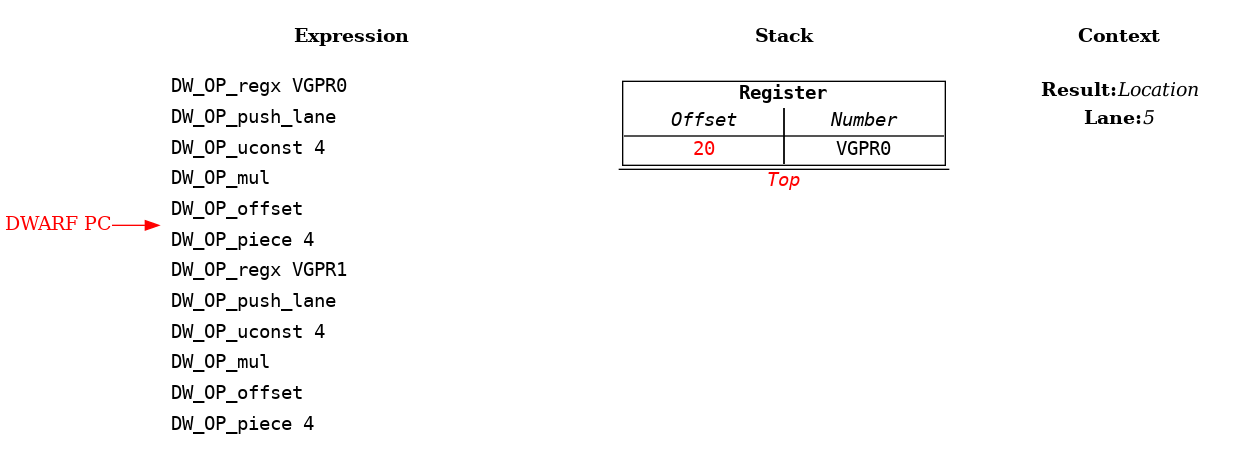
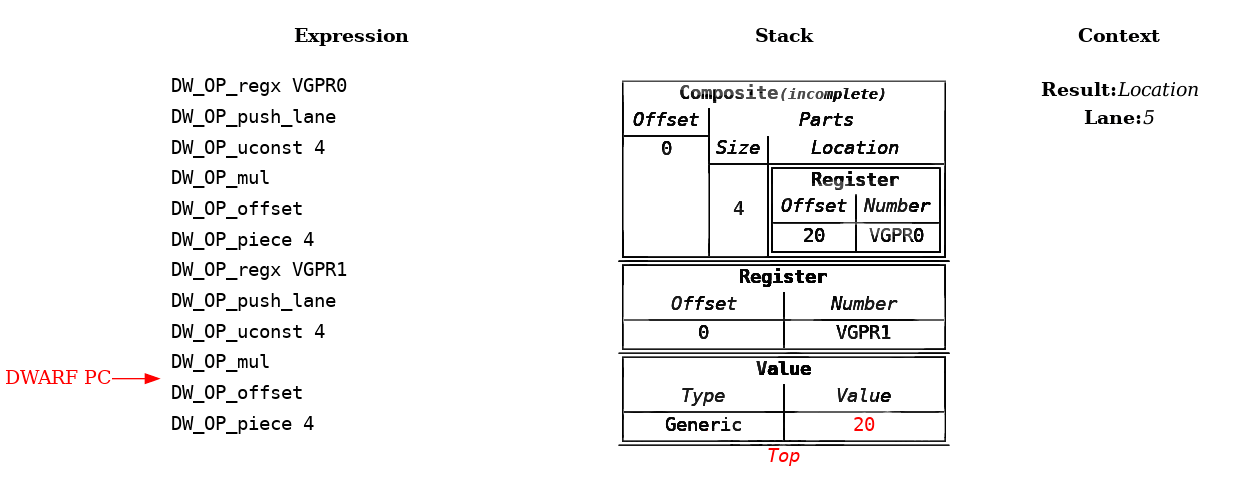
| 469 |
|
| 470 |
To demonstrate the problem, consider a program which GCC chooses to optimize in |
| 471 |
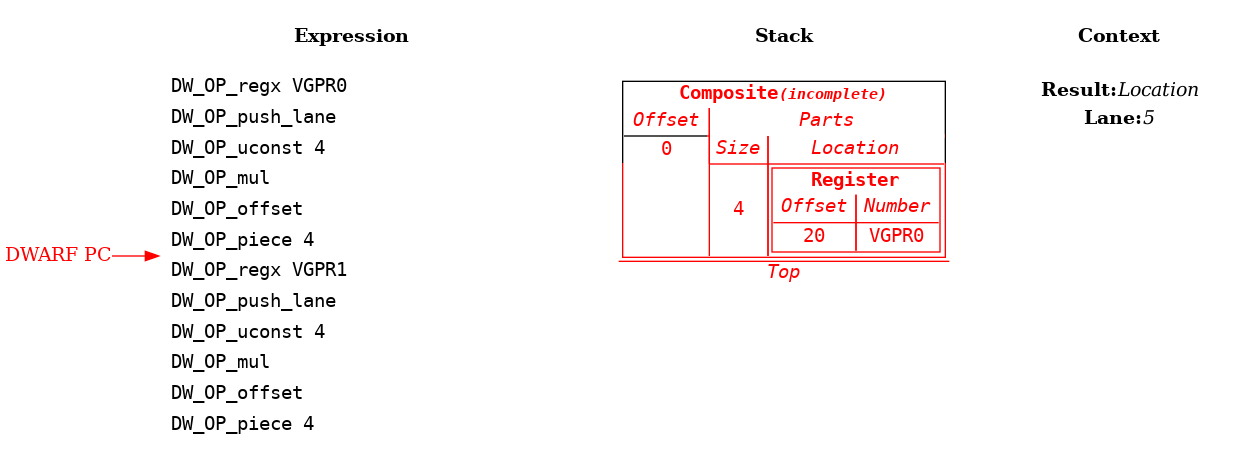
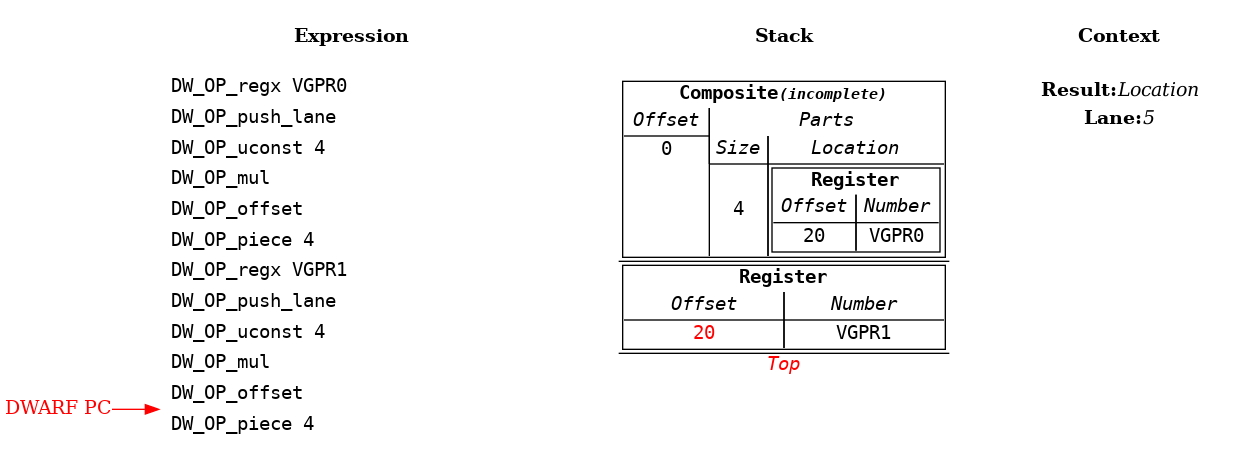
such a way that the containing object is not in memory at all: |
| 472 |
|
| 473 |
ptm.h: |
| 474 |
```cpp |
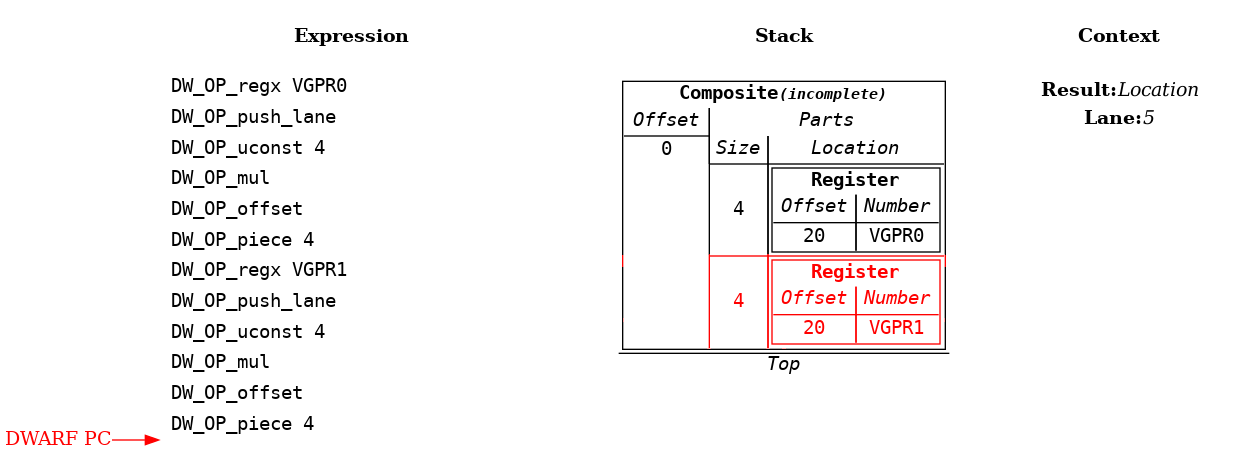
| 475 |
struct s { |
| 476 |
int m; |
| 477 |
int n; |
| 478 |
}; |
| 479 |
void i(int); |
| 480 |
extern int t; |
| 481 |
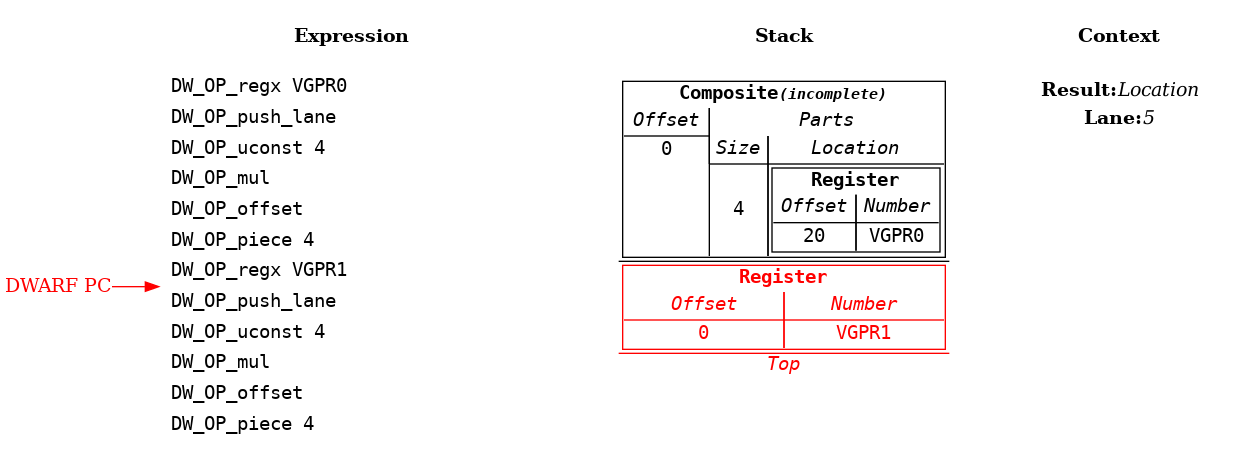
void f(s x, int s::* p); |
| 482 |
``` |
| 483 |
|
| 484 |
ptm.cc: |
| 485 |
```cpp |
| 486 |
#include "ptm.h" |
| 487 |
void f(s x, int s::* p) { |
| 488 |
for (int a = 0; a < t; ++a) { |
| 489 |
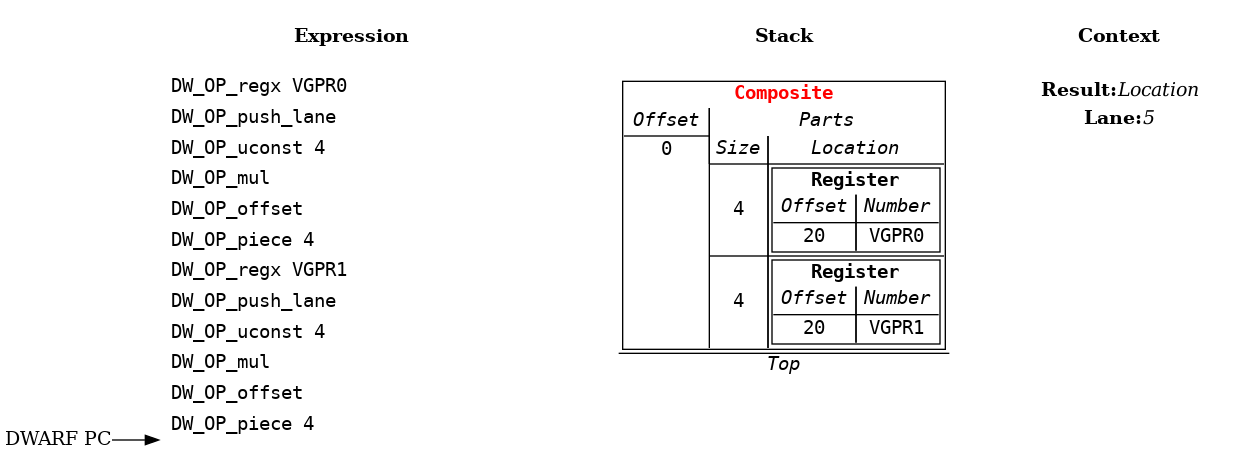
x.m += a + x.n; |
| 490 |
i(x.*p); |
| 491 |
} |
| 492 |
} |
| 493 |
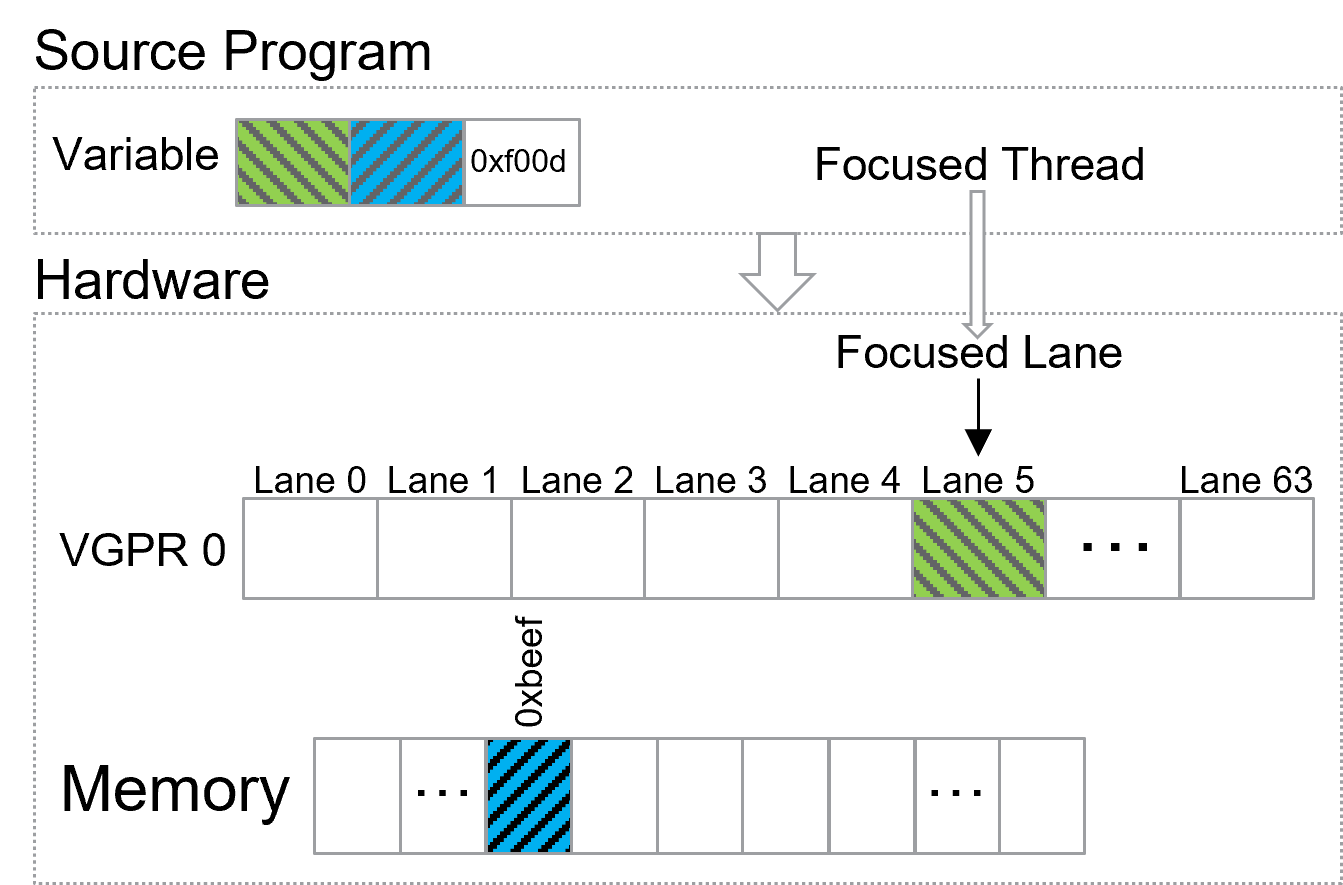
``` |
| 494 |
|
| 495 |
main.cc: |
| 496 |
```cpp |
| 497 |
#include "ptm.h" |
| 498 |
int t = 100; |
| 499 |
void i(int) {} |
| 500 |
int main(int argc, char *argv[]) { |
| 501 |
s x = { 0, 1 }; |
| 502 |
f(x, &s::m); |
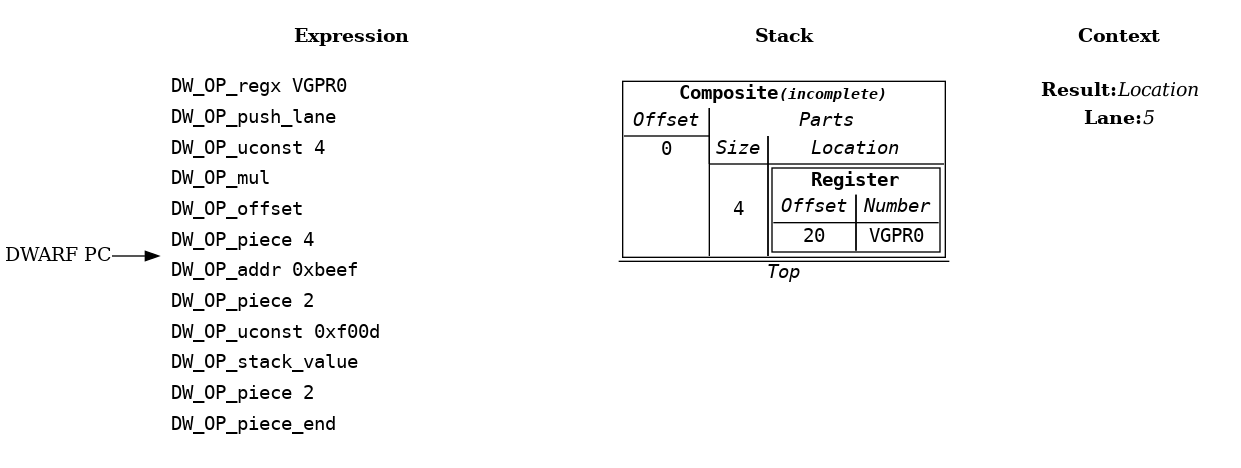
| 503 |
} |
| 504 |
``` |
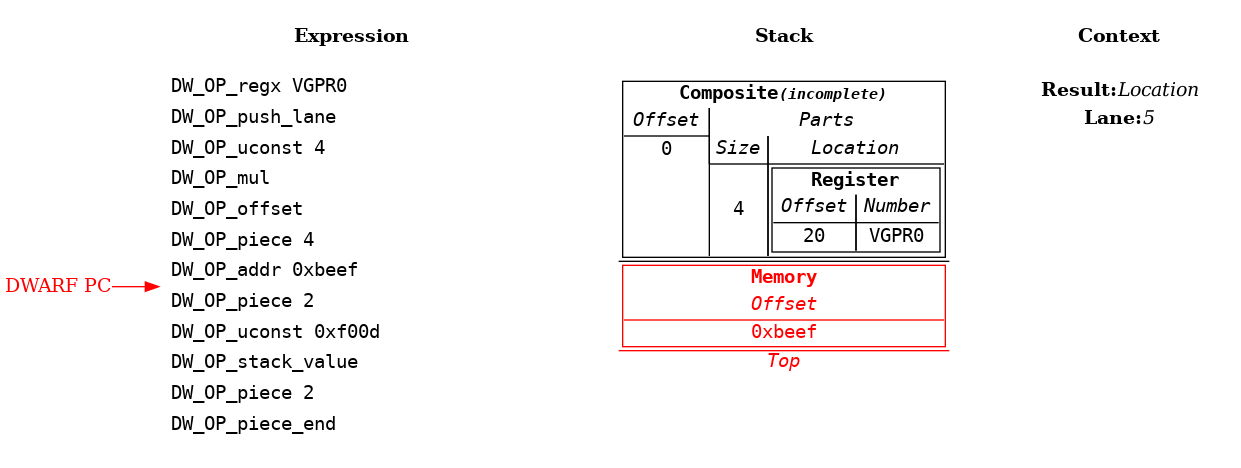
| 505 |
|
| 506 |
When compiled and run under GDB: |
| 507 |
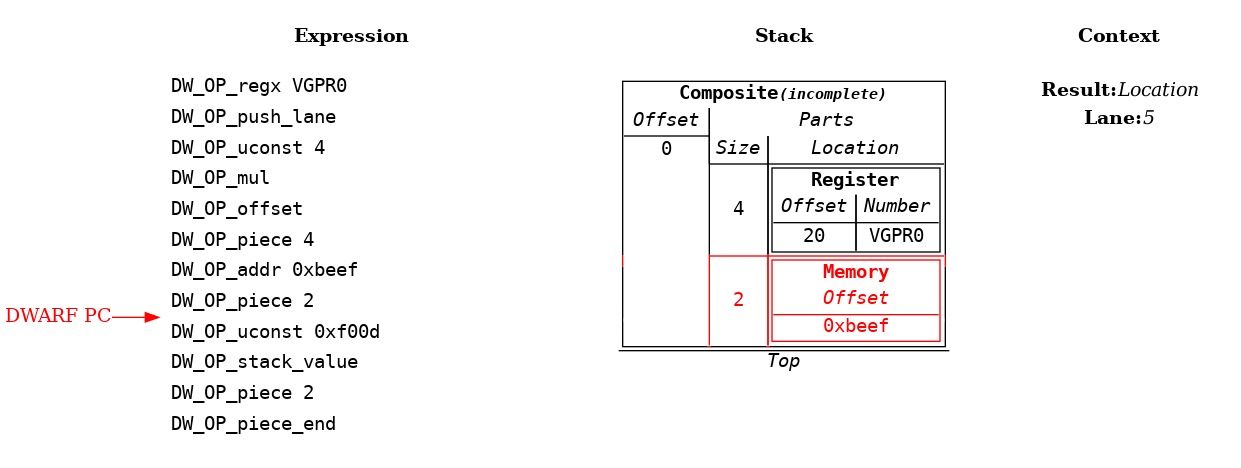
|
| 508 |
``` |
| 509 |
$ g++-9 -gdwarf-4 -O3 -c main.cc -o main.o |
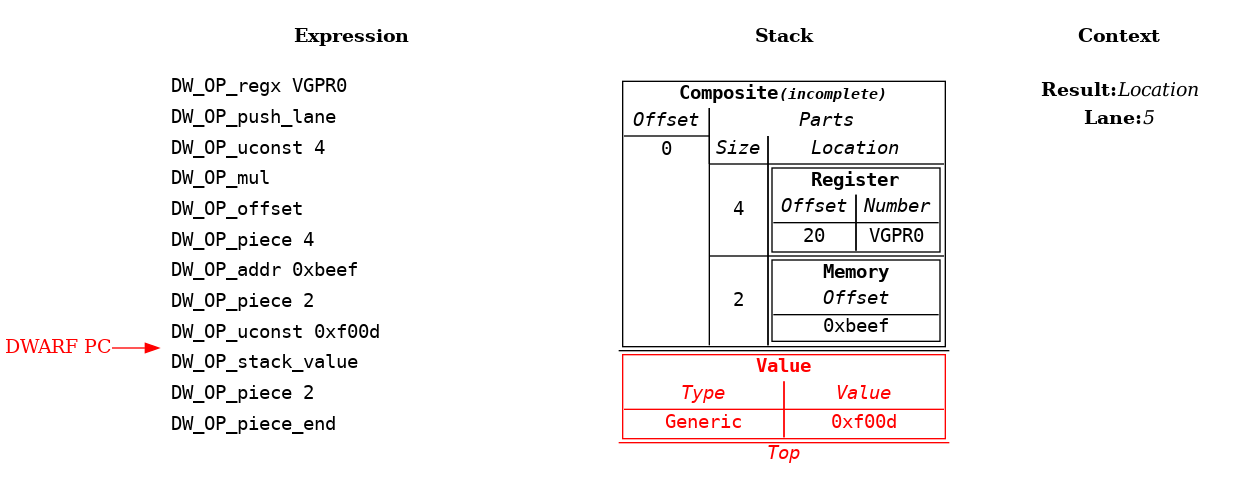
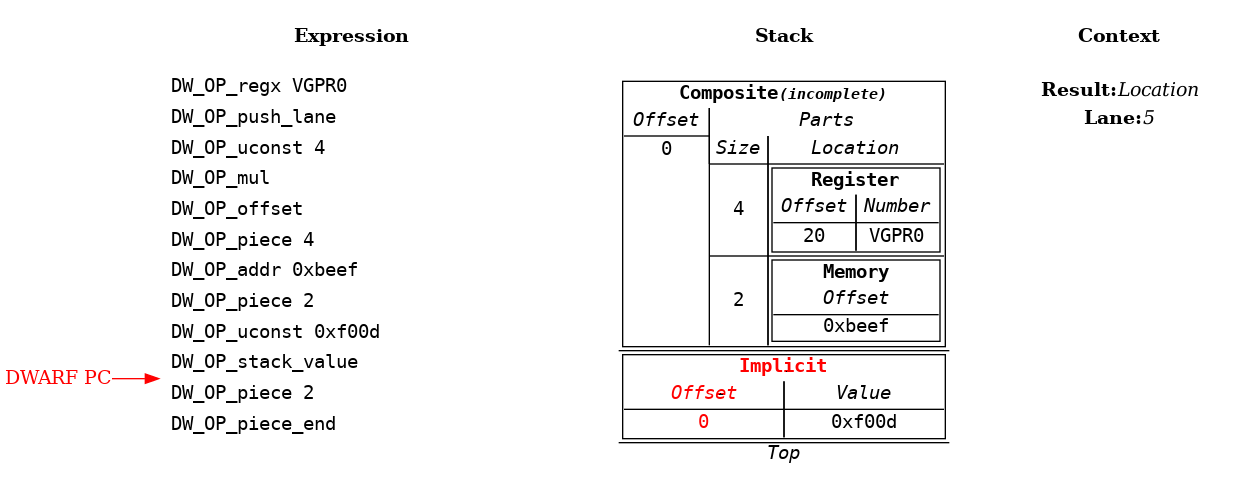
| 510 |
$ g++-9 -gdwarf-4 -O3 -c ptm.cc -o ptm.o |
| 511 |
$ g++-9 main.o ptm.o -o use_location.out |
| 512 |
$ gdb ./use_location.out |
| 513 |
(gdb) maint set dwarf always-disassemble |
| 514 |
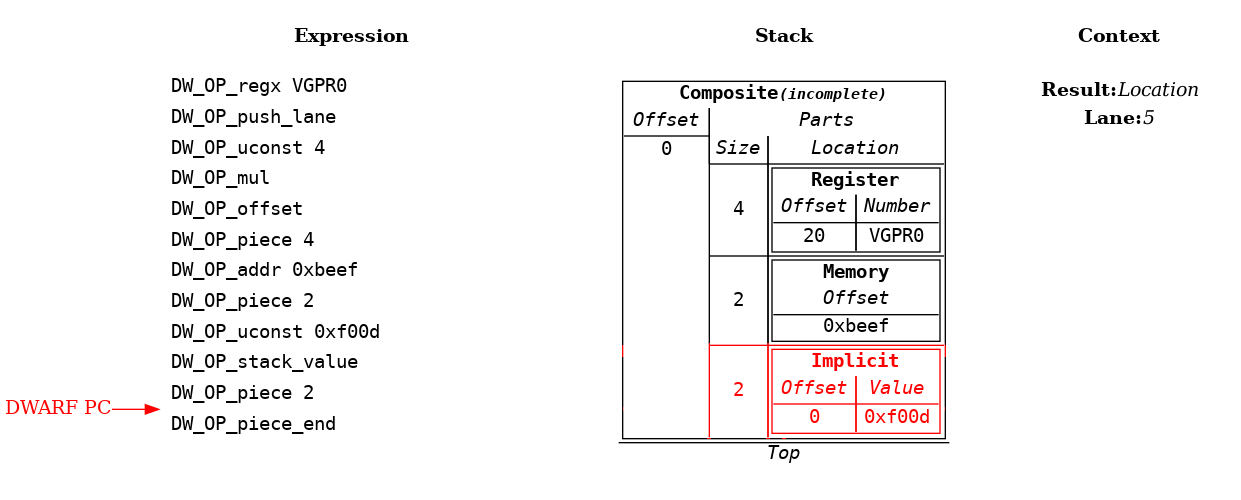
(gdb) b ptm.cc:5 |
| 515 |
Breakpoint 1 at 0x119e: file ptm.cc, line 5. |
| 516 |
(gdb) r |
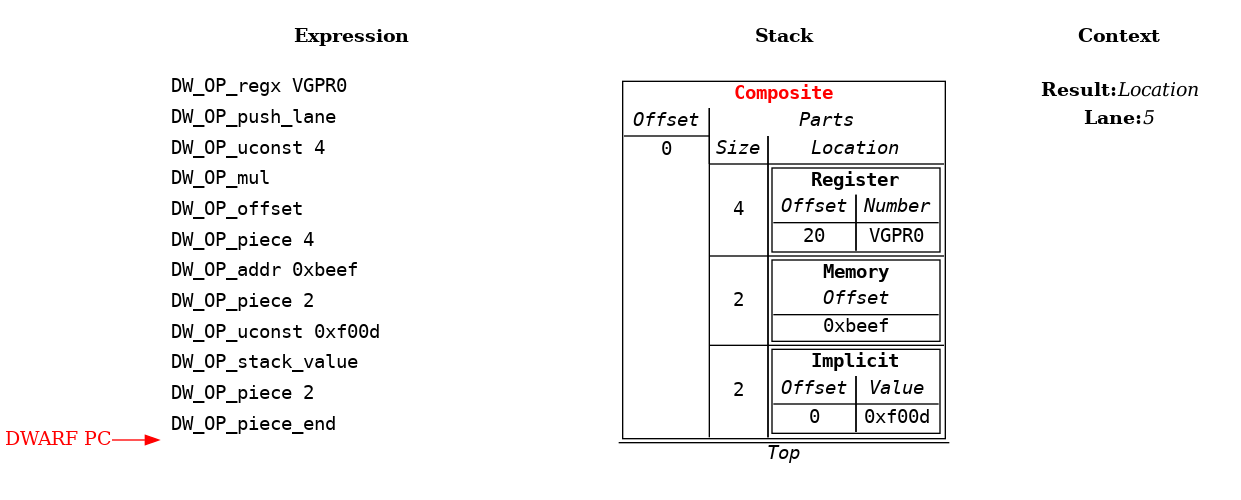
| 517 |
|
| 518 |
Breakpoint 1, f (x=..., p=<optimized out>) at ptm.cc:5 |
| 519 |
5 i(x.*p); |
| 520 |
``` |
| 521 |
|
| 522 |
Note that the compiler has promoted the entire object `x` into register `rdi` |
| 523 |
for the body of the loop: |
| 524 |
|
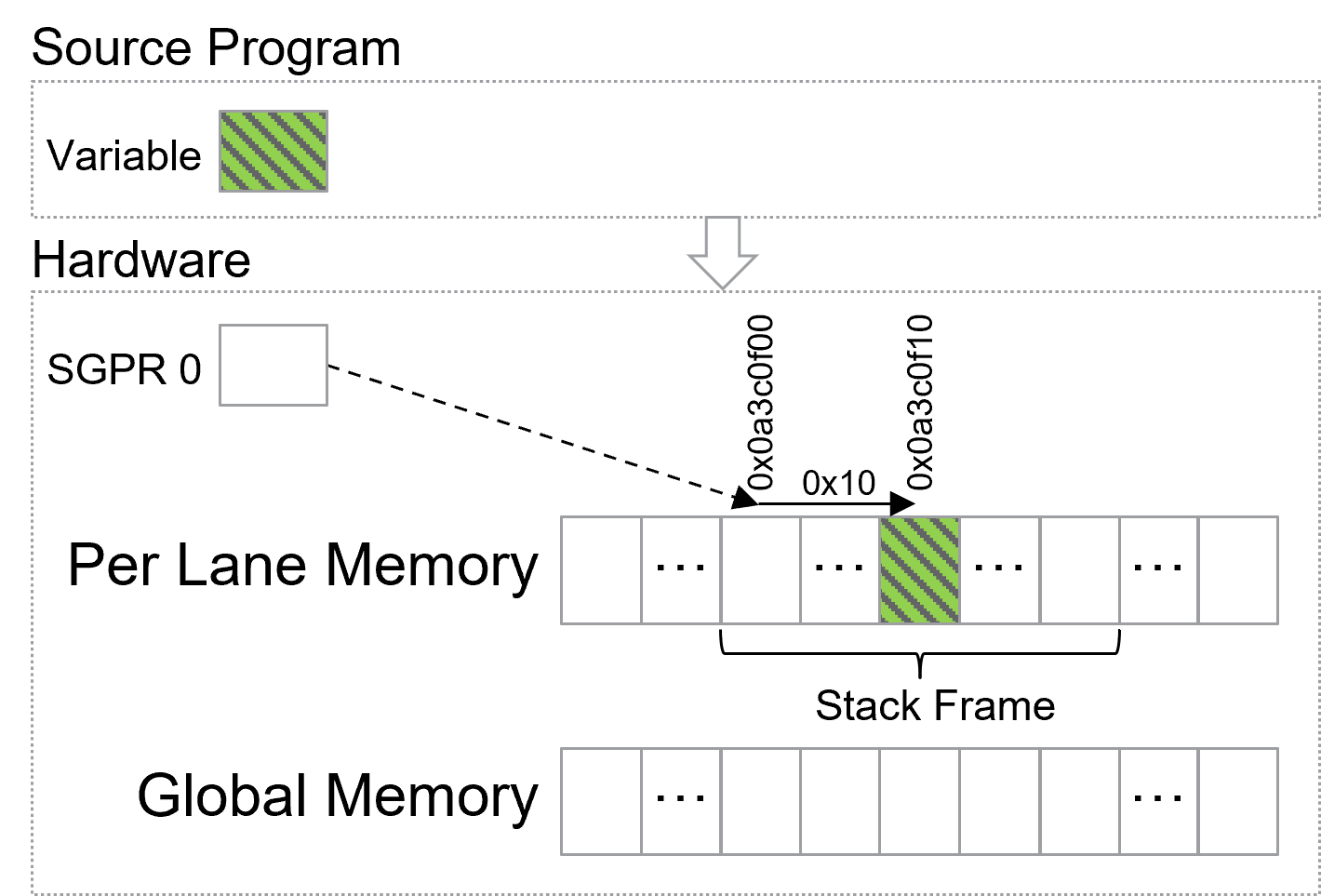
| 525 |
``` |
| 526 |
(gdb) info addr x |
| 527 |
Symbol "x" is multi-location: |
| 528 |
Range 0x555555555160-0x5555555551af: a complex DWARF expression: |
| 529 |
0: DW_OP_reg5 [$rdi] |
| 530 |
|
| 531 |
Range 0x5555555551af-0x5555555551ba: a complex DWARF expression: |
| 532 |
0: DW_OP_fbreg -56 |
| 533 |
|
| 534 |
. |
| 535 |
(gdb) p $pc |
| 536 |
$1 = (void (*)(void)) 0x55555555519e <f(s, int s::*)+62> |
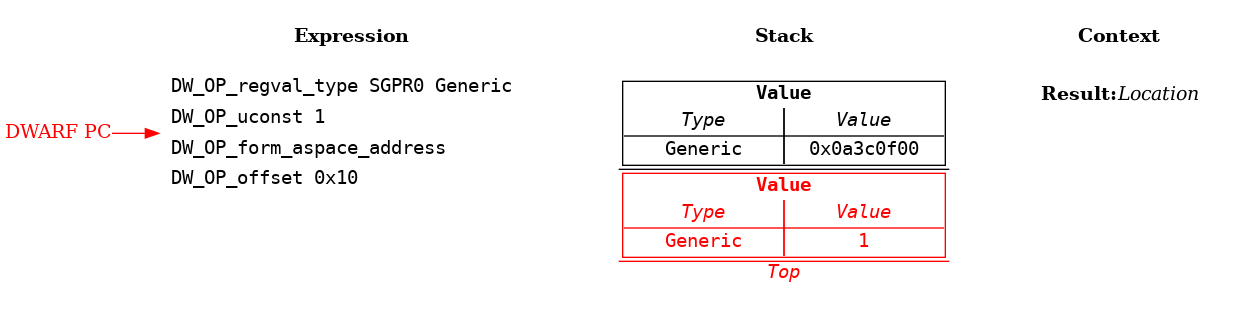
| 537 |
``` |
| 538 |
|
| 539 |
And so it is impossible to interpret `DW_OP_use_location` in this case: |
| 540 |
|
| 541 |
``` |
| 542 |
(gdb) p x.*p |
| 543 |
Address requested for identifier "x" which is in register $rdi |
| 544 |
``` |
| 545 |
|
| 546 |
With location descriptions on the stack, the definition of `DW_OP_use_location` |
| 547 |
can be modified by replacing every instance of "address" with "location |
| 548 |
description", as is described in [Type Entries](#type-entries). |
| 549 |
|
| 550 |
To implement the fully generalized version of this attribute, GCC would only |
| 551 |
need to change the expression from `DW_OP_plus` to `DW_OP_swap, |
| 552 |
DW_OP_LLVM_offset`. |
| 553 |
|
| 554 |
### 3.2.7 Virtual Base Class |
| 555 |
|
| 556 |
> NOTE: Without loss of generality, DWARF 4 is used in this example as full |
| 557 |
> support for DWARF 5 is not present in the versions of the tools used. No |
| 558 |
> feature of DWARF 5 provides a remedy for this issue. |
| 559 |
|
| 560 |
This example highlights the inability of DWARF 5 to describe C++ |
| 561 |
virtual inheritance semantics. |
| 562 |
|
| 563 |
The mechanism DWARF 5 provides for describing the location of an inherited |
| 564 |
subobject is `DW_AT_data_member_location`. This attribute is overloaded to |
| 565 |
describe both data member locations and inherited subobject locations, and |
| 566 |
in each case has multiple possible forms: |
| 567 |
|
| 568 |
* If an integral constant form, it encodes the byte offset from the derived |
| 569 |
object to the data member or subobject. |
| 570 |
* Otherwise, it encodes a location description to compute the address of the |
| 571 |
data member or subobject given the address of the derived object. |
| 572 |
|
| 573 |
Only the attribute describing a subobject, and only the location description |
| 574 |
form are considered here. |
| 575 |
|
| 576 |
In this case, when a debug agent wishes to locate the subobject, it first |
| 577 |
pushes the address of the derived object onto the DWARF expression stack. It |
| 578 |
then evaluates the location description associated with the |
| 579 |
`DW_AT_data_member_location` of the `DW_TAG_inheritence` DIE corresponding to |
| 580 |
the inherited subobject. |
| 581 |
|
| 582 |
Consider the following C++ source file `ab.cc`: |
| 583 |
|
| 584 |
```cpp |
| 585 |
class A { |
| 586 |
public: |
| 587 |
char x; |
| 588 |
}; |
| 589 |
class B |
| 590 |
: public virtual A {} o; |
| 591 |
``` |
| 592 |
|
| 593 |
When compiled with GCC and inspected with dwarfdump: |
| 594 |
|
| 595 |
``` |
| 596 |
$ g++ -gdwarf-5 -O3 -c ab.cc |
| 597 |
$ dwarfdump ab.o |
| 598 |
< 1><0x0000002a> DW_TAG_class_type |
| 599 |
DW_AT_name A |
| 600 |
DW_AT_byte_size 0x00000001 |
| 601 |
DW_AT_sibling <0x00000042> |
| 602 |
< 1><0x00000049> DW_TAG_class_type |
| 603 |
DW_AT_name B |
| 604 |
DW_AT_byte_size 0x00000010 |
| 605 |
DW_AT_containing_type <0x00000049> |
| 606 |
DW_AT_sibling <0x000000f9> |
| 607 |
< 2><0x00000058> DW_TAG_inheritance |
| 608 |
DW_AT_type <0x0000002a> |
| 609 |
DW_AT_data_member_location len 0x0006: 1206481c0622: |
| 610 |
DW_OP_dup DW_OP_deref DW_OP_lit24 DW_OP_minus DW_OP_deref DW_OP_plus |
| 611 |
DW_AT_virtuality DW_VIRTUALITY_virtual |
| 612 |
DW_AT_accessibility DW_ACCESS_public |
| 613 |
``` |
| 614 |
|
| 615 |
This `DW_AT_data_member_location` expression describes the dynamic process of |
| 616 |
locating the `A`-in-`B` subobject according to the [Itanium |
| 617 |
ABI](https://refspecs.linuxfoundation.org/cxxabi-1.86.html#layout). A diagram |
| 618 |
of the logical layout of class `B` is: |
| 619 |
|
| 620 |
``` |
| 621 |
0: class B |
| 622 |
0: vptr B |
| 623 |
8: class A |
| 624 |
8: A::x |
| 625 |
``` |
| 626 |
|
| 627 |
That is, the address of an object of class `B` is equivalent to the address for |
| 628 |
the `vtable` pointer for `B`. As there are no other direct data members of `B` |
| 629 |
the primary base class subobject of class `A` comes next, and there is no |
| 630 |
intervening padding as the subobject alignment requirements are already |
| 631 |
satisfied. |
| 632 |
|
| 633 |
The `vtable` pointer for `B` contains an entry `vbase_offset` for each virtual |
| 634 |
base class. In this case, that table layout is: |
| 635 |
|
| 636 |
``` |
| 637 |
-24: vbase_offset[A]=8 |
| 638 |
-16: offset_to_top=0 |
| 639 |
-8: B RTTI |
| 640 |
0: <vtable for B> |
| 641 |
``` |
| 642 |
|
| 643 |
That is, to find the `vbase_offset` for the `A`-in-`B` subobject the address |
| 644 |
`vptr B` is offset by the statically determined value `-24`. |
| 645 |
|
| 646 |
Thus, in order to implement `DW_AT_data_member_location` for `A`-in-`B`, the |
| 647 |
expression needs to index to a statically known byte offset of `-24` through |
| 648 |
`vptr B` to lookup `vbase_offset` for `A`-in-`B`. It must then offset the |
| 649 |
location of `B` by the dynamic value of `vbase_offset` (in this case `8`) to |
| 650 |
arrive at the location of the inherited subobject. |
| 651 |
|
| 652 |
This definition shares the same problem as example [3.2.6](#pointer-to-member) |
| 653 |
in that it relies on the address of the derived object and inherited subobject, |
| 654 |
when there is no guarantee either or both have any address at all. |
| 655 |
|
| 656 |
To demonstrate the problem, consider a program which GCC chooses to optimize in |
| 657 |
such a way that the derived object is not in memory at all: |
| 658 |
|
| 659 |
f.h: |
| 660 |
```cpp |
| 661 |
class A { |
| 662 |
public: |
| 663 |
char x; |
| 664 |
}; |
| 665 |
class B |
| 666 |
: public virtual A {}; |
| 667 |
void f(B b); |
| 668 |
``` |
| 669 |
|
| 670 |
f.cc: |
| 671 |
```cpp |
| 672 |
#include "f.h" |
| 673 |
void f(B b) {} |
| 674 |
``` |
| 675 |
|
| 676 |
main.cc: |
| 677 |
```cpp |
| 678 |
#include "f.h" |
| 679 |
int main(int argc, char *argv[]) { |
| 680 |
B b; |
| 681 |
b.x = 42; |
| 682 |
f(b); |
| 683 |
return b.x; |
| 684 |
} |
| 685 |
``` |
| 686 |
|
| 687 |
When compiled and run under GDB: |
| 688 |
|
| 689 |
``` |
| 690 |
$ g++-9 -gdwarf-4 -O3 -c main.cc -o main.o |
| 691 |
$ g++-9 -gdwarf-4 -O3 -c f.cc -o f.o |
| 692 |
$ g++-9 main.o f.o -o cpp-vbase.out |
| 693 |
(gdb) maint set dwarf always-disassemble |
| 694 |
(gdb) b main.cc:6 |
| 695 |
Breakpoint 1 at 0x1090: file main.cc, line 6. |
| 696 |
(gdb) r |
| 697 |
|
| 698 |
Breakpoint 1, main (argc=<optimized out>, argv=<optimized out>) at main.cc:6 |
| 699 |
6 return b.x; |
| 700 |
``` |
| 701 |
|
| 702 |
Note that the compiler has elided storage for the entire object `x` in the |
| 703 |
body of `main()`: |
| 704 |
|
| 705 |
``` |
| 706 |
(gdb) info addr b |
| 707 |
Symbol "b" is multi-location: |
| 708 |
Range 0x555555555078-0x5555555550af: a complex DWARF expression: |
| 709 |
0: DW_OP_piece 8 (bytes) |
| 710 |
2: DW_OP_const1u 42 |
| 711 |
4: DW_OP_stack_value |
| 712 |
5: DW_OP_piece 1 (bytes) |
| 713 |
7: DW_OP_piece 7 (bytes) |
| 714 |
|
| 715 |
. |
| 716 |
(gdb) p $pc |
| 717 |
$1 = (void (*)(void)) 0x555555555090 <main(int, char**)+48> |
| 718 |
``` |
| 719 |
|
| 720 |
And so it is impossible to interpret `DW_OP_data_member_location` in this case: |
| 721 |
|
| 722 |
``` |
| 723 |
(gdb) p b |
| 724 |
$2 = {<A> = <invalid address>, _vptr.B = <optimized out>} |
| 725 |
``` |
| 726 |
|
| 727 |
> NOTE: The `vptr B` which should occupy the first 8 bytes of the object `b` |
| 728 |
> are undefined in the DWARF, but could be described as an implicit value by |
| 729 |
> the compiler. This change would be trivial and would directly expose the |
| 730 |
> issue in DWARF 5 described here. |
| 731 |
|
| 732 |
With location descriptions on the stack, the definition of |
| 733 |
`DW_OP_data_member_location` can be modified by replacing every instance of |
| 734 |
"address" with "location description", as is described in [A.5 Type Entries](#type-entries). |
| 735 |
|
| 736 |
To implement the fully generalized version of this attribute, GCC would only |
| 737 |
need to change the last operation in the expression from `DW_OP_plus` to |
| 738 |
`DW_OP_LLVM_offset`. |
| 739 |
|
| 740 |
## 3.3 Limitations |
| 741 |
|
| 742 |
DWARF 5 is unable to describe variables in runtime indexed parts of registers. |
| 743 |
This is required to describe a source variable that is located in a lane of a |
| 744 |
SIMT vector register. |
| 745 |
|
| 746 |
Some features only work when located in global memory. The type attribute |
| 747 |
expressions require a base object which could be in any kind of location. |
| 748 |
|
| 749 |
DWARF procedures can only accept global memory address arguments. This limits |
| 750 |
the ability to factorize the creation of locations that involve other location |
| 751 |
kinds. |
| 752 |
|
| 753 |
There are no vector base types. This is required to describe vector registers. |
| 754 |
|
| 755 |
There is no operation to create a memory location in a non-global address space. |
| 756 |
Only the dereference operation supports providing an address space. |
| 757 |
|
| 758 |
CFI location expressions do not allow composite locations or non-global address |
| 759 |
space memory locations. Both these are needed in optimized code for devices with |
| 760 |
vector registers and address spaces. |
| 761 |
|
| 762 |
Bit field offsets are only supported in a limited way for register locations. |
| 763 |
Supporting them in a uniform manner for all location kinds is required to |
| 764 |
support languages with bit sized entities. |
| 765 |
|
| 766 |
# 4. Extension Solution |
| 767 |
|
| 768 |
This section outlines the extension to generalize the DWARF expression evaluation |
| 769 |
model to allow location descriptions to be manipulated on the stack. It presents |
| 770 |
a number of simplified examples to demonstrate the benefits and how the extension |
| 771 |
solves the issues of heterogeneous devices. It presents how this is done in |
| 772 |
a manner that is backwards compatible with DWARF 5. |
| 773 |
|
| 774 |
## 4.1 Location Description |
| 775 |
|
| 776 |
In order to have consistent, composable operations that act on location |
| 777 |
descriptions, the extension defines a uniform way to handle all location kinds. |
| 778 |
That includes memory, register, implicit, implicit pointer, undefined, and |
| 779 |
composite location descriptions. |
| 780 |
|
| 781 |
Each kind of location description is conceptually a zero-based offset within a |
| 782 |
piece of storage. The storage is a contiguous linear organization of a certain |
| 783 |
number of bytes (see below for how this is extended to support bit sized |
| 784 |
storage). |
| 785 |
|
| 786 |
- For global memory, the storage is the linear stream of bytes of the |
| 787 |
architecture's address size. |
| 788 |
- For each separate architecture register, it is the linear stream of bytes of |
| 789 |
the size of that specific register. |
| 790 |
- For an implicit, it is the linear stream of bytes of the value when |
| 791 |
represented using the value's base type which specifies the encoding, size, |
| 792 |
and byte ordering. |
| 793 |
- For undefined, it is an infinitely sized linear stream where every byte is |
| 794 |
undefined. |
| 795 |
- For composite, it is a linear stream of bytes defined by the composite's parts. |
| 796 |
|
| 797 |
## 4.2 Stack Location Description Operations |
| 798 |
|
| 799 |
The DWARF expression stack is extended to allow each stack entry to either be a |
| 800 |
value or a location description. |
| 801 |
|
| 802 |
Evaluation rules are defined to implicitly convert a stack element that is a |
| 803 |
value to a location description, or vice versa, so that all DWARF 5 expressions |
| 804 |
continue to have the same semantics. This reflects that a memory address is |
| 805 |
effectively used as a proxy for a memory location description. |
| 806 |
|
| 807 |
For each place that allows a DWARF expression to be specified, it is defined if |
| 808 |
the expression is to be evaluated as a value or a location description. |
| 809 |
|
| 810 |
Existing DWARF expression operations that are used to act on memory addresses |
| 811 |
are generalized to act on any location description kind. For example, the |
| 812 |
DW_OP_deref operation pops a location description rather than a memory address |
| 813 |
value from the stack and reads the storage associated with the location kind |
| 814 |
starting at the location description's offset. |
| 815 |
|
| 816 |
Existing DWARF expression operations that create location descriptions are |
| 817 |
changed to pop and push location descriptions on the stack. For example, the |
| 818 |
DW_OP_value, DW_OP_regx, DW_OP_implicit_value, DW_OP_implicit_pointer, |
| 819 |
DW_OP_stack_value, and DW_OP_piece. |
| 820 |
|
| 821 |
New operations that act on location descriptions can be added. For example, a |
| 822 |
DW_OP_offset operation that modifies the offset of the location description on |
| 823 |
top of the stack. Unlike the DW_OP_plus operation that only works with memory |
| 824 |
address, a DW_OP_offset operation can work with any location kind. |
| 825 |
|
| 826 |
To allow incremental and nested creation of composite location descriptions, a |
| 827 |
DW_OP_piece_end can be defined to explicitly indicate the last part of a |
| 828 |
composite. Currently, creating a composite must always be the last operation of |
| 829 |
an expression. |
| 830 |
|
| 831 |
A DW_OP_undefined operation can be defined that explicitly creates the undefined |
| 832 |
location description. Currently this is only possible as a piece of a composite |
| 833 |
when the stack is empty. |
| 834 |
|
| 835 |
## 4.3 Examples |
| 836 |
|
| 837 |
This section provides some motivating examples to illustrate the benefits that |
| 838 |
result from allowing location descriptions on the stack. |
| 839 |
|
| 840 |
### 4.3.1 Source Language Variable Spilled to Part of a Vector Register |
| 841 |
|
| 842 |
A compiler generating code for a GPU may allocate a source language variable |
| 843 |
that it proves has the same value for every lane of a SIMT thread in a scalar |
| 844 |
register. It may then need to spill that scalar register. To avoid the high cost |
| 845 |
of spilling to memory, it may spill to a fixed lane of one of the numerous |
| 846 |
vector registers. |
| 847 |
|
| 848 |
 |
| 849 |
|
| 850 |
The following expression defines the location of a source language variable that |
| 851 |
the compiler allocated in a scalar register, but had to spill to lane 5 of a |
| 852 |
vector register at this point of the code. |
| 853 |
|
| 854 |
DW_OP_regx VGPR0 |
| 855 |
DW_OP_offset_uconst 20 |
| 856 |
|
| 857 |
 |
| 858 |
|
| 859 |
The DW_OP_regx pushes a register location description on the stack. The storage |
| 860 |
for the register is the size of the vector register. The register location |
| 861 |
description conceptually references that storage with an initial offset of 0. |
| 862 |
The architecture defines the byte ordering of the register. |
| 863 |
|
| 864 |
 |
| 865 |
|
| 866 |
The DW_OP_offset_uconst pops a location description off the stack, adds its |
| 867 |
operand value to the offset, and pushes the updated location description back on |
| 868 |
the stack. In this case the source language variable is being spilled to lane 5 |
| 869 |
and each lane's component which is 32-bits (4 bytes), so the offset is 5*4=20. |
| 870 |
|
| 871 |
 |
| 872 |
|
| 873 |
The result of the expression evaluation is the location description on the top |
| 874 |
of the stack. |
| 875 |
|
| 876 |
An alternative approach could be for the target to define distinct register |
| 877 |
names for each part of each vector register. However, this is not practical for |
| 878 |
GPUs due to the sheer number of registers that would have to be defined. It |
| 879 |
would also not permit a runtime index into part of the whole register to be used |
| 880 |
as shown in the next example. |
| 881 |
|
| 882 |
### 4.3.2 Source Language Variable Spread Across Multiple Vector Registers |
| 883 |
|
| 884 |
A compiler may generate SIMT code for a GPU. Each source language thread of |
| 885 |
execution is mapped to a single lane of the GPU thread. Source language |
| 886 |
variables that are mapped to a register, are mapped to the lane component of the |
| 887 |
vector registers corresponding to the source language's thread of execution. |
| 888 |
|
| 889 |
The location expression for such variables must therefore be executed in the |
| 890 |
context of the focused source language thread of execution. A DW_OP_push_lane |
| 891 |
operation can be defined to push the value of the lane for the currently focused |
| 892 |
source language thread of execution. The value to use would be provided by the |
| 893 |
consumer of DWARF when it evaluates the location expression. |
| 894 |
|
| 895 |
If the source language variable is larger than the size of the vector register |
| 896 |
lane component, then multiple vector registers are used. Each source language |
| 897 |
thread of execution will only use the vector register components for its |
| 898 |
associated lane. |
| 899 |
|
| 900 |
 |
| 901 |
|
| 902 |
The following expression defines the location of a source language variable that |
| 903 |
has to occupy two vector registers. A composite location description is created |
| 904 |
that combines the two parts. It will give the correct result regardless of which |
| 905 |
lane corresponds to the source language thread of execution that the user is |
| 906 |
focused on. |
| 907 |
|
| 908 |
DW_OP_regx VGPR0 |
| 909 |
DW_OP_push_lane |
| 910 |
DW_OP_uconst 4 |
| 911 |
DW_OP_mul |
| 912 |
DW_OP_offset |
| 913 |
DW_OP_piece 4 |
| 914 |
DW_OP_regx VGPR1 |
| 915 |
DW_OP_push_lane |
| 916 |
DW_OP_uconst 4 |
| 917 |
DW_OP_mul |
| 918 |
DW_OP_offset |
| 919 |
DW_OP_piece 4 |
| 920 |
|
| 921 |
 |
| 922 |
|
| 923 |
The DW_OP_regx VGPR0 pushes a location description for the first register. |
| 924 |
|
| 925 |
 |
| 926 |
|
| 927 |
The DW_OP_push_lane; DW_OP_uconst 4; DW_OP_mul calculates the offset for the |
| 928 |
focused lanes vector register component as 4 times the lane number. |
| 929 |
|
| 930 |
 |
| 931 |
|
| 932 |
 |
| 933 |
|
| 934 |
 |
| 935 |
|
| 936 |
The DW_OP_offset adjusts the register location description's offset to the |
| 937 |
runtime computed value. |
| 938 |
|
| 939 |
 |
| 940 |
|
| 941 |
The DW_OP_piece either creates a new composite location description, or adds a |
| 942 |
new part to an existing incomplete one. It pops the location description to use |
| 943 |
for the new part. It then pops the next stack element if it is an incomplete |
| 944 |
composite location description, otherwise it creates a new incomplete composite |
| 945 |
location description with no parts. Finally it pushes the incomplete composite |
| 946 |
after adding the new part. |
| 947 |
|
| 948 |
In this case a register location description is added to a new incomplete |
| 949 |
composite location description. The 4 of the DW_OP_piece specifies the size of |
| 950 |
the register storage that comprises the part. Note that the 4 bytes start at the |
| 951 |
computed register offset. |
| 952 |
|
| 953 |
For backwards compatibility, if the stack is empty or the top stack element is |
| 954 |
an incomplete composite, an undefined location description is used for the part. |
| 955 |
If the top stack element is a generic base type value, then it is implicitly |
| 956 |
converted to a global memory location description with an offset equal to the |
| 957 |
value. |
| 958 |
|
| 959 |
 |
| 960 |
|
| 961 |
The rest of the expression does the same for VGPR1. However, when the |
| 962 |
DW_OP_piece is evaluated there is an incomplete composite on the stack. So the |
| 963 |
VGPR1 register location description is added as a second part. |
| 964 |
|
| 965 |
 |
| 966 |
|
| 967 |
 |
| 968 |
|
| 969 |
 |
| 970 |
|
| 971 |
 |
| 972 |
|
| 973 |
 |
| 974 |
|
| 975 |
 |
| 976 |
|
| 977 |
At the end of the expression, if the top stack element is an incomplete |
| 978 |
composite location description, it is converted to a complete location |
| 979 |
description and returned as the result. |
| 980 |
|
| 981 |
 |
| 982 |
|
| 983 |
### 4.3.3 Source Language Variable Spread Across Multiple Kinds of Locations |
| 984 |
|
| 985 |
This example is the same as the previous one, except the first 2 bytes of the |
| 986 |
second vector register have been spilled to memory, and the last 2 bytes have |
| 987 |
been proven to be a constant and optimized away. |
| 988 |
|
| 989 |
 |
| 990 |
|
| 991 |
DW_OP_regx VGPR0 |
| 992 |
DW_OP_push_lane |
| 993 |
DW_OP_uconst 4 |
| 994 |
DW_OP_mul |
| 995 |
DW_OP_offset |
| 996 |
DW_OP_piece 4 |
| 997 |
DW_OP_addr 0xbeef |
| 998 |
DW_OP_piece 2 |
| 999 |
DW_OP_uconst 0xf00d |
| 1000 |
DW_OP_stack_value |
| 1001 |
DW_OP_piece 2 |
| 1002 |
DW_OP_piece_end |
| 1003 |
|
| 1004 |
The first 6 operations are the same. |
| 1005 |
|
| 1006 |
 |
| 1007 |
|
| 1008 |
The DW_OP_addr operation pushes a global memory location description on the |
| 1009 |
stack with an offset equal to the address. |
| 1010 |
|
| 1011 |
 |
| 1012 |
|
| 1013 |
The next DW_OP_piece adds the global memory location description as the next 2 |
| 1014 |
byte part of the composite. |
| 1015 |
|
| 1016 |
 |
| 1017 |
|
| 1018 |
The DW_OP_uconst 0xf00d; DW_OP_stack_value pushes an implicit location |
| 1019 |
description on the stack. The storage of the implicit location description is |
| 1020 |
the representation of the value 0xf00d using the generic base type's encoding, |
| 1021 |
size, and byte ordering. |
| 1022 |
|
| 1023 |
 |
| 1024 |
|
| 1025 |
 |
| 1026 |
|
| 1027 |
The final DW_OP_piece adds 2 bytes of the implicit location description as the |
| 1028 |
third part of the composite location description. |
| 1029 |
|
| 1030 |
 |
| 1031 |
|
| 1032 |
The DW_OP_piece_end operation explicitly makes the incomplete composite location |
| 1033 |
description into a complete location description. This allows a complete |
| 1034 |
composite location description to be created on the stack that can be used as |
| 1035 |
the location description of another following operation. For example, the |
| 1036 |
DW_OP_offset can be applied to it. More practically, it permits creation of |
| 1037 |
multiple composite location descriptions on the stack which can be used to pass |
| 1038 |
arguments to a DWARF procedure using a DW_OP_call* operation. This can be |
| 1039 |
beneficial to factor the incrementally creation of location descriptions. |
| 1040 |
|
| 1041 |
 |
| 1042 |
|
| 1043 |
### 4.3.4 Address Spaces |
| 1044 |
|
| 1045 |
Heterogeneous devices can have multiple hardware supported address spaces which |
| 1046 |
use specific hardware instructions to access them. |
| 1047 |
|
| 1048 |
For example, GPUs that use SIMT execution may provide hardware support to access |
| 1049 |
memory such that each lane can see a linear memory view, while the backing |
| 1050 |
memory is actually being accessed in an interleaved manner so that the locations |
| 1051 |
for each lanes Nth dword are contiguous. This minimizes cache lines read by the |
| 1052 |
SIMT execution. |
| 1053 |
|
| 1054 |
 |
| 1055 |
|
| 1056 |
The following expression defines the location of a source language variable that |
| 1057 |
is allocated at offset 0x10 in the current subprograms stack frame. The |
| 1058 |
subprogram stack frames are per lane and reside in an interleaved address space. |
| 1059 |
|
| 1060 |
DW_OP_regval_type SGPR0 Generic |
| 1061 |
DW_OP_uconst 1 |
| 1062 |
DW_OP_form_aspace_address |
| 1063 |
DW_OP_offset 0x10 |
| 1064 |
|
| 1065 |
 |
| 1066 |
|
| 1067 |
The DW_OP_regval_type operation pushes the contents of SGPR0 as a generic value. |
| 1068 |
This is the register that holds the address of the current stack frame. |
| 1069 |
|
| 1070 |
 |
| 1071 |
|
| 1072 |
The DW_OP_uconst operation pushes the address space number. Each architecture |
| 1073 |
defines the numbers it uses in DWARF. In this case, address space 1 is being |
| 1074 |
used as the per lane memory. |
| 1075 |
|
| 1076 |
 |
| 1077 |
|
| 1078 |
The DW_OP_form_aspace_address operation pops a value and an address space |
| 1079 |
number. Each address space is associated with a separate storage. A memory |
| 1080 |
location description is pushed which refers to the address space's storage, with |
| 1081 |
an offset of the popped value. |
| 1082 |
|
| 1083 |
 |
| 1084 |
|
| 1085 |
All operations that act on location descriptions work with memory locations |
| 1086 |
regardless of their address space. |
| 1087 |
|
| 1088 |
Every architecture defines address space 0 as the default global memory address |
| 1089 |
space. |
| 1090 |
|
| 1091 |
Generalizing memory location descriptions to include an address space component |
| 1092 |
avoids having to create specialized operations to work with address spaces. |
| 1093 |
|
| 1094 |
The source variable is at offset 0x10 in the stack frame. The DW_OP_offset |
| 1095 |
operation works on memory location descriptions that have an address space just |
| 1096 |
like for any other kind of location description. |
| 1097 |
|
| 1098 |
 |
| 1099 |
|
| 1100 |
The only operations in DWARF 5 that take an address space are DW_OP_xderef*. |
| 1101 |
They treat a value as the address in a specified address space, and read its |
| 1102 |
contents. There is no operation to actually create a location description that |
| 1103 |
references an address space. There is no way to include address space memory |
| 1104 |
locations in parts of composite locations. |
| 1105 |
|
| 1106 |
Since DW_OP_piece now takes any kind of location description for its pieces, it |
| 1107 |
is now possible for parts of a composite to involve locations in different |
| 1108 |
address spaces. For example, this can happen when parts of a source variable |
| 1109 |
allocated in a register are spilled to a stack frame that resides in the |
| 1110 |
non-global address space. |
| 1111 |
|
| 1112 |
### 4.3.5 Bit Offsets |
| 1113 |
|
| 1114 |
With the generalization of location descriptions on the stack, it is possible to |
| 1115 |
define a DW_OP_bit_offset operation that adjusts the offset of any kind of |
| 1116 |
location in terms of bits rather than bytes. The offset can be a runtime |
| 1117 |
computed value. This is generally useful for any source language that support |
| 1118 |
bit sized entities, and for registers that are not a whole number of bytes. |
| 1119 |
|
| 1120 |
DWARF 5 only supports bit fields in composites using DW_OP_bit_piece. It does |
| 1121 |
not support runtime computed offsets which can happen for bit field packed |
| 1122 |
arrays. It is also not generally composable as it must be the last part of an |
| 1123 |
expression. |
| 1124 |
|
| 1125 |
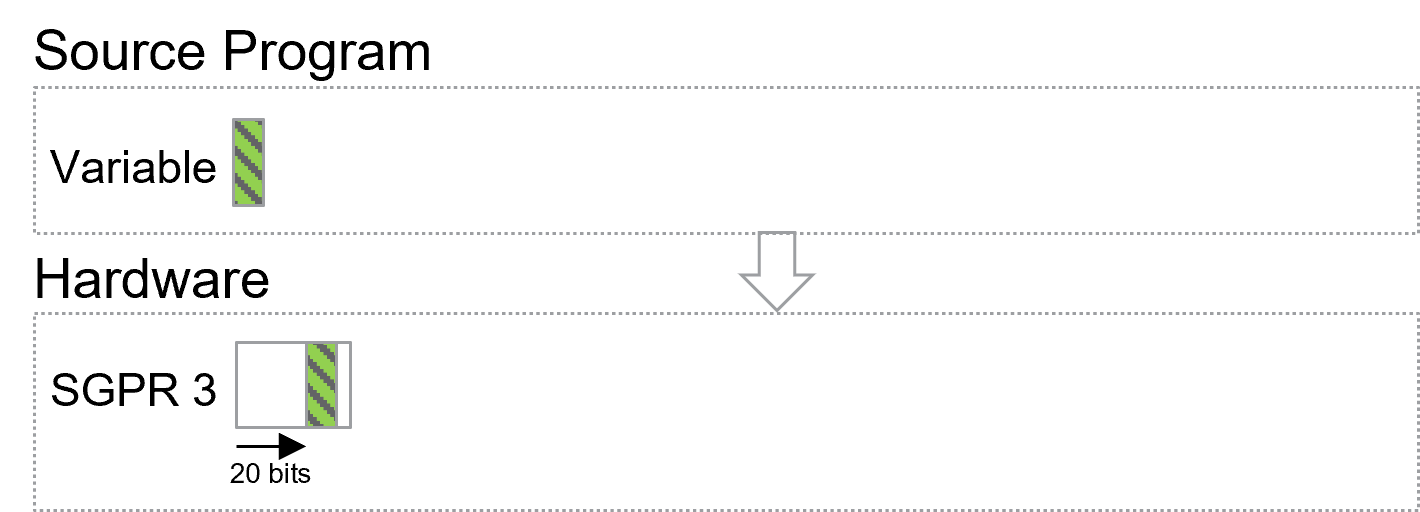
The following example defines a location description for a source variable that |
| 1126 |
is allocated starting at bit 20 of a register. A similar expression could be |
| 1127 |
used if the source variable was at a bit offset within memory or a particular |
| 1128 |
address space, or if the offset is a runtime value. |
| 1129 |
|
| 1130 |
 |
| 1131 |
|
| 1132 |
DW_OP_regx SGPR3 |
| 1133 |
DW_OP_uconst 20 |
| 1134 |
DW_OP_bit_offset |
| 1135 |
|
| 1136 |
 |
| 1137 |
|
| 1138 |
 |
| 1139 |
|
| 1140 |
 |
| 1141 |
|
| 1142 |
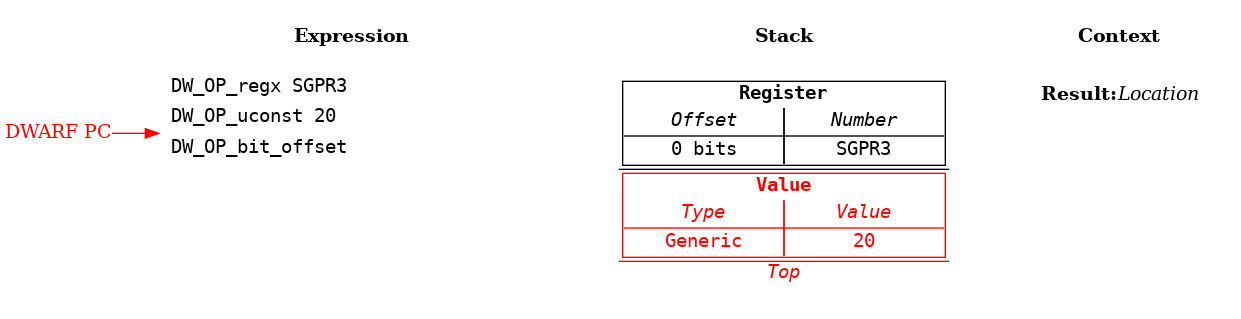
The DW_OP_bit_offset operation pops a value and location description from the |
| 1143 |
stack. It pushes the location description after updating its offset using the |
| 1144 |
value as a bit count. |
| 1145 |
|
| 1146 |
 |
| 1147 |
|
| 1148 |
The ordering of bits within a byte, like byte ordering, is defined by the target |
| 1149 |
architecture. A base type could be extended to specify bit ordering in addition |
| 1150 |
to byte ordering. |
| 1151 |
|
| 1152 |
## 4.4 Call Frame Information (CFI) |
| 1153 |
|
| 1154 |
DWARF defines call frame information (CFI) that can be used to virtually unwind |
| 1155 |
the subprogram call stack. This involves determining the location where register |
| 1156 |
values have been spilled. DWARF 5 limits these locations to either be registers |
| 1157 |
or global memory. As shown in the earlier examples, heterogeneous devices may |
| 1158 |
spill registers to parts of other registers, to non-global memory address |
| 1159 |
spaces, or even a composite of different location kinds. |
| 1160 |
|
| 1161 |
Therefore, the extension extends the CFI rules to support any kind of location |
| 1162 |
description, and operations to create locations in address spaces. |
| 1163 |
|
| 1164 |
## 4.5 Objects Not In Byte Aligned Global Memory |
| 1165 |
|
| 1166 |
DWARF 5 only effectively supports byte aligned memory locations on the stack by |
| 1167 |
using a global memory address as a proxy for a memory location description. This |
| 1168 |
is a problem for attributes that define DWARF expressions that require the |
| 1169 |
location of some source language entity that is not allocated in byte aligned |
| 1170 |
global memory. |
| 1171 |
|
| 1172 |
For example, the DWARF expression of the DW_AT_data_member_location attribute is |
| 1173 |
evaluated with an initial stack containing the location of a type instance |
| 1174 |
object. That object could be located in a register, in a non-global memory |
| 1175 |
address space, be described by a composite location description, or could even |
| 1176 |
be an implicit location description. |
| 1177 |
|
| 1178 |
A similar problem exists for DWARF expressions that use the |
| 1179 |
DW_OP_push_object_address operation. This operation pushes the location of a |
| 1180 |
program object associated with the attribute that defines the expression. |
| 1181 |
|
| 1182 |
Allowing any kind of location description on the stack permits the DW_OP_call* |
| 1183 |
operations to be used to factor the creation of location descriptions. The |
| 1184 |
inputs and outputs of the call are passed on the stack. For example, on GPUs an |
| 1185 |
expression can be defined to describe the effective PC of inactive lanes of SIMT |
| 1186 |
execution. This is naturally done by composing the result of expressions for |
| 1187 |
each nested control flow region. This can be done by making each control flow |
| 1188 |
region have its own DWARF procedure, and then calling it from the expressions of |
| 1189 |
the nested control flow regions. The alternative is to make each control flow |
| 1190 |
region have the complete expression which results in much larger DWARF and is |
| 1191 |
less convenient to generate. |
| 1192 |
|
| 1193 |
GPU compilers work hard to allocate objects in the larger number of registers to |
| 1194 |
reduce memory accesses, they have to use different memory address spaces, and |
| 1195 |
they perform optimizations that result in composites of these. Allowing |
| 1196 |
operations to work with any kind of location description enables creating |
| 1197 |
expressions that support all of these. |
| 1198 |
|
| 1199 |
Full general support for bit fields and implicit locations benefits |
| 1200 |
optimizations on any target. |
| 1201 |
|
| 1202 |
## 4.6 Higher Order Operations |
| 1203 |
|
| 1204 |
The generalization allows an elegant way to add higher order operations that |
| 1205 |
create location descriptions out of other location descriptions in a general |
| 1206 |
composable manner. |
| 1207 |
|
| 1208 |
For example, a DW_OP_extend operation could create a composite location |
| 1209 |
description out of a location description, an element size, and an element |
| 1210 |
count. The resulting composite would effectively be a vector of element count |
| 1211 |
elements with each element being the same location description of the specified |
| 1212 |
bit size. |
| 1213 |
|
| 1214 |
A DW_OP_select_bit_piece operation could create a composite location description |
| 1215 |
out of two location descriptions, a bit mask value, and an element size. The |
| 1216 |
resulting composite would effectively be a vector of elements, selecting from |
| 1217 |
one of the two input locations according to the bit mask. |
| 1218 |
|
| 1219 |
These could be used in the expression of an attribute that computes the |
| 1220 |
effective PC of lanes of SIMT execution. The vector result efficiently computes |
| 1221 |
the PC for each SIMT lane at once. The mask could be the hardware execution mask |
| 1222 |
register that controls which SIMT lanes are executing. For active divergent |
| 1223 |
lanes the vector element would be the current PC, and for inactive divergent |
| 1224 |
lanes the PC would correspond to the source language line at which the lane is |
| 1225 |
logically positioned. |
| 1226 |
|
| 1227 |
Similarly, a DW_OP_overlay_piece operation could be defined that creates a |
| 1228 |
composite location description out of two location descriptions, an offset |
| 1229 |
value, and a size. The resulting composite would consist of parts that are |
| 1230 |
equivalent to one of the location descriptions, but with the other location |
| 1231 |
description replacing a slice defined by the offset and size. This could be used |
| 1232 |
to efficiently express a source language array that has had a set of elements |
| 1233 |
promoted into a vector register when executing a set of iterations of a loop in |
| 1234 |
a SIMD manner. |
| 1235 |
|
| 1236 |
## 4.7 Objects In Multiple Places |
| 1237 |
|
| 1238 |
A compiler may allocate a source variable in stack frame memory, but for some |
| 1239 |
range of code may promote it to a register. If the generated code does not |
| 1240 |
change the register value, then there is no need to save it back to memory. |
| 1241 |
Effectively, during that range, the source variable is in both memory and a |
| 1242 |
register. If a consumer, such as a debugger, allows the user to change the value |
| 1243 |
of the source variable in that PC range, then it would need to change both |
| 1244 |
places. |
| 1245 |
|
| 1246 |
DWARF 5 supports loclists which are able to specify the location of a source |
| 1247 |
language entity is in different places at different PC locations. It can also |
| 1248 |
express that a source language entity is in multiple places at the same time. |
| 1249 |
|
| 1250 |
DWARF 5 defines operation expressions and loclists separately. In general, this |
| 1251 |
is adequate as non-memory location descriptions can only be computed as the last |
| 1252 |
step of an expression evaluation. |
| 1253 |
|
| 1254 |
However, allowing location descriptions on the stack permits non-memory location |
| 1255 |
descriptions to be used in the middle of expression evaluation. For example, the |
| 1256 |
DW_OP_call* and DW_OP_implicit_pointer operations can result in evaluating the |
| 1257 |
expression of a DW_AT_location attribute of a DIE. The DW_AT_location attribute |
| 1258 |
allows the loclist form. So the result could include multiple location |
| 1259 |
descriptions. |
| 1260 |
|
| 1261 |
Similarly, the DWARF expression associated with attributes such as |
| 1262 |
DW_AT_data_member_location that are evaluated with an initial stack containing a |
| 1263 |
location description, or a DWARF operation expression that uses the |
| 1264 |
DW_OP_push_object_address operation, may want to act on the result of another |
| 1265 |
expression that returned a location description involving multiple places. |
| 1266 |
|
| 1267 |
Therefore, the extension needs to define how expression operations that use those |
| 1268 |
results will behave. The extension does this by generalizing the expression stack |
| 1269 |
to allow an entry to be one or more single location descriptions. In doing this, |
| 1270 |
it unifies the definitions of DWARF operation expressions and loclist |
| 1271 |
expressions in a natural way. |
| 1272 |
|
| 1273 |
All operations that act on location descriptions are extended to act on multiple |
| 1274 |
single location descriptions. For example, the DW_OP_offset operation adds the |
| 1275 |
offset to each single location description. The DW_OP_deref* operations simply |
| 1276 |
read the storage of one of the single location descriptions, since multiple |
| 1277 |
single location descriptions must all hold the same value. Similarly, if the |
| 1278 |
evaluation of a DWARF expression results in multiple single location |
| 1279 |
descriptions, the consumer can ensure any updates are done to all of them, and |
| 1280 |
any reads can use any one of them. |
| 1281 |
|
| 1282 |
# 5. Conclusion |
| 1283 |
|
| 1284 |
A strength of DWARF is that it has generally sought to provide generalized |
| 1285 |
composable solutions that address many problems, rather than solutions that only |
| 1286 |
address one-off issues. This extension attempts to follow that tradition by |
| 1287 |
defining a backwards compatible composable generalization that can address a |
| 1288 |
significant family of issues. It addresses the specific issues present for |
| 1289 |
heterogeneous computing devices, provides benefits for non-heterogeneous |
| 1290 |
devices, and can help address a number of other previously reported issues. |
| 1291 |
|
| 1292 |
# A. Changes to DWARF Debugging Information Format Version 5 |
| 1293 |
|
| 1294 |
> NOTE: This appendix provides changes relative to DWARF Version 5. It has been |
| 1295 |
> defined such that it is backwards compatible with DWARF Version 5. |
| 1296 |
> Non-normative text is shown in <i>italics</i>. The section numbers generally |
| 1297 |
> correspond to those in the DWARF Version 5 standard unless specified |
| 1298 |
> otherwise. Definitions are given to clarify how existing expression |
| 1299 |
> operations, CFI operations, and attributes behave with respect to generalized |
| 1300 |
> location descriptions that support multiple places. |
| 1301 |
> |
| 1302 |
> > NOTE: Notes are included to describe how the changes are to be applied to |
| 1303 |
> > the DWARF Version 5 standard. They also describe rational and issues that |
| 1304 |
> > may need further consideration. |
| 1305 |
|
| 1306 |
## A.2 General Description |
| 1307 |
|
| 1308 |
### A.2.5 DWARF Expressions |
| 1309 |
|
| 1310 |
> NOTE: This section, and its nested sections, replaces DWARF Version 5 section |
| 1311 |
> 2.5 and section 2.6. It is based on the text of the existing DWARF Version 5 |
| 1312 |
> standard. |
| 1313 |
|
| 1314 |
DWARF expressions describe how to compute a value or specify a location. |
| 1315 |
|
| 1316 |
<i>The evaluation of a DWARF expression can provide the location of an object, |
| 1317 |
the value of an array bound, the length of a dynamic string, the desired value |
| 1318 |
itself, and so on.</i> |
| 1319 |
|
| 1320 |
If the evaluation of a DWARF expression does not encounter an error, then it can |
| 1321 |
either result in a value (see [2.5.2 DWARF Expression |
| 1322 |
Value](#dwarf-expression-value)) or a location description (see [2.5.3 DWARF |
| 1323 |
Location Description](#dwarf-location-description)). When a DWARF expression |
| 1324 |
is evaluated, it may be specified whether a value or location description is |
| 1325 |
required as the result kind. |
| 1326 |
|
| 1327 |
If a result kind is specified, and the result of the evaluation does not match |
| 1328 |
the specified result kind, then the implicit conversions described in |
| 1329 |
[2.5.4.4.3 Memory Location Description Operations](#memory-location-description-operations) |
| 1330 |
are performed if valid. Otherwise, the DWARF expression is ill-formed. |
| 1331 |
|
| 1332 |
If the evaluation of a DWARF expression encounters an evaluation error, then the |
| 1333 |
result is an evaluation error. |
| 1334 |
|
| 1335 |
> NOTE: Decided to define the concept of an evaluation error. An alternative is |
| 1336 |
> to introduce an undefined value base type in a similar way to location |
| 1337 |
> descriptions having an undefined location description. Then operations that |
| 1338 |
> encounter an evaluation error can return the undefined location description or |
| 1339 |
> value with an undefined base type. |
| 1340 |
> |
| 1341 |
> All operations that act on values would return an undefined entity if given an |
| 1342 |
> undefined value. The expression would then always evaluate to completion, and |
| 1343 |
> can be tested to determine if it is an undefined entity. |
| 1344 |
> |
| 1345 |
> However, this would add considerable additional complexity and does not match |
| 1346 |
> that GDB throws an exception when these evaluation errors occur. |
| 1347 |
|
| 1348 |
If a DWARF expression is ill-formed, then the result is undefined. |
| 1349 |
|
| 1350 |
The following sections detail the rules for when a DWARF expression is |
| 1351 |
ill-formed or results in an evaluation error. |
| 1352 |
|
| 1353 |
A DWARF expression can either be encoded as an operation expression (see [2.5.4 |
| 1354 |
DWARF Operation Expressions](#dwarf-operation-expressions)), or as a |
| 1355 |
location list expression (see [2.5.5 DWARF Location List |
| 1356 |
Expressions](#dwarf-location-list-expressions)). |
| 1357 |
|
| 1358 |
#### A.2.5.1 DWARF Expression Evaluation Context |
| 1359 |
|
| 1360 |
A DWARF expression is evaluated in a context that can include a number of |
| 1361 |
context elements. If multiple context elements are specified then they must be |
| 1362 |
self consistent or the result of the evaluation is undefined. The context |
| 1363 |
elements that can be specified are: |
| 1364 |
|
| 1365 |
1. <i>A current result kind</i> |
| 1366 |
|
| 1367 |
The kind of result required by the DWARF expression evaluation. If specified |
| 1368 |
it can be a location description or a value. |
| 1369 |
|
| 1370 |
2. <i>A current thread</i> |
| 1371 |
|
| 1372 |
The target architecture thread identifier of the source program thread of |
| 1373 |
execution for which a user presented expression is currently being |
| 1374 |
evaluated. |
| 1375 |
|
| 1376 |
It is required for operations that are related to target architecture |
| 1377 |
threads. |
| 1378 |
|
| 1379 |
<i>For example, the `DW_OP_regval_type` operation.</i> |
| 1380 |
|
| 1381 |
3. <i>A current call frame</i> |
| 1382 |
|
| 1383 |
The target architecture call frame identifier. It identifies a call frame |
| 1384 |
that corresponds to an active invocation of a subprogram in the current |
| 1385 |
thread. It is identified by its address on the call stack. The address is |
| 1386 |
referred to as the Canonical Frame Address (CFA). The call frame information |
| 1387 |
is used to determine the CFA for the call frames of the current thread's |
| 1388 |
call stack (see [6.4 Call Frame Information](#call-frame-information)). |
| 1389 |
|
| 1390 |
It is required for operations that specify target architecture registers to |
| 1391 |
support virtual unwinding of the call stack. |
| 1392 |
|
| 1393 |
<i>For example, the `DW_OP_*reg*` operations.</i> |
| 1394 |
|
| 1395 |
If specified, it must be an active call frame in the current thread. |
| 1396 |
Otherwise the result is undefined. |
| 1397 |
|
| 1398 |
If it is the currently executing call frame, then it is termed the top call |
| 1399 |
frame. |
| 1400 |
|
| 1401 |
4. <i>A current program location</i> |
| 1402 |
|
| 1403 |
The target architecture program location corresponding to the current call |
| 1404 |
frame of the current thread. |
| 1405 |
|
| 1406 |
The program location of the top call frame is the target architecture |
| 1407 |
program counter for the current thread. The call frame information is used |
| 1408 |
to obtain the value of the return address register to determine the program |
| 1409 |
location of the other call frames (see [6.4 Call Frame |
| 1410 |
Information](#call-frame-information)). |
| 1411 |
|
| 1412 |
It is required for the evaluation of location list expressions to select |
| 1413 |
amongst multiple program location ranges. It is required for operations that |
| 1414 |
specify target architecture registers to support virtual unwinding of the |
| 1415 |
call stack (see [6.4 Call Frame Information](#call-frame-information)). |
| 1416 |
|
| 1417 |
If specified: |
| 1418 |
|
| 1419 |
- If the current call frame is the top call frame, it must be the current |
| 1420 |
target architecture program location. |
| 1421 |
- If the current call frame F is not the top call frame, it must be the |
| 1422 |
program location associated with the call site in the current caller frame |
| 1423 |
F that invoked the callee frame. |
| 1424 |
- Otherwise the result is undefined. |
| 1425 |
|
| 1426 |
5. <i>A current compilation unit</i> |
| 1427 |
|
| 1428 |
The compilation unit debug information entry that contains the DWARF |
| 1429 |
expression being evaluated. |
| 1430 |
|
| 1431 |
It is required for operations that reference debug information associated |
| 1432 |
with the same compilation unit, including indicating if such references use |
| 1433 |
the 32-bit or 64-bit DWARF format. It can also provide the default address |
| 1434 |
space address size if no current target architecture is specified. |
| 1435 |
|
| 1436 |
<i>For example, the `DW_OP_constx` and `DW_OP_addrx` operations.</i> |
| 1437 |
|
| 1438 |
<i>Note that this compilation unit may not be the same as the compilation |
| 1439 |
unit determined from the loaded code object corresponding to the current |
| 1440 |
program location. For example, the evaluation of the expression E associated |
| 1441 |
with a `DW_AT_location` attribute of the debug information entry operand of |
| 1442 |
the `DW_OP_call*` operations is evaluated with the compilation unit that |
| 1443 |
contains E and not the one that contains the `DW_OP_call*` operation |
| 1444 |
expression.</i> |
| 1445 |
|
| 1446 |
6. <i>A current target architecture</i> |
| 1447 |
|
| 1448 |
The target architecture. |
| 1449 |
|
| 1450 |
It is required for operations that specify target architecture specific |
| 1451 |
entities. |
| 1452 |
|
| 1453 |
<i>For example, target architecture specific entities include DWARF register |
| 1454 |
identifiers, DWARF address space identifiers, the default address space, and |
| 1455 |
the address space address sizes.</i> |
| 1456 |
|
| 1457 |
If specified: |
| 1458 |
|
| 1459 |
- If the current frame is specified, then the current target architecture |
| 1460 |
must be the same as the target architecture of the current frame. |
| 1461 |
|
| 1462 |
- If the current frame is specified and is the top frame, and if the current |
| 1463 |
thread is specified, then the current target architecture must be the same |
| 1464 |
as the target architecture of the current thread. |
| 1465 |
|
| 1466 |
- If the current compilation unit is specified, then the current target |
| 1467 |
architecture default address space address size must be the same as the |
| 1468 |
`address_size` field in the header of the current compilation unit and any |
| 1469 |
associated entry in the `.debug_aranges` section. |
| 1470 |
- If the current program location is specified, then the current target |
| 1471 |
architecture must be the same as the target architecture of any line |
| 1472 |
number information entry (see [6.2 Line Number |
| 1473 |
Information](#line-number-information)) corresponding to the current |
| 1474 |
program location. |
| 1475 |
- If the current program location is specified, then the current target |
| 1476 |
architecture default address space address size must be the same as the |
| 1477 |
`address_size` field in the header of any entry corresponding to the |
| 1478 |
current program location in the `.debug_addr`, `.debug_line`, |
| 1479 |
`.debug_rnglists`, `.debug_rnglists.dwo`, `.debug_loclists`, and |
| 1480 |
`.debug_loclists.dwo` sections. |
| 1481 |
- Otherwise the result is undefined. |
| 1482 |
|
| 1483 |
7. <i>A current object</i> |
| 1484 |
|
| 1485 |
The location description of a program object. |
| 1486 |
|
| 1487 |
It is required for the `DW_OP_push_object_address` operation. |
| 1488 |
|
| 1489 |
<i>For example, the `DW_AT_data_location` attribute on type debug |
| 1490 |
information entries specifies the program object corresponding to a runtime |
| 1491 |
descriptor as the current object when it evaluates its associated |
| 1492 |
expression.</i> |
| 1493 |
|
| 1494 |
The result is undefined if the location description is invalid (see [2.5.3 |
| 1495 |
DWARF Location Description](#dwarf-location-description)). |
| 1496 |
|
| 1497 |
8. <i>An initial stack</i> |
| 1498 |
|
| 1499 |
This is a list of values or location descriptions that will be pushed on the |
| 1500 |
operation expression evaluation stack in the order provided before |
| 1501 |
evaluation of an operation expression starts. |
| 1502 |
|
| 1503 |
Some debugger information entries have attributes that evaluate their DWARF |
| 1504 |
expression value with initial stack entries. In all other cases the initial |
| 1505 |
stack is empty. |
| 1506 |
|
| 1507 |
The result is undefined if any location descriptions are invalid (see [2.5.3 |
| 1508 |
DWARF Location Description](#dwarf-location-description)). |
| 1509 |
|
| 1510 |
If the evaluation requires a context element that is not specified, then the |
| 1511 |
result of the evaluation is an error. |
| 1512 |
|
| 1513 |
<i>A DWARF expression for a location description may be able to be evaluated |
| 1514 |
without a thread, call frame, program location, or architecture context. For |
| 1515 |
example, the location of a global variable may be able to be evaluated without |
| 1516 |
such context. If the expression evaluates with an error then it may indicate the |
| 1517 |
variable has been optimized and so requires more context.</i> |
| 1518 |
|
| 1519 |
<i>The DWARF expression for call frame information (see [6.4 Call Frame |
| 1520 |
Information](#call-frame-information)) operations are restricted to those |
| 1521 |
that do not require the compilation unit context to be specified.</i> |
| 1522 |
|
| 1523 |
The DWARF is ill-formed if all the `address_size` fields in the headers of all |
| 1524 |
the entries in the `.debug_info`, `.debug_addr`, `.debug_line`, |
| 1525 |
`.debug_rnglists`, `.debug_rnglists.dwo`, `.debug_loclists`, and |
| 1526 |
`.debug_loclists.dwo` sections corresponding to any given program location do |
| 1527 |
not match. |
| 1528 |
|
| 1529 |
#### A.2.5.2 DWARF Expression Value |
| 1530 |
|
| 1531 |
A value has a type and a literal value. It can represent a literal value of any |
| 1532 |
supported base type of the target architecture. The base type specifies the |
| 1533 |
size, encoding, and endianity of the literal value. |
| 1534 |
|
| 1535 |
> NOTE: It may be desirable to add an implicit pointer base type encoding. It |
| 1536 |
> would be used for the type of the value that is produced when the |
| 1537 |
> `DW_OP_deref*` operation retrieves the full contents of an implicit pointer |
| 1538 |
> location storage created by the `DW_OP_implicit_pointer` operation. The |
| 1539 |
> literal value would record the debugging information entry and byte |
| 1540 |
> displacement specified by the associated `DW_OP_implicit_pointer` operation. |
| 1541 |
|
| 1542 |
There is a distinguished base type termed the generic type, which is an integral |
| 1543 |
type that has the size of an address in the target architecture default address |
| 1544 |
space, a target architecture defined endianity, and unspecified signedness. |
| 1545 |
|
| 1546 |
<i>The generic type is the same as the unspecified type used for stack |
| 1547 |
operations defined in DWARF Version 4 and before.</i> |
| 1548 |
|
| 1549 |
An integral type is a base type that has an encoding of `DW_ATE_signed`, |
| 1550 |
`DW_ATE_signed_char`, `DW_ATE_unsigned`, `DW_ATE_unsigned_char`, |
| 1551 |
`DW_ATE_boolean`, or any target architecture defined integral encoding in the |
| 1552 |
inclusive range `DW_ATE_lo_user` to `DW_ATE_hi_user`. |
| 1553 |
|
| 1554 |
> NOTE: It is unclear if `DW_ATE_address` is an integral type. GDB does not seem |
| 1555 |
> to consider it as integral. |
| 1556 |
|
| 1557 |
#### A.2.5.3 DWARF Location Description |
| 1558 |
|
| 1559 |
<i>Debugging information must provide consumers a way to find the location of |
| 1560 |
program variables, determine the bounds of dynamic arrays and strings, and |
| 1561 |
possibly to find the base address of a subprogram's call frame or the return |
| 1562 |
address of a subprogram. Furthermore, to meet the needs of recent computer |
| 1563 |
architectures and optimization techniques, debugging information must be able to |
| 1564 |
describe the location of an object whose location changes over the object's |
| 1565 |
lifetime, and may reside at multiple locations simultaneously during parts of an |
| 1566 |
object's lifetime.</i> |
| 1567 |
|
| 1568 |
Information about the location of program objects is provided by location |
| 1569 |
descriptions. |
| 1570 |
|
| 1571 |
Location descriptions can consist of one or more single location descriptions. |
| 1572 |
|
| 1573 |
A single location description specifies the location storage that holds a |
| 1574 |
program object and a position within the location storage where the program |
| 1575 |
object starts. The position within the location storage is expressed as a bit |
| 1576 |
offset relative to the start of the location storage. |
| 1577 |
|
| 1578 |
A location storage is a linear stream of bits that can hold values. Each |
| 1579 |
location storage has a size in bits and can be accessed using a zero-based bit |
| 1580 |
offset. The ordering of bits within a location storage uses the bit numbering |
| 1581 |
and direction conventions that are appropriate to the current language on the |
| 1582 |
target architecture. |
| 1583 |
|
| 1584 |
There are five kinds of location storage: |
| 1585 |
|
| 1586 |
1. <i>memory location storage</i> |
| 1587 |
|
| 1588 |
Corresponds to the target architecture memory address spaces. |
| 1589 |
|
| 1590 |
2. <i>register location storage</i> |
| 1591 |
|
| 1592 |
Corresponds to the target architecture registers. |
| 1593 |
|
| 1594 |
3. <i>implicit location storage</i> |
| 1595 |
|
| 1596 |
Corresponds to fixed values that can only be read. |
| 1597 |
|
| 1598 |
4. <i>undefined location storage</i> |
| 1599 |
|
| 1600 |
Indicates no value is available and therefore cannot be read or written. |
| 1601 |
|
| 1602 |
5. <i>composite location storage</i> |
| 1603 |
|
| 1604 |
Allows a mixture of these where some bits come from one location storage and |
| 1605 |
some from another location storage, or from disjoint parts of the same |
| 1606 |
location storage. |
| 1607 |
|
| 1608 |
> NOTE: It may be better to add an implicit pointer location storage kind used |
| 1609 |
> by the `DW_OP_implicit_pointer` operation. It would specify the debugger |
| 1610 |
> information entry and byte offset provided by the operations. |
| 1611 |
|
| 1612 |
<i>Location descriptions are a language independent representation of addressing |
| 1613 |
rules.</i> |
| 1614 |
|
| 1615 |
- <i>They can be the result of evaluating a debugger information entry attribute |
| 1616 |
that specifies an operation expression of arbitrary complexity. In this usage |
| 1617 |
they can describe the location of an object as long as its lifetime is either |
| 1618 |
static or the same as the lexical block (see [3.5 Lexical Block |
| 1619 |
Entries](#lexical-block-entries)) that owns it, and it does not move during |
| 1620 |
its lifetime.</i> |
| 1621 |
|
| 1622 |
- <i>They can be the result of evaluating a debugger information entry attribute |
| 1623 |
that specifies a location list expression. In this usage they can describe the |
| 1624 |
location of an object that has a limited lifetime, changes its location during |
| 1625 |
its lifetime, or has multiple locations over part or all of its lifetime.</i> |
| 1626 |
|
| 1627 |
If a location description has more than one single location description, the |
| 1628 |
DWARF expression is ill-formed if the object value held in each single location |
| 1629 |
description's position within the associated location storage is not the same |
| 1630 |
value, except for the parts of the value that are uninitialized. |
| 1631 |
|
| 1632 |
<i>A location description that has more than one single location description can |
| 1633 |
only be created by a location list expression that has overlapping program |
| 1634 |
location ranges, or certain expression operations that act on a location |
| 1635 |
description that has more than one single location description. There are no |
| 1636 |
operation expression operations that can directly create a location description |
| 1637 |
with more than one single location description.</i> |
| 1638 |
|
| 1639 |
<i>A location description with more than one single location description can be |
| 1640 |
used to describe objects that reside in more than one piece of storage at the |
| 1641 |
same time. An object may have more than one location as a result of |
| 1642 |
optimization. For example, a value that is only read may be promoted from memory |
| 1643 |
to a register for some region of code, but later code may revert to reading the |
| 1644 |
value from memory as the register may be used for other purposes. For the code |
| 1645 |
region where the value is in a register, any change to the object value must be |
| 1646 |
made in both the register and the memory so both regions of code will read the |
| 1647 |
updated value.</i> |
| 1648 |
|
| 1649 |
<i>A consumer of a location description with more than one single location |
| 1650 |
description can read the object's value from any of the single location |
| 1651 |
descriptions (since they all refer to location storage that has the same value), |
| 1652 |
but must write any changed value to all the single location descriptions.</i> |
| 1653 |
|
| 1654 |
Updating a location description L by a bit offset B is defined as adding the |
| 1655 |
value of B to the bit offset of each single location description SL of L. It is |
| 1656 |
an evaluation error if the updated bit offset of any SL is less than 0 or |
| 1657 |
greater than or equal to the size of the location storage specified by SL. |
| 1658 |
|
| 1659 |
The evaluation of an expression may require context elements to create a |
| 1660 |
location description. If such a location description is accessed, the storage it |
| 1661 |
denotes is that associated with the context element values specified when the |
| 1662 |
location description was created, which may differ from the context at the time |
| 1663 |
it is accessed. |
| 1664 |
|
| 1665 |
<i>For example, creating a register location description requires the thread |
| 1666 |
context: the location storage is for the specified register of that thread. |
| 1667 |
Creating a memory location description for an address space may required a |
| 1668 |
thread context: the location storage is the memory associated with that |
| 1669 |
thread.</i> |
| 1670 |
|
| 1671 |
If any of the context elements required to create a location description change, |
| 1672 |
the location description becomes invalid and accessing it is undefined. |
| 1673 |
|
| 1674 |
<i>Examples of context that can invalidate a location description are:</i> |
| 1675 |
|
| 1676 |
- <i>The thread context is required and execution causes the thread to |
| 1677 |
terminate.</i> |
| 1678 |
- <i>The call frame context is required and further execution causes the call |
| 1679 |
frame to return to the calling frame.</i> |
| 1680 |
- <i>The program location is required and further execution of the thread |
| 1681 |
occurs. That could change the location list entry or call frame information |
| 1682 |
entry that applies.</i> |
| 1683 |
- <i>An operation uses call frame information:</i> |
| 1684 |
- <i>Any of the frames used in the virtual call frame unwinding return.</i> |
| 1685 |
- <i>The top call frame is used, the program location is used to select the |
| 1686 |
call frame information entry, and further execution of the thread |
| 1687 |
occurs.</i> |
| 1688 |
|
| 1689 |
<i>A DWARF expression can be used to compute a location description for an |
| 1690 |
object. A subsequent DWARF expression evaluation can be given the object |
| 1691 |
location description as the object context or initial stack context to compute a |
| 1692 |
component of the object. The final result is undefined if the object location |
| 1693 |
description becomes invalid between the two expression evaluations.</i> |
| 1694 |
|
| 1695 |
A change of a thread's program location may not make a location description |
| 1696 |
invalid, yet may still render it as no longer meaningful. Accessing such a |
| 1697 |
location description, or using it as the object context or initial stack context |
| 1698 |
of an expression evaluation, may produce an undefined result. |
| 1699 |
|
| 1700 |
<i>For example, a location description may specify a register that no longer |
| 1701 |
holds the intended program object after a program location change. One way to |
| 1702 |
avoid such problems is to recompute location descriptions associated with |
| 1703 |
threads when their program locations change.</i> |
| 1704 |
|
| 1705 |
#### A.2.5.4 DWARF Operation Expressions |
| 1706 |
|
| 1707 |
An operation expression is comprised of a stream of operations, each consisting |
| 1708 |
of an opcode followed by zero or more operands. The number of operands is |
| 1709 |
implied by the opcode. |
| 1710 |
|
| 1711 |
Operations represent a postfix operation on a simple stack machine. Each stack |
| 1712 |
entry can hold either a value or a location description. Operations can act on |
| 1713 |
entries on the stack, including adding entries and removing entries. If the kind |
| 1714 |
of a stack entry does not match the kind required by the operation and is not |
| 1715 |
implicitly convertible to the required kind |
| 1716 |
(see [2.5.4.4.3 Memory Location Description Operations](#memory-location-description-operations)), |
| 1717 |
then the DWARF operation expression is ill-formed. |
| 1718 |
|
| 1719 |
Evaluation of an operation expression starts with an empty stack on which the |
| 1720 |
entries from the initial stack provided by the context are pushed in the order |
| 1721 |
provided. Then the operations are evaluated, starting with the first operation |
| 1722 |
of the stream. Evaluation continues until either an operation has an evaluation |
| 1723 |
error, or until one past the last operation of the stream is reached. |
| 1724 |
|
| 1725 |
The result of the evaluation is: |
| 1726 |
|
| 1727 |
- If an operation has an evaluation error, or an operation evaluates an |
| 1728 |
expression that has an evaluation error, then the result is an evaluation |
| 1729 |
error. |
| 1730 |
- If the current result kind specifies a location description, then: |
| 1731 |
- If the stack is empty, the result is a location description with one |
| 1732 |
undefined location description. |
| 1733 |
|
| 1734 |
<i>This rule is for backwards compatibility with DWARF Version 5 which uses |
| 1735 |
an empty operation expression for this purpose.</i> |
| 1736 |
|
| 1737 |
- If the top stack entry is a location description, or can be converted to one |
| 1738 |
(see [2.5.4.4.3 Memory Location Description Operations](#memory-location-description-operations)), |
| 1739 |
then the result is that, possibly converted, location description. Any other entries on the |
| 1740 |
stack are discarded. |
| 1741 |
- Otherwise the DWARF expression is ill-formed. |
| 1742 |
|
| 1743 |
> NOTE: Could define this case as returning an implicit location description |
| 1744 |
> as if the `DW_OP_implicit` operation is performed. |
| 1745 |
|
| 1746 |
- If the current result kind specifies a value, then: |
| 1747 |
- If the top stack entry is a value, or can be converted to one (see |
| 1748 |
[2.5.4.4.3 Memory Location Description Operations](#memory-location-description-operations)), |
| 1749 |
then the result is that, possibly converted, value. Any other entries on the stack are |
| 1750 |
discarded. |
| 1751 |
- Otherwise the DWARF expression is ill-formed. |
| 1752 |
- If the current result kind is not specified, then: |
| 1753 |
- If the stack is empty, the result is a location description with one |
| 1754 |
undefined location description. |
| 1755 |
|
| 1756 |
<i>This rule is for backwards compatibility with DWARF Version 5 which uses |
| 1757 |
an empty operation expression for this purpose.</i> |
| 1758 |
|
| 1759 |
> NOTE: This rule is consistent with the rule above for when a location |
| 1760 |
> description is requested. However, GDB appears to report this as an error |
| 1761 |
> and no GDB tests appear to cause an empty stack for this case. |
| 1762 |
|
| 1763 |
- Otherwise, the top stack entry is returned. Any other entries on the stack |
| 1764 |
are discarded. |
| 1765 |
|
| 1766 |
An operation expression is encoded as a byte block with some form of prefix that |
| 1767 |
specifies the byte count. It can be used: |
| 1768 |
|
| 1769 |
- as the value of a debugging information entry attribute that is encoded using |
| 1770 |
class `exprloc` (see [7.5.5 Classes and Forms](#classes-and-forms)), |
| 1771 |
- as the operand to certain operation expression operations, |
| 1772 |
- as the operand to certain call frame information operations (see [6.4 Call |
| 1773 |
Frame Information](#call-frame-information)), |
| 1774 |
- and in location list entries (see [2.5.5 DWARF Location List |
| 1775 |
Expressions](#dwarf-location-list-expressions)). |
| 1776 |
|
| 1777 |
##### A.2.5.4.1 Stack Operations |
| 1778 |
|
| 1779 |
> NOTE: This section replaces DWARF Version 5 section 2.5.1.3. |
| 1780 |
|
| 1781 |
The following operations manipulate the DWARF stack. Operations that index the |
| 1782 |
stack assume that the top of the stack (most recently added entry) has index 0. |
| 1783 |
They allow the stack entries to be either a value or location description. |
| 1784 |
|
| 1785 |
If any stack entry accessed by a stack operation is an incomplete composite |
| 1786 |
location description (see [2.5.4.4.6 Composite Location Description Operations] |
| 1787 |
(#composite-location-description-operations)), then the DWARF expression is ill-formed. |
| 1788 |
|
| 1789 |
> NOTE: These operations now support stack entries that are values and location |
| 1790 |
> descriptions. |
| 1791 |
|
| 1792 |
> NOTE: If it is desired to also make them work with incomplete composite |
| 1793 |
> location descriptions, then would need to define that the composite location |
| 1794 |
> storage specified by the incomplete composite location description is also |
| 1795 |
> replicated when a copy is pushed. This ensures that each copy of the |
| 1796 |
> incomplete composite location description can update the composite location |
| 1797 |
> storage they specify independently. |
| 1798 |
|
| 1799 |
1. `DW_OP_dup` |
| 1800 |
|
| 1801 |
`DW_OP_dup` duplicates the stack entry at the top of the stack. |
| 1802 |
|
| 1803 |
2. `DW_OP_drop` |
| 1804 |
|
| 1805 |
`DW_OP_drop` pops the stack entry at the top of the stack and discards it. |
| 1806 |
|
| 1807 |
3. `DW_OP_pick` |
| 1808 |
|
| 1809 |
`DW_OP_pick` has a single unsigned 1-byte operand that represents an index |
| 1810 |
I. A copy of the stack entry with index I is pushed onto the stack. |
| 1811 |
|
| 1812 |
4. `DW_OP_over` |
| 1813 |
|
| 1814 |
`DW_OP_over` pushes a copy of the entry with index 1. |
| 1815 |
|
| 1816 |
<i>This is equivalent to a `DW_OP_pick 1` operation.</i> |
| 1817 |
|
| 1818 |
5. `DW_OP_swap` |
| 1819 |
|
| 1820 |
`DW_OP_swap` swaps the top two stack entries. The entry at the top of the |
| 1821 |
stack becomes the second stack entry, and the second stack entry becomes the |
| 1822 |
top of the stack. |
| 1823 |
|
| 1824 |
6. `DW_OP_rot` |
| 1825 |
|
| 1826 |
`DW_OP_rot` rotates the first three stack entries. The entry at the top of |
| 1827 |
the stack becomes the third stack entry, the second entry becomes the top of |
| 1828 |
the stack, and the third entry becomes the second entry. |
| 1829 |
|
| 1830 |
<i>Examples illustrating many of these stack operations are found in Appendix |
| 1831 |
D.1.2 on page 289.</i> |
| 1832 |
|
| 1833 |
##### A.2.5.4.2 Control Flow Operations |
| 1834 |
|
| 1835 |
> NOTE: This section replaces DWARF Version 5 section 2.5.1.5. |
| 1836 |
|
| 1837 |
The following operations provide simple control of the flow of a DWARF operation |
| 1838 |
expression. |
| 1839 |
|
| 1840 |
1. `DW_OP_nop` |
| 1841 |
|
| 1842 |
`DW_OP_nop` is a place holder. It has no effect on the DWARF stack entries. |
| 1843 |
|
| 1844 |
2. `DW_OP_le`, `DW_OP_ge`, `DW_OP_eq`, `DW_OP_lt`, `DW_OP_gt`, |
| 1845 |
`DW_OP_ne` |
| 1846 |
|
| 1847 |
> NOTE: The same as in DWARF Version 5 section 2.5.1.5. |
| 1848 |
|
| 1849 |
3. `DW_OP_skip` |
| 1850 |
|
| 1851 |
`DW_OP_skip` is an unconditional branch. Its single operand is a 2-byte |
| 1852 |
signed integer constant. The 2-byte constant is the number of bytes of the |
| 1853 |
DWARF expression to skip forward or backward from the current operation, |
| 1854 |
beginning after the 2-byte constant. |
| 1855 |
|
| 1856 |
If the updated position is at one past the end of the last operation, then |
| 1857 |
the operation expression evaluation is complete. |
| 1858 |
|
| 1859 |
Otherwise, the DWARF expression is ill-formed if the updated operation |
| 1860 |
position is not in the range of the first to last operation inclusive, or |
| 1861 |
not at the start of an operation. |
| 1862 |
|
| 1863 |
4. `DW_OP_bra` |
| 1864 |
|
| 1865 |
`DW_OP_bra` is a conditional branch. Its single operand is a 2-byte signed |
| 1866 |
integer constant. This operation pops the top of stack. If the value popped |
| 1867 |
is not the constant 0, the 2-byte constant operand is the number of bytes of |
| 1868 |
the DWARF operation expression to skip forward or backward from the current |
| 1869 |
operation, beginning after the 2-byte constant. |
| 1870 |
|
| 1871 |
If the updated position is at one past the end of the last operation, then |
| 1872 |
the operation expression evaluation is complete. |
| 1873 |
|
| 1874 |
Otherwise, the DWARF expression is ill-formed if the updated operation |
| 1875 |
position is not in the range of the first to last operation inclusive, or |
| 1876 |
not at the start of an operation. |
| 1877 |
|
| 1878 |
5. `DW_OP_call2, DW_OP_call4, DW_OP_call_ref` |
| 1879 |
|
| 1880 |
`DW_OP_call2`, `DW_OP_call4`, and `DW_OP_call_ref` perform DWARF procedure |
| 1881 |
calls during evaluation of a DWARF operation expression. |
| 1882 |
|
| 1883 |
`DW_OP_call2` and `DW_OP_call4`, have one operand that is, respectively, a |
| 1884 |
2-byte or 4-byte unsigned offset DR that represents the byte offset of a |
| 1885 |
debugging information entry D relative to the beginning of the current |
| 1886 |
compilation unit. |
| 1887 |
|
| 1888 |
`DW_OP_call_ref` has one operand that is a 4-byte unsigned value in the |
| 1889 |
32-bit DWARF format, or an 8-byte unsigned value in the 64-bit DWARF format, |
| 1890 |
that represents the byte offset DR of a debugging information entry D |
| 1891 |
relative to the beginning of the `.debug_info` section that contains the |
| 1892 |
current compilation unit. D may not be in the current compilation unit. |
| 1893 |
|
| 1894 |
> NOTE: DWARF Version 5 states that DR can be an offset in a `.debug_info` |
| 1895 |
> section other than the one that contains the current compilation unit. It |
| 1896 |
> states that relocation of references from one executable or shared object |
| 1897 |
> file to another must be performed by the consumer. But given that DR is |
| 1898 |
> defined as an offset in a `.debug_info` section this seems impossible. If |
| 1899 |
> DR was defined as an implementation defined value, then the consumer could |
| 1900 |
> choose to interpret the value in an implementation defined manner to |
| 1901 |
> reference a debug information in another executable or shared object. |
| 1902 |
> |
| 1903 |
> In ELF the `.debug_info` section is in a non-`PT_LOAD` segment so standard |
| 1904 |
> dynamic relocations cannot be used. But even if they were loaded segments |
| 1905 |
> and dynamic relocations were used, DR would need to be the address of D, |
| 1906 |
> not an offset in a `.debug_info` section. That would also need DR to be |
| 1907 |
> the size of a global address. So it would not be possible to use the |
| 1908 |
> 32-bit DWARF format in a 64-bit global address space. In addition, the |
| 1909 |
> consumer would need to determine what executable or shared object the |
| 1910 |
> relocated address was in so it could determine the containing compilation |
| 1911 |
> unit. |
| 1912 |
> |
| 1913 |
> GDB only interprets DR as an offset in the `.debug_info` section that |
| 1914 |
> contains the current compilation unit. |
| 1915 |
> |
| 1916 |
> This comment also applies to `DW_OP_implicit_pointer`. |
| 1917 |
|
| 1918 |
<i>Operand interpretation of `DW_OP_call2`, `DW_OP_call4`, and |
| 1919 |
`DW_OP_call_ref` is exactly like that for `DW_FORM_ref2`, `DW_FORM_ref4`, |
| 1920 |
and `DW_FORM_ref_addr`, respectively.</i> |
| 1921 |
|
| 1922 |
The call operation is evaluated by: |
| 1923 |
|
| 1924 |
- If D has a `DW_AT_location` attribute that is encoded as a `exprloc` that |
| 1925 |
specifies an operation expression E, then execution of the current |
| 1926 |
operation expression continues from the first operation of E. Execution |
| 1927 |
continues until one past the last operation of E is reached, at which |
| 1928 |
point execution continues with the operation following the call operation. |
| 1929 |
The operations of E are evaluated with the same current context, except |
| 1930 |
current compilation unit is the one that contains D and the stack is the |
| 1931 |
same as that being used by the call operation. After the call operation |
| 1932 |
has been evaluated, the stack is therefore as it is left by the evaluation |
| 1933 |
of the operations of E. Since E is evaluated on the same stack as the call |
| 1934 |
operation, E can use, and/or remove entries already on the stack, and can |
| 1935 |
add new entries to the stack. |
| 1936 |
|
| 1937 |
<i>Values on the stack at the time of the call may be used as parameters |
| 1938 |
by the called expression and values left on the stack by the called |
| 1939 |
expression may be used as return values by prior agreement between the |
| 1940 |
calling and called expressions.</i> |
| 1941 |
|
| 1942 |
- If D has a `DW_AT_location` attribute that is encoded as a `loclist` or |
| 1943 |
`loclistsptr`, then the specified location list expression E is evaluated. |
| 1944 |
The evaluation of E uses the current context, except the result kind is a |
| 1945 |
location description, the compilation unit is the one that contains D, and |
| 1946 |
the initial stack is empty. The location description result is pushed on |
| 1947 |
the stack. |
| 1948 |
|
| 1949 |
> NOTE: This rule avoids having to define how to execute a matched |
| 1950 |
> location list entry operation expression on the same stack as the call |
| 1951 |
> when there are multiple matches. But it allows the call to obtain the |
| 1952 |
> location description for a variable or formal parameter which may use a |
| 1953 |
> location list expression. |
| 1954 |
> |
| 1955 |
> An alternative is to treat the case when D has a `DW_AT_location` |
| 1956 |
> attribute that is encoded as a `loclist` or `loclistsptr`, and the |
| 1957 |
> specified location list expression E' matches a single location list |
| 1958 |
> entry with operation expression E, the same as the `exprloc` case and |
| 1959 |
> evaluate on the same stack. |
| 1960 |
> |
| 1961 |
> But this is not attractive as if the attribute is for a variable that |
| 1962 |
> happens to end with a non-singleton stack, it will not simply put a |
| 1963 |
> location description on the stack. Presumably the intent of using |
| 1964 |
> `DW_OP_call*` on a variable or formal parameter debugger information |
| 1965 |
> entry is to push just one location description on the stack. That |
| 1966 |
> location description may have more than one single location description. |
| 1967 |
> |
| 1968 |
> The previous rule for `exprloc` also has the same problem, as normally a |
| 1969 |
> variable or formal parameter location expression may leave multiple |
| 1970 |
> entries on the stack and only return the top entry. |
| 1971 |
> |
| 1972 |
> GDB implements `DW_OP_call*` by always executing E on the same stack. If |
| 1973 |
> the location list has multiple matching entries, it simply picks the |
| 1974 |
> first one and ignores the rest. This seems fundamentally at odds with |
| 1975 |
> the desire to support multiple places for variables. |
| 1976 |
> |
| 1977 |
> So, it feels like `DW_OP_call*` should both support pushing a location |
| 1978 |
> description on the stack for a variable or formal parameter, and also |
| 1979 |
> support being able to execute an operation expression on the same stack. |
| 1980 |
> Being able to specify a different operation expression for different |
| 1981 |
> program locations seems a desirable feature to retain. |
| 1982 |
> |
| 1983 |
> A solution to that is to have a distinct `DW_AT_proc` attribute for the |
| 1984 |
> `DW_TAG_dwarf_procedure` debugging information entry. Then the |
| 1985 |
> `DW_AT_location` attribute expression is always executed separately and |
| 1986 |
> pushes a location description (that may have multiple single location |
| 1987 |
> descriptions), and the `DW_AT_proc` attribute expression is always |
| 1988 |
> executed on the same stack and can leave anything on the stack. |
| 1989 |
> |
| 1990 |
> The `DW_AT_proc` attribute could have the new classes `exprproc`, |
| 1991 |
> `loclistproc`, and `loclistsptrproc` to indicate that the expression is |
| 1992 |
> executed on the same stack. `exprproc` is the same encoding as |
| 1993 |
> `exprloc`. `loclistproc` and `loclistsptrproc` are the same encoding as |
| 1994 |
> their non-`proc` counterparts, except the DWARF is ill-formed if the |
| 1995 |
> location list does not match exactly one location list entry and a |
| 1996 |
> default entry is required. These forms indicate explicitly that the |
| 1997 |
> matched single operation expression must be executed on the same stack. |
| 1998 |
> This is better than ad hoc special rules for `loclistproc` and |
| 1999 |
> `loclistsptrproc` which are currently clearly defined to always return a |
| 2000 |
> location description. The producer then explicitly indicates the intent |
| 2001 |
> through the attribute classes. |
| 2002 |
> |
| 2003 |
> Such a change would be a breaking change for how GDB implements |
| 2004 |
> `DW_OP_call*`. However, are the breaking cases actually occurring in |
| 2005 |
> practice? GDB could implement the current approach for DWARF Version 5, |
| 2006 |
> and the new semantics for DWARF Version 6 which has been done for some |
| 2007 |
> other features. |
| 2008 |
> |
| 2009 |
> Another option is to limit the execution to be on the same stack only to |
| 2010 |
> the evaluation of an expression E that is the value of a |
| 2011 |
> `DW_AT_location` attribute of a `DW_TAG_dwarf_procedure` debugging |
| 2012 |
> information entry. The DWARF would be ill-formed if E is a location list |
| 2013 |
> expression that does not match exactly one location list entry. In all |
| 2014 |
> other cases the evaluation of an expression E that is the value of a |
| 2015 |
> `DW_AT_location` attribute would evaluate E with the current context, |
| 2016 |
> except the result kind is a location description, the compilation unit |
| 2017 |
> is the one that contains D, and the initial stack is empty. The location |
| 2018 |
> description result is pushed on the stack. |
| 2019 |
|
| 2020 |
- If D has a `DW_AT_const_value` attribute with a value V, then it is as if |
| 2021 |
a `DW_OP_implicit_value V` operation was executed. |
| 2022 |
|
| 2023 |
<i>This allows a call operation to be used to compute the location |
| 2024 |
description for any variable or formal parameter regardless of whether the |
| 2025 |
producer has optimized it to a constant. This is consistent with the |
| 2026 |
`DW_OP_implicit_pointer` operation.</i> |
| 2027 |
|
| 2028 |
> NOTE: Alternatively, could deprecate using `DW_AT_const_value` for |
| 2029 |
> `DW_TAG_variable` and `DW_TAG_formal_parameter` debugger information |
| 2030 |
> entries that are constants and instead use `DW_AT_location` with an |
| 2031 |
> operation expression that results in a location description with one |
| 2032 |
> implicit location description. Then this rule would not be required. |
| 2033 |
|
| 2034 |
- Otherwise, there is no effect and no changes are made to the stack. |
| 2035 |
|
| 2036 |
> NOTE: In DWARF Version 5, if D does not have a `DW_AT_location` then |
| 2037 |
> `DW_OP_call*` is defined to have no effect. It is unclear that this is |
| 2038 |
> the right definition as a producer should be able to rely on using |
| 2039 |
> `DW_OP_call*` to get a location description for any |
| 2040 |
> non-`DW_TAG_dwarf_procedure` debugging information entries. Also, the |
| 2041 |
> producer should not be creating DWARF with `DW_OP_call*` to a |
| 2042 |
> `DW_TAG_dwarf_procedure` that does not have a `DW_AT_location` |
| 2043 |
> attribute. So, should this case be defined as an ill-formed DWARF |
| 2044 |
> expression? |
| 2045 |
|
| 2046 |
<i>The `DW_TAG_dwarf_procedure` debugging information entry can be used to |
| 2047 |
define DWARF procedures that can be called.</i> |
| 2048 |
|
| 2049 |
##### A.2.5.4.3 Value Operations |
| 2050 |
|
| 2051 |
This section describes the operations that push values on the stack. |
| 2052 |
|
| 2053 |
Each value stack entry has a type and a literal value. It can represent a |
| 2054 |
literal value of any supported base type of the target architecture. The base |
| 2055 |
type specifies the size, encoding, and endianity of the literal value. |
| 2056 |
|
| 2057 |
The base type of value stack entries can be the distinguished generic type. |
| 2058 |
|
| 2059 |
###### A.2.5.4.3.1 Literal Operations |
| 2060 |
|
| 2061 |
> NOTE: This section replaces DWARF Version 5 section 2.5.1.1. |
| 2062 |
|
| 2063 |
The following operations all push a literal value onto the DWARF stack. |
| 2064 |
|
| 2065 |
Operations other than `DW_OP_const_type` push a value V with the generic type. |
| 2066 |
If V is larger than the generic type, then V is truncated to the generic type |
| 2067 |
size and the low-order bits used. |
| 2068 |
|
| 2069 |
1. `DW_OP_lit0`, `DW_OP_lit1`, ..., `DW_OP_lit31` |
| 2070 |
|
| 2071 |
`DW_OP_lit<N>` operations encode an unsigned literal value N from 0 through |
| 2072 |
31, inclusive. They push the value N with the generic type. |
| 2073 |
|
| 2074 |
2. `DW_OP_const1u`, `DW_OP_const2u`, `DW_OP_const4u`, `DW_OP_const8u` |
| 2075 |
|
| 2076 |
`DW_OP_const<N>u` operations have a single operand that is a 1, 2, 4, or |
| 2077 |
8-byte unsigned integer constant U, respectively. They push the value U with |
| 2078 |
the generic type. |
| 2079 |
|
| 2080 |
3. `DW_OP_const1s`, `DW_OP_const2s`, `DW_OP_const4s`, `DW_OP_const8s` |
| 2081 |
|
| 2082 |
`DW_OP_const<N>s` operations have a single operand that is a 1, 2, 4, or |
| 2083 |
8-byte signed integer constant S, respectively. They push the value S with |
| 2084 |
the generic type. |
| 2085 |
|
| 2086 |
4. `DW_OP_constu` |
| 2087 |
|
| 2088 |
`DW_OP_constu` has a single unsigned LEB128 integer operand N. It pushes the |
| 2089 |
value N with the generic type. |
| 2090 |
|
| 2091 |
5. `DW_OP_consts` |
| 2092 |
|
| 2093 |
`DW_OP_consts` has a single signed LEB128 integer operand N. It pushes the |
| 2094 |
value N with the generic type. |
| 2095 |
|
| 2096 |
6. `DW_OP_constx` |
| 2097 |
|
| 2098 |
`DW_OP_constx` has a single unsigned LEB128 integer operand that represents |
| 2099 |
a zero-based index into the `.debug_addr` section relative to the value of |
| 2100 |
the `DW_AT_addr_base` attribute of the associated compilation unit. The |
| 2101 |
value N in the `.debug_addr` section has the size of the generic type. It |
| 2102 |
pushes the value N with the generic type. |
| 2103 |
|
| 2104 |
<i>The `DW_OP_constx` operation is provided for constants that require |
| 2105 |
link-time relocation but should not be interpreted by the consumer as a |
| 2106 |
relocatable address (for example, offsets to thread-local storage).</i> |
| 2107 |
|
| 2108 |
7. `DW_OP_const_type` |
| 2109 |
|
| 2110 |
`DW_OP_const_type` has three operands. The first is an unsigned LEB128 |
| 2111 |
integer DR that represents the byte offset of a debugging information entry |
| 2112 |
D relative to the beginning of the current compilation unit, that provides |
| 2113 |
the type T of the constant value. The second is a 1-byte unsigned integral |
| 2114 |
constant S. The third is a block of bytes B, with a length equal to S. |
| 2115 |
|
| 2116 |
TS is the bit size of the type T. The least significant TS bits of B are |
| 2117 |
interpreted as a value V of the type D. It pushes the value V with the type |
| 2118 |
D. |
| 2119 |
|
| 2120 |
The DWARF is ill-formed if D is not a `DW_TAG_base_type` debugging |
| 2121 |
information entry in the current compilation unit, or if TS divided by 8 |
| 2122 |
(the byte size) and rounded up to a whole number is not equal to S. |
| 2123 |
|
| 2124 |
<i>While the size of the byte block B can be inferred from the type D |
| 2125 |
definition, it is encoded explicitly into the operation so that the |
| 2126 |
operation can be parsed easily without reference to the `.debug_info` |
| 2127 |
section.</i> |
| 2128 |
|
| 2129 |
###### A.2.5.4.3.2 Arithmetic and Logical Operations |
| 2130 |
|
| 2131 |
> NOTE: This section is the same as DWARF Version 5 section 2.5.1.4. |
| 2132 |
|
| 2133 |
###### A.2.5.4.3.3 Type Conversion Operations |
| 2134 |
|
| 2135 |
> NOTE: This section is the same as DWARF Version 5 section 2.5.1.6. |
| 2136 |
|
| 2137 |
###### A.2.5.4.3.4 Special Value Operations |
| 2138 |
|
| 2139 |
> NOTE: This section replaces parts of DWARF Version 5 sections 2.5.1.2, |
| 2140 |
2.5.1.3, and 2.5.1.7. |
| 2141 |
|
| 2142 |
There are these special value operations currently defined: |
| 2143 |
|
| 2144 |
1. `DW_OP_regval_type` |
| 2145 |
|
| 2146 |
`DW_OP_regval_type` has two operands. The first is an unsigned LEB128 |
| 2147 |
integer that represents a register number R. The second is an unsigned |
| 2148 |
LEB128 integer DR that represents the byte offset of a debugging information |
| 2149 |
entry D relative to the beginning of the current compilation unit, that |
| 2150 |
provides the type T of the register value. |
| 2151 |
|
| 2152 |
The operation is equivalent to performing `DW_OP_regx R; DW_OP_deref_type |
| 2153 |
DR`. |
| 2154 |
|
| 2155 |
> NOTE: Should DWARF allow the type T to be a larger size than the size of |
| 2156 |
> the register R? Restricting a larger bit size avoids any issue of |
| 2157 |
> conversion as the, possibly truncated, bit contents of the register is |
| 2158 |
> simply interpreted as a value of T. If a conversion is wanted it can be |
| 2159 |
> done explicitly using a `DW_OP_convert` operation. |
| 2160 |
> |
| 2161 |
> GDB has a per register hook that allows a target specific conversion on a |
| 2162 |
> register by register basis. It defaults to truncation of bigger registers. |
| 2163 |
> Removing use of the target hook does not cause any test failures in common |
| 2164 |
> architectures. If the compiler for a target architecture did want some |
| 2165 |
> form of conversion, including a larger result type, it could always |
| 2166 |
> explicitly use the `DW_OP_convert` operation. |
| 2167 |
> |
| 2168 |
> If T is a larger type than the register size, then the default GDB |
| 2169 |
> register hook reads bytes from the next register (or reads out of bounds |
| 2170 |
> for the last register!). Removing use of the target hook does not cause |
| 2171 |
> any test failures in common architectures (except an illegal hand written |
| 2172 |
> assembly test). If a target architecture requires this behavior, these |
| 2173 |
> extensions allow a composite location description to be used to combine |
| 2174 |
> multiple registers. |
| 2175 |
|
| 2176 |
2. `DW_OP_deref` |
| 2177 |
|
| 2178 |
S is the bit size of the generic type divided by 8 (the byte size) and |
| 2179 |
rounded up to a whole number. DR is the offset of a hypothetical debug |
| 2180 |
information entry D in the current compilation unit for a base type of the |
| 2181 |
generic type. |
| 2182 |
|
| 2183 |
The operation is equivalent to performing `DW_OP_deref_type S, DR`. |
| 2184 |
|
| 2185 |
3. `DW_OP_deref_size` |
| 2186 |
|
| 2187 |
`DW_OP_deref_size` has a single 1-byte unsigned integral constant that |
| 2188 |
represents a byte result size S. |
| 2189 |
|
| 2190 |
TS is the smaller of the generic type bit size and S scaled by 8 (the byte |
| 2191 |
size). If TS is smaller than the generic type bit size then T is an unsigned |
| 2192 |
integral type of bit size TS, otherwise T is the generic type. DR is the |
| 2193 |
offset of a hypothetical debug information entry D in the current |
| 2194 |
compilation unit for a base type T. |
| 2195 |
|
| 2196 |
> NOTE: Truncating the value when S is larger than the generic type matches |
| 2197 |
> what GDB does. This allows the generic type size to not be an integral |
| 2198 |
> byte size. It does allow S to be arbitrarily large. Should S be restricted |
| 2199 |
> to the size of the generic type rounded up to a multiple of 8? |
| 2200 |
|
| 2201 |
The operation is equivalent to performing `DW_OP_deref_type S, DR`, except |
| 2202 |
if T is not the generic type, the value V pushed is zero-extended to the |
| 2203 |
generic type bit size and its type changed to the generic type. |
| 2204 |
|
| 2205 |
4. `DW_OP_deref_type` |
| 2206 |
|
| 2207 |
`DW_OP_deref_type` has two operands. The first is a 1-byte unsigned integral |
| 2208 |
constant S. The second is an unsigned LEB128 integer DR that represents the |
| 2209 |
byte offset of a debugging information entry D relative to the beginning of |
| 2210 |
the current compilation unit, that provides the type T of the result value. |
| 2211 |
|
| 2212 |
TS is the bit size of the type T. |
| 2213 |
|
| 2214 |
<i>While the size of the pushed value V can be inferred from the type T, it |
| 2215 |
is encoded explicitly as the operand S so that the operation can be parsed |
| 2216 |
easily without reference to the `.debug_info` section.</i> |
| 2217 |
|
| 2218 |
> NOTE: It is unclear why the operand S is needed. Unlike |
| 2219 |
> `DW_OP_const_type`, the size is not needed for parsing. Any evaluation |
| 2220 |
> needs to get the base type T to push with the value to know its encoding |
| 2221 |
> and bit size. |
| 2222 |
|
| 2223 |
It pops one stack entry that must be a location description L. |
| 2224 |
|
| 2225 |
A value V of TS bits is retrieved from the location storage LS specified by |
| 2226 |
one of the single location descriptions SL of L. |
| 2227 |
|
| 2228 |
<i>If L, or the location description of any composite location description |
| 2229 |
part that is a subcomponent of L, has more than one single location |
| 2230 |
description, then any one of them can be selected as they are required to |
| 2231 |
all have the same value. For any single location description SL, bits are |
| 2232 |
retrieved from the associated storage location starting at the bit offset |
| 2233 |
specified by SL. For a composite location description, the retrieved bits |
| 2234 |
are the concatenation of the N bits from each composite location part PL, |
| 2235 |
where N is limited to the size of PL.</i> |
| 2236 |
|
| 2237 |
V is pushed on the stack with the type T. |
| 2238 |
|
| 2239 |
> NOTE: This definition makes it an evaluation error if L is a register |
| 2240 |
> location description that has less than TS bits remaining in the register |
| 2241 |
> storage. Particularly since these extensions extend location descriptions |
| 2242 |
> to have a bit offset, it would be odd to define this as performing sign |
| 2243 |
> extension based on the type, or be target architecture dependent, as the |
| 2244 |
> number of remaining bits could be any number. This matches the GDB |
| 2245 |
> implementation for `DW_OP_deref_type`. |
| 2246 |
> |
| 2247 |
> These extensions define `DW_OP_*breg*` in terms of `DW_OP_regval_type`. |
| 2248 |
> `DW_OP_regval_type` is defined in terms of `DW_OP_regx`, which uses a 0 |
| 2249 |
> bit offset, and `DW_OP_deref_type`. Therefore, it requires the register |
| 2250 |
> size to be greater or equal to the address size of the address space. This |
| 2251 |
> matches the GDB implementation for `DW_OP_*breg*`. |
| 2252 |
|
| 2253 |
The DWARF is ill-formed if D is not in the current compilation unit, D is |
| 2254 |
not a `DW_TAG_base_type` debugging information entry, or if TS divided by 8 |
| 2255 |
(the byte size) and rounded up to a whole number is not equal to S. |
| 2256 |
|
| 2257 |
> NOTE: This definition allows the base type to be a bit size since there |
| 2258 |
> seems no reason to restrict it. |
| 2259 |
|
| 2260 |
It is an evaluation error if any bit of the value is retrieved from the |
| 2261 |
undefined location storage or the offset of any bit exceeds the size of the |
| 2262 |
location storage LS specified by any single location description SL of L. |
| 2263 |
|
| 2264 |
See [2.5.4.4.5 Implicit Location Description Operations](#implicit-location-description-operations) |
| 2265 |
for special rules concerning implicit location descriptions created by the |
| 2266 |
`DW_OP_implicit_pointer` operation. |
| 2267 |
|
| 2268 |
5. `DW_OP_xderef` |
| 2269 |
|
| 2270 |
`DW_OP_xderef` pops two stack entries. The first must be an integral type |
| 2271 |
value that represents an address A. The second must be an integral type |
| 2272 |
value that represents a target architecture specific address space |
| 2273 |
identifier AS. |
| 2274 |
|
| 2275 |
The address size S is defined as the address bit size of the target |
| 2276 |
architecture specific address space that corresponds to AS. |
| 2277 |
|
| 2278 |
A is adjusted to S bits by zero extending if necessary, and then treating |
| 2279 |
the least significant S bits as an unsigned value A'. |
| 2280 |
|
| 2281 |
It creates a location description L with one memory location description SL. |
| 2282 |
SL specifies the memory location storage LS that corresponds to AS with a |
| 2283 |
bit offset equal to A' scaled by 8 (the byte size). |
| 2284 |
|
| 2285 |
If AS is an address space that is specific to context elements, then LS |
| 2286 |
corresponds to the location storage associated with the current context. |
| 2287 |
|
| 2288 |
<i>For example, if AS is for per thread storage then LS is the location |
| 2289 |
storage for the current thread. Therefore, if L is accessed by an operation, |
| 2290 |
the location storage selected when the location description was created is |
| 2291 |
accessed, and not the location storage associated with the current context |
| 2292 |
of the access operation.</i> |
| 2293 |
|
| 2294 |
The DWARF expression is ill-formed if AS is not one of the values defined by |
| 2295 |
the target architecture specific `DW_ASPACE_*` values. |
| 2296 |
|
| 2297 |
The operation is equivalent to popping A and AS, pushing L, and then |
| 2298 |
performing `DW_OP_deref`. The value V retrieved is left on the stack with |
| 2299 |
the generic type. |
| 2300 |
|
| 2301 |
6. `DW_OP_xderef_size` |
| 2302 |
|
| 2303 |
`DW_OP_xderef_size` has a single 1-byte unsigned integral constant that |
| 2304 |
represents a byte result size S. |
| 2305 |
|
| 2306 |
It pops two stack entries. The first must be an integral type value |
| 2307 |
that represents an address A. The second must be an integral type |
| 2308 |
value that represents a target architecture specific address space |
| 2309 |
identifier AS. |
| 2310 |
|
| 2311 |
It creates a location description L as described for `DW_OP_xderef`. |
| 2312 |
|
| 2313 |
The operation is equivalent to popping A and AS, pushing L, and then |
| 2314 |
performing `DW_OP_deref_size S` . The zero-extended value V retrieved is |
| 2315 |
left on the stack with the generic type. |
| 2316 |
|
| 2317 |
7. `DW_OP_xderef_type` |
| 2318 |
|
| 2319 |
`DW_OP_xderef_type` has two operands. The first is a 1-byte unsigned |
| 2320 |
integral constant S. The second operand is an unsigned LEB128 integer DR |
| 2321 |
that represents the byte offset of a debugging information entry D relative |
| 2322 |
to the beginning of the current compilation unit, that provides the type T |
| 2323 |
of the result value. |
| 2324 |
|
| 2325 |
It pops two stack entries. The first must be an integral type value that |
| 2326 |
represents an address A. The second must be an integral type value that |
| 2327 |
represents a target architecture specific address space identifier AS. |
| 2328 |
|
| 2329 |
It creates a location description L as described for `DW_OP_xderef`. |
| 2330 |
|
| 2331 |
The operation is equivalent to popping A and AS, pushing L, and then |
| 2332 |
performing `DW_OP_deref_type DR` . The value V retrieved is left on the |
| 2333 |
stack with the type T. |
| 2334 |
|
| 2335 |
8. `DW_OP_entry_value` <i>Deprecated</i> |
| 2336 |
|
| 2337 |
`DW_OP_entry_value` pushes the value of an expression that is evaluated in |
| 2338 |
the context of the calling frame. |
| 2339 |
|
| 2340 |
<i>It may be used to determine the value of arguments on entry to the |
| 2341 |
current call frame provided they are not clobbered.</i> |
| 2342 |
|
| 2343 |
It has two operands. The first is an unsigned LEB128 integer S. The second |
| 2344 |
is a block of bytes, with a length equal S, interpreted as a DWARF operation |
| 2345 |
expression E. |
| 2346 |
|
| 2347 |
E is evaluated with the current context, except the result kind is |
| 2348 |
unspecified, the call frame is the one that called the current frame, the |
| 2349 |
program location is the call site in the calling frame, the object is |
| 2350 |
unspecified, and the initial stack is empty. The calling frame information |
| 2351 |
is obtained by virtually unwinding the current call frame using the call |
| 2352 |
frame information (see [6.4 Call Frame |
| 2353 |
Information](#call-frame-information)). |
| 2354 |
|
| 2355 |
If the result of E is a location description L (see [2.5.4.4.4 Register |
| 2356 |
Location Description |
| 2357 |
Operations](#register-location-description-operations)), and the last |
| 2358 |
operation executed by E is a `DW_OP_reg*` for register R with a target |
| 2359 |
architecture specific base type of T, then the contents of the register are |
| 2360 |
retrieved as if a `DW_OP_deref_type DR` operation was performed where DR is |
| 2361 |
the offset of a hypothetical debug information entry in the current |
| 2362 |
compilation unit for T. The resulting value V is pushed on the stack. |
| 2363 |
|
| 2364 |
<i>Using `DW_OP_reg*` provides a more compact form for the case where the |
| 2365 |
value was in a register on entry to the subprogram.</i> |
| 2366 |
|
| 2367 |
> NOTE: It is unclear how this provides a more compact expression, as |
| 2368 |
> `DW_OP_regval_type` could be used which is marginally larger. |
| 2369 |
|
| 2370 |
If the result of E is a value V, then V is pushed on the stack. |
| 2371 |
|
| 2372 |
Otherwise, the DWARF expression is ill-formed. |
| 2373 |
|
| 2374 |
<i>The `DW_OP_entry_value` operation is deprecated as its main usage is |
| 2375 |
provided by other means. DWARF Version 5 added the |
| 2376 |
`DW_TAG_call_site_parameter` debugger information entry for call sites that |
| 2377 |
has `DW_AT_call_value`, `DW_AT_call_data_location`, and |
| 2378 |
`DW_AT_call_data_value` attributes that provide DWARF expressions to compute |
| 2379 |
actual parameter values at the time of the call, and requires the producer |
| 2380 |
to ensure the expressions are valid to evaluate even when virtually |
| 2381 |
unwound.</i> |
| 2382 |
|
| 2383 |
> NOTE: GDB only implements `DW_OP_entry_value` when E is exactly |
| 2384 |
> `DW_OP_reg*` or `DW_OP_breg*; DW_OP_deref*`. |
| 2385 |
|
| 2386 |
##### A.2.5.4.4 Location Description Operations |
| 2387 |
|
| 2388 |
This section describes the operations that push location descriptions on the |
| 2389 |
stack. |
| 2390 |
|
| 2391 |
###### A.2.5.4.4.1 General Location Description Operations |
| 2392 |
|
| 2393 |
> NOTE: This section replaces part of DWARF Version 5 section 2.5.1.3. |
| 2394 |
|
| 2395 |
1. `DW_OP_push_object_address` |
| 2396 |
|
| 2397 |
`DW_OP_push_object_address` pushes the location description L of the current |
| 2398 |
object. |
| 2399 |
|
| 2400 |
<i>This object may correspond to an independent variable that is part of a |
| 2401 |
user presented expression that is being evaluated. The object location |
| 2402 |
description may be determined from the variable's own debugging information |
| 2403 |
entry or it may be a component of an array, structure, or class whose |
| 2404 |
address has been dynamically determined by an earlier step during user |
| 2405 |
expression evaluation.</i> |
| 2406 |
|
| 2407 |
<i>This operation provides explicit functionality (especially for arrays |
| 2408 |
involving descriptors) that is analogous to the implicit push of the base |
| 2409 |
location description of a structure prior to evaluation of a |
| 2410 |
`DW_AT_data_member_location` to access a data member of a structure.</i> |
| 2411 |
|
| 2412 |
> NOTE: This operation could be removed and the object location description |
| 2413 |
> specified as the initial stack as for `DW_AT_data_member_location`. |
| 2414 |
> |
| 2415 |
> Or this operation could be used instead of needing to specify an initial |
| 2416 |
> stack. The latter approach is more composable as access to the object may |
| 2417 |
> be needed at any point of the expression, and passing it as the initial |
| 2418 |
> stack requires the entire expression to be aware where on the stack it is. |
| 2419 |
> If this were done, ``DW_AT_use_location`` would require a |
| 2420 |
> ``DW_OP_push_object2_address`` operation for the second object. |
| 2421 |
> |
| 2422 |
> Or a more general way to pass an arbitrary number of arguments in and an |
| 2423 |
> operation to get the Nth one such as ``DW_OP_arg N``. A vector of |
| 2424 |
> arguments would then be passed in the expression context rather than an |
| 2425 |
> initial stack. This could also resolve the issues with ``DW_OP_call*`` by |
| 2426 |
> allowing a specific number of arguments passed in and returned to be |
| 2427 |
> specified. The ``DW_OP_call*`` operation could then always execute on a |
| 2428 |
> separate stack: the number of arguments would be specified in a new call |
| 2429 |
> operation and taken from the callers stack, and similarly the number of |
| 2430 |
> return results specified and copied from the called stack back to the |
| 2431 |
> callee stack when the called expression was complete. |
| 2432 |
> |
| 2433 |
> The only attribute that specifies a current object is |
| 2434 |
> `DW_AT_data_location` so the non-normative text seems to overstate how |
| 2435 |
> this is being used. Or are there other attributes that need to state they |
| 2436 |
> pass an object? |
| 2437 |
|
| 2438 |
###### A.2.5.4.4.2 Undefined Location Description Operations |
| 2439 |
|
| 2440 |
> NOTE: This section replaces DWARF Version 5 section 2.6.1.1.1. |
| 2441 |
|
| 2442 |
<i>The undefined location storage represents a piece or all of an object that is |
| 2443 |
present in the source but not in the object code (perhaps due to optimization). |
| 2444 |
Neither reading nor writing to the undefined location storage is meaningful.</i> |
| 2445 |
|
| 2446 |
An undefined location description specifies the undefined location storage. |
| 2447 |
There is no concept of the size of the undefined location storage, nor of a bit |
| 2448 |
offset for an undefined location description. The `DW_OP_*piece` operations can |
| 2449 |
implicitly specify an undefined location description, allowing any size and |
| 2450 |
offset to be specified, and results in a part with all undefined bits. |
| 2451 |
|
| 2452 |
###### A.2.5.4.4.3 Memory Location Description Operations |
| 2453 |
|
| 2454 |
> NOTE: This section replaces parts of DWARF Version 5 section 2.5.1.1, 2.5.1.2, |
| 2455 |
> 2.5.1.3, and 2.6.1.1.2. |
| 2456 |
|
| 2457 |
Each of the target architecture specific address spaces has a corresponding |
| 2458 |
memory location storage that denotes the linear addressable memory of that |
| 2459 |
address space. The size of each memory location storage corresponds to the range |
| 2460 |
of the addresses in the corresponding address space. |
| 2461 |
|
| 2462 |
<i>It is target architecture defined how address space location storage maps to |
| 2463 |
target architecture physical memory. For example, they may be independent |
| 2464 |
memory, or more than one location storage may alias the same physical memory |
| 2465 |
possibly at different offsets and with different interleaving. The mapping may |
| 2466 |
also be dictated by the source language address classes.</i> |
| 2467 |
|
| 2468 |
A memory location description specifies a memory location storage. The bit |
| 2469 |
offset corresponds to a bit position within a byte of the memory. Bits accessed |
| 2470 |
using a memory location description, access the corresponding target |
| 2471 |
architecture memory starting at the bit position within the byte specified by |
| 2472 |
the bit offset. |
| 2473 |
|
| 2474 |
A memory location description that has a bit offset that is a multiple of 8 (the |
| 2475 |
byte size) is defined to be a byte address memory location description. It has a |
| 2476 |
memory byte address A that is equal to the bit offset divided by 8. |
| 2477 |
|
| 2478 |
A memory location description that does not have a bit offset that is a multiple |
| 2479 |
of 8 (the byte size) is defined to be a bit field memory location description. |
| 2480 |
It has a bit position B equal to the bit offset modulo 8, and a memory byte |
| 2481 |
address A equal to the bit offset minus B that is then divided by 8. |
| 2482 |
|
| 2483 |
The address space AS of a memory location description is defined to be the |
| 2484 |
address space that corresponds to the memory location storage associated with |
| 2485 |
the memory location description. |
| 2486 |
|
| 2487 |
A location description that is comprised of one byte address memory location |
| 2488 |
description SL is defined to be a memory byte address location description. It |
| 2489 |
has a byte address equal to A and an address space equal to AS of the |
| 2490 |
corresponding SL. |
| 2491 |
|
| 2492 |
`DW_ASPACE_none` is defined as the target architecture default address space. |
| 2493 |
|
| 2494 |
If a stack entry is required to be a location description, but it is a value V |
| 2495 |
with the generic type, then it is implicitly converted to a location description |
| 2496 |
L with one memory location description SL. SL specifies the memory location |
| 2497 |
storage that corresponds to the target architecture default address space with a |
| 2498 |
bit offset equal to V scaled by 8 (the byte size). |
| 2499 |
|
| 2500 |
> NOTE: If it is wanted to allow any integral type value to be implicitly |
| 2501 |
> converted to a memory location description in the target architecture default |
| 2502 |
> address space: |
| 2503 |
> |
| 2504 |
> > If a stack entry is required to be a location description, but is a value V |
| 2505 |
> > with an integral type, then it is implicitly converted to a location |
| 2506 |
> > description L with a one memory location description SL. If the type size of |
| 2507 |
> > V is less than the generic type size, then the value V is zero extended to |
| 2508 |
> > the size of the generic type. The least significant generic type size bits |
| 2509 |
> > are treated as an unsigned value to be used as an address A. SL specifies |
| 2510 |
> > memory location storage corresponding to the target architecture default |
| 2511 |
> > address space with a bit offset equal to A scaled by 8 (the byte size). |
| 2512 |
> |
| 2513 |
> The implicit conversion could also be defined as target architecture specific. |
| 2514 |
> For example, GDB checks if V is an integral type. If it is not it gives an |
| 2515 |
> error. Otherwise, GDB zero-extends V to 64 bits. If the GDB target defines a |
| 2516 |
> hook function, then it is called. The target specific hook function can modify |
| 2517 |
> the 64-bit value, possibly sign extending based on the original value type. |
| 2518 |
> Finally, GDB treats the 64-bit value V as a memory location address. |
| 2519 |
|
| 2520 |
If a stack entry is required to be a location description, but it is an implicit |
| 2521 |
pointer value IPV with the target architecture default address space, then it is |
| 2522 |
implicitly converted to a location description with one single location |
| 2523 |
description specified by IPV. See |
| 2524 |
[2.5.4.4.5 Implicit Location Description Operations](#implicit-location-description-operations). |
| 2525 |
|
| 2526 |
If a stack entry is required to be a value, but it is a location description L |
| 2527 |
with one memory location description SL in the target architecture default |
| 2528 |
address space with a bit offset B that is a multiple of 8, then it is implicitly |
| 2529 |
converted to a value equal to B divided by 8 (the byte size) with the generic |
| 2530 |
type. |
| 2531 |
|
| 2532 |
1. `DW_OP_addr` |
| 2533 |
|
| 2534 |
`DW_OP_addr` has a single byte constant value operand, which has the size of |
| 2535 |
the generic type, that represents an address A. |
| 2536 |
|
| 2537 |
It pushes a location description L with one memory location description SL |
| 2538 |
on the stack. SL specifies the memory location storage corresponding to the |
| 2539 |
target architecture default address space with a bit offset equal to A |
| 2540 |
scaled by 8 (the byte size). |
| 2541 |
|
| 2542 |
<i>If the DWARF is part of a code object, then A may need to be relocated. |
| 2543 |
For example, in the ELF code object format, A must be adjusted by the |
| 2544 |
difference between the ELF segment virtual address and the virtual address |
| 2545 |
at which the segment is loaded.</i> |
| 2546 |
|
| 2547 |
2. `DW_OP_addrx` |
| 2548 |
|
| 2549 |
`DW_OP_addrx` has a single unsigned LEB128 integer operand that represents a |
| 2550 |
zero-based index into the `.debug_addr` section relative to the value of the |
| 2551 |
`DW_AT_addr_base` attribute of the associated compilation unit. The address |
| 2552 |
value A in the `.debug_addr` section has the size of the generic type. |
| 2553 |
|
| 2554 |
It pushes a location description L with one memory location description SL |
| 2555 |
on the stack. SL specifies the memory location storage corresponding to the |
| 2556 |
target architecture default address space with a bit offset equal to A |
| 2557 |
scaled by 8 (the byte size). |
| 2558 |
|
| 2559 |
<i>If the DWARF is part of a code object, then A may need to be relocated. |
| 2560 |
For example, in the ELF code object format, A must be adjusted by the |
| 2561 |
difference between the ELF segment virtual address and the virtual address |
| 2562 |
at which the segment is loaded.</i> |
| 2563 |
|
| 2564 |
3. `DW_OP_form_tls_address` |
| 2565 |
|
| 2566 |
`DW_OP_form_tls_address` pops one stack entry that must be an integral type |
| 2567 |
value and treats it as a thread-local storage address TA. |
| 2568 |
|
| 2569 |
It pushes a location description L with one memory location description SL |
| 2570 |
on the stack. SL is the target architecture specific memory location |
| 2571 |
description that corresponds to the thread-local storage address TA. |
| 2572 |
|
| 2573 |
The meaning of the thread-local storage address TA is defined by the |
| 2574 |
run-time environment. If the run-time environment supports multiple |
| 2575 |
thread-local storage blocks for a single thread, then the block |
| 2576 |
corresponding to the executable or shared library containing this DWARF |
| 2577 |
expression is used. |
| 2578 |
|
| 2579 |
<i>Some implementations of C, C++, Fortran, and other languages, support a |
| 2580 |
thread-local storage class. Variables with this storage class have distinct |
| 2581 |
values and addresses in distinct threads, much as automatic variables have |
| 2582 |
distinct values and addresses in each subprogram invocation. Typically, |
| 2583 |
there is a single block of storage containing all thread-local variables |
| 2584 |
declared in the main executable, and a separate block for the variables |
| 2585 |
declared in each shared library. Each thread-local variable can then be |
| 2586 |
accessed in its block using an identifier. This identifier is typically a |
| 2587 |
byte offset into the block and pushed onto the DWARF stack by one of the |
| 2588 |
`DW_OP_const*` operations prior to the `DW_OP_form_tls_address` operation. |
| 2589 |
Computing the address of the appropriate block can be complex (in some |
| 2590 |
cases, the compiler emits a function call to do it), and difficult to |
| 2591 |
describe using ordinary DWARF location descriptions. Instead of forcing |
| 2592 |
complex thread-local storage calculations into the DWARF expressions, the |
| 2593 |
`DW_OP_form_tls_address` allows the consumer to perform the computation |
| 2594 |
based on the target architecture specific run-time environment.</i> |
| 2595 |
|
| 2596 |
4. `DW_OP_call_frame_cfa` |
| 2597 |
|
| 2598 |
`DW_OP_call_frame_cfa` pushes the location description L of the Canonical |
| 2599 |
Frame Address (CFA) of the current subprogram, obtained from the call frame |
| 2600 |
information on the stack. See [6.4 Call Frame |
| 2601 |
Information](#call-frame-information). |
| 2602 |
|
| 2603 |
<i>Although the value of the `DW_AT_frame_base` attribute of the debugger |
| 2604 |
information entry corresponding to the current subprogram can be computed |
| 2605 |
using a location list expression, in some cases this would require an |
| 2606 |
extensive location list because the values of the registers used in |
| 2607 |
computing the CFA change during a subprogram execution. If the call frame |
| 2608 |
information is present, then it already encodes such changes, and it is |
| 2609 |
space efficient to reference that using the `DW_OP_call_frame_cfa` |
| 2610 |
operation.</i> |
| 2611 |
|
| 2612 |
5. `DW_OP_fbreg` |
| 2613 |
|
| 2614 |
`DW_OP_fbreg` has a single signed LEB128 integer operand that represents a |
| 2615 |
byte displacement B. |
| 2616 |
|
| 2617 |
The location description L for the <i>frame base</i> of the current |
| 2618 |
subprogram is obtained from the `DW_AT_frame_base` attribute of the debugger |
| 2619 |
information entry corresponding to the current subprogram as described in |
| 2620 |
[3.3.5 Low-Level Information](#low-level-information). |
| 2621 |
|
| 2622 |
The location description L is updated by bit offset B scaled by 8 (the byte |
| 2623 |
size) and pushed on the stack. |
| 2624 |
|
| 2625 |
6. `DW_OP_breg0`, `DW_OP_breg1`, ..., `DW_OP_breg31` |
| 2626 |
|
| 2627 |
The `DW_OP_breg<N>` operations encode the numbers of up to 32 registers, |
| 2628 |
numbered from 0 through 31, inclusive. The register number R corresponds to |
| 2629 |
the N in the operation name. |
| 2630 |
|
| 2631 |
They have a single signed LEB128 integer operand that represents a byte |
| 2632 |
displacement B. |
| 2633 |
|
| 2634 |
The address space identifier AS is defined as the one corresponding to the |
| 2635 |
target architecture specific default address space. |
| 2636 |
|
| 2637 |
The address size S is defined as the address bit size of the target |
| 2638 |
architecture specific address space corresponding to AS. |
| 2639 |
|
| 2640 |
The contents of the register specified by R are retrieved as if a |
| 2641 |
`DW_OP_regval_type R, DR` operation was performed where DR is the offset of |
| 2642 |
a hypothetical debug information entry in the current compilation unit for |
| 2643 |
an unsigned integral base type of size S bits. B is added and the least |
| 2644 |
significant S bits are treated as an unsigned value to be used as an address |
| 2645 |
A. |
| 2646 |
|
| 2647 |
They push a location description L comprising one memory location |
| 2648 |
description LS on the stack. LS specifies the memory location storage that |
| 2649 |
corresponds to AS with a bit offset equal to A scaled by 8 (the byte size). |
| 2650 |
|
| 2651 |
7. `DW_OP_bregx` |
| 2652 |
|
| 2653 |
`DW_OP_bregx` has two operands. The first is an unsigned LEB128 integer that |
| 2654 |
represents a register number R. The second is a signed LEB128 integer that |
| 2655 |
represents a byte displacement B. |
| 2656 |
|
| 2657 |
The action is the same as for `DW_OP_breg<N>`, except that R is used as the |
| 2658 |
register number and B is used as the byte displacement. |
| 2659 |
|
| 2660 |
###### A.2.5.4.4.4 Register Location Description Operations |
| 2661 |
|
| 2662 |
> NOTE: This section replaces DWARF Version 5 section 2.6.1.1.3. |
| 2663 |
|
| 2664 |
There is a register location storage that corresponds to each of the target |
| 2665 |
architecture registers. The size of each register location storage corresponds |
| 2666 |
to the size of the corresponding target architecture register. |
| 2667 |
|
| 2668 |
A register location description specifies a register location storage. The bit |
| 2669 |
offset corresponds to a bit position within the register. Bits accessed using a |
| 2670 |
register location description access the corresponding target architecture |
| 2671 |
register starting at the specified bit offset. |
| 2672 |
|
| 2673 |
1. `DW_OP_reg0`, `DW_OP_reg1`, ..., `DW_OP_reg31` |
| 2674 |
|
| 2675 |
`DW_OP_reg<N>` operations encode the numbers of up to 32 registers, numbered |
| 2676 |
from 0 through 31, inclusive. The target architecture register number R |
| 2677 |
corresponds to the N in the operation name. |
| 2678 |
|
| 2679 |
The operation is equivalent to performing `DW_OP_regx R`. |
| 2680 |
|
| 2681 |
2. `DW_OP_regx` |
| 2682 |
|
| 2683 |
`DW_OP_regx` has a single unsigned LEB128 integer operand that represents a |
| 2684 |
target architecture register number R. |
| 2685 |
|
| 2686 |
If the current call frame is the top call frame, it pushes a location |
| 2687 |
description L that specifies one register location description SL on the |
| 2688 |
stack. SL specifies the register location storage that corresponds to R with |
| 2689 |
a bit offset of 0 for the current thread. |
| 2690 |
|
| 2691 |
If the current call frame is not the top call frame, call frame information |
| 2692 |
(see [6.4 Call Frame Information](#call-frame-information)) is used to |
| 2693 |
determine the location description that holds the register for the current |
| 2694 |
call frame and current program location of the current thread. The resulting |
| 2695 |
location description L is pushed. |
| 2696 |
|
| 2697 |
<i>Note that if call frame information is used, the resulting location |
| 2698 |
description may be register, memory, or undefined.</i> |
| 2699 |
|
| 2700 |
<i>An implementation may evaluate the call frame information immediately, or |
| 2701 |
may defer evaluation until L is accessed by an operation. If evaluation is |
| 2702 |
deferred, R and the current context can be recorded in L. When accessed, the |
| 2703 |
recorded context is used to evaluate the call frame information, not the |
| 2704 |
current context of the access operation.</i> |
| 2705 |
|
| 2706 |
<i>These operations obtain a register location. To fetch the contents of a |
| 2707 |
register, it is necessary to use `DW_OP_regval_type`, use one of the |
| 2708 |
`DW_OP_breg*` register-based addressing operations, or use `DW_OP_deref*` on a |
| 2709 |
register location description.</i> |
| 2710 |
|
| 2711 |
###### A.2.5.4.4.5 Implicit Location Description Operations |
| 2712 |
|
| 2713 |
> NOTE: This section replaces DWARF Version 5 section 2.6.1.1.4. |
| 2714 |
|
| 2715 |
Implicit location storage represents a piece or all of an object which has no |
| 2716 |
actual location in the program but whose contents are nonetheless known, either |
| 2717 |
as a constant or can be computed from other locations and values in the program. |
| 2718 |
|
| 2719 |
An implicit location description specifies an implicit location storage. The bit |
| 2720 |
offset corresponds to a bit position within the implicit location storage. Bits |
| 2721 |
accessed using an implicit location description, access the corresponding |
| 2722 |
implicit storage value starting at the bit offset. |
| 2723 |
|
| 2724 |
1. `DW_OP_implicit_value` |
| 2725 |
|
| 2726 |
`DW_OP_implicit_value` has two operands. The first is an unsigned LEB128 |
| 2727 |
integer that represents a byte size S. The second is a block of bytes with a |
| 2728 |
length equal to S treated as a literal value V. |
| 2729 |
|
| 2730 |
An implicit location storage LS is created with the literal value V and a |
| 2731 |
size of S. |
| 2732 |
|
| 2733 |
It pushes location description L with one implicit location description SL |
| 2734 |
on the stack. SL specifies LS with a bit offset of 0. |
| 2735 |
|
| 2736 |
2. `DW_OP_stack_value` |
| 2737 |
|
| 2738 |
`DW_OP_stack_value` pops one stack entry that must be a value V. |
| 2739 |
|
| 2740 |
An implicit location storage LS is created with the literal value V using |
| 2741 |
the size, encoding, and endianity specified by V's base type. |
| 2742 |
|
| 2743 |
It pushes a location description L with one implicit location description SL |
| 2744 |
on the stack. SL specifies LS with a bit offset of 0. |
| 2745 |
|
| 2746 |
<i>The `DW_OP_stack_value` operation specifies that the object does not |
| 2747 |
exist in memory, but its value is nonetheless known. In this form, the |
| 2748 |
location description specifies the actual value of the object, rather than |
| 2749 |
specifying the memory or register storage that holds the value.</i> |
| 2750 |
|
| 2751 |
See `DW_OP_implicit_pointer` (following) for special rules concerning |
| 2752 |
implicit pointer values produced by dereferencing implicit location |
| 2753 |
descriptions created by the `DW_OP_implicit_pointer` operation. |
| 2754 |
|
| 2755 |
Note: Since location descriptions are allowed on the stack, the |
| 2756 |
`DW_OP_stack_value` operation no longer terminates the DWARF operation |
| 2757 |
expression execution as in DWARF Version 5. |
| 2758 |
|
| 2759 |
3. `DW_OP_implicit_pointer` |
| 2760 |
|
| 2761 |
<i>An optimizing compiler may eliminate a pointer, while still retaining the |
| 2762 |
value that the pointer addressed. `DW_OP_implicit_pointer` allows a producer |
| 2763 |
to describe this value.</i> |
| 2764 |
|
| 2765 |
<i>`DW_OP_implicit_pointer` specifies an object is a pointer to the target |
| 2766 |
architecture default address space that cannot be represented as a real |
| 2767 |
pointer, even though the value it would point to can be described. In this |
| 2768 |
form, the location description specifies a debugging information entry that |
| 2769 |
represents the actual location description of the object to which the |
| 2770 |
pointer would point. Thus, a consumer of the debug information would be able |
| 2771 |
to access the dereferenced pointer, even when it cannot access the pointer |
| 2772 |
itself.</i> |
| 2773 |
|
| 2774 |
`DW_OP_implicit_pointer` has two operands. The first operand is a 4-byte |
| 2775 |
unsigned value in the 32-bit DWARF format, or an 8-byte unsigned value in |
| 2776 |
the 64-bit DWARF format, that represents the byte offset DR of a debugging |
| 2777 |
information entry D relative to the beginning of the `.debug_info` section |
| 2778 |
that contains the current compilation unit. The second operand is a signed |
| 2779 |
LEB128 integer that represents a byte displacement B. |
| 2780 |
|
| 2781 |
<i>Note that D might not be in the current compilation unit.</i> |
| 2782 |
|
| 2783 |
<i>The first operand interpretation is exactly like that for |
| 2784 |
`DW_FORM_ref_addr`.</i> |
| 2785 |
|
| 2786 |
The address space identifier AS is defined as the one corresponding to the |
| 2787 |
target architecture specific default address space. |
| 2788 |
|
| 2789 |
The address size S is defined as the address bit size of the target |
| 2790 |
architecture specific address space corresponding to AS. |
| 2791 |
|
| 2792 |
An implicit location storage LS is created with the debugging information |
| 2793 |
entry D, address space AS, and size of S. |
| 2794 |
|
| 2795 |
It pushes a location description L that comprises one implicit location |
| 2796 |
description SL on the stack. SL specifies LS with a bit offset of 0. |
| 2797 |
|
| 2798 |
It is an evaluation error if a `DW_OP_deref*` operation pops a location |
| 2799 |
description L', and retrieves S bits, such that any retrieved bits come from |
| 2800 |
an implicit location storage that is the same as LS, unless both the |
| 2801 |
following conditions are met: |
| 2802 |
|
| 2803 |
1. All retrieved bits come from an implicit location description that |
| 2804 |
refers to an implicit location storage that is the same as LS. |
| 2805 |
|
| 2806 |
<i>Note that all bits do not have to come from the same implicit |
| 2807 |
location description, as L' may involve composite location |
| 2808 |
descriptions.</i> |
| 2809 |
|
| 2810 |
2. The bits come from consecutive ascending offsets within their respective |
| 2811 |
implicit location storage. |
| 2812 |
|
| 2813 |
<i>These rules are equivalent to retrieving the complete contents of LS.</i> |
| 2814 |
|
| 2815 |
If both the above conditions are met, then the value V pushed by the |
| 2816 |
`DW_OP_deref*` operation is an implicit pointer value IPV with a target |
| 2817 |
architecture specific address space of AS, a debugging information entry of |
| 2818 |
D, and a base type of T. If AS is the target architecture default address |
| 2819 |
space, then T is the generic type. Otherwise, T is a target architecture |
| 2820 |
specific integral type with a bit size equal to S. |
| 2821 |
|
| 2822 |
If IPV is either implicitly converted to a location description (only done |
| 2823 |
if AS is the target architecture default address space), then the resulting |
| 2824 |
location description RL is: |
| 2825 |
|
| 2826 |
- If D has a `DW_AT_location` attribute, the DWARF expression E from the |
| 2827 |
`DW_AT_location` attribute is evaluated with the current context, except |
| 2828 |
that the result kind is a location description, the compilation unit is |
| 2829 |
the one that contains D, the object is unspecified, and the initial stack |
| 2830 |
is empty. RL is the expression result. |
| 2831 |
|
| 2832 |
<i>Note that E is evaluated with the context of the expression accessing |
| 2833 |
IPV, and not the context of the expression that contained the |
| 2834 |
`DW_OP_implicit_pointer` operation that created L.</i> |
| 2835 |
|
| 2836 |
- If D has a `DW_AT_const_value` attribute, then an implicit location |
| 2837 |
storage RLS is created from the `DW_AT_const_value` attribute's value with |
| 2838 |
a size matching the size of the `DW_AT_const_value` attribute's value. RL |
| 2839 |
comprises one implicit location description SRL. SRL specifies RLS with a |
| 2840 |
bit offset of 0. |
| 2841 |
|
| 2842 |
> NOTE: If using `DW_AT_const_value` for variables and formal parameters |
| 2843 |
> is deprecated and instead `DW_AT_location` is used with an implicit |
| 2844 |
> location description, then this rule would not be required. |
| 2845 |
|
| 2846 |
- Otherwise, it is an evaluation error. |
| 2847 |
|
| 2848 |
The location description RL is updated by bit offset B scaled by 8 (the byte |
| 2849 |
size). |
| 2850 |
|
| 2851 |
If a `DW_OP_stack_value` operation pops a value that is the same as IPV, |
| 2852 |
then it pushes a location description that is the same as L. |
| 2853 |
|
| 2854 |
It is an evaluation error if LS or IPV is accessed in any other manner. |
| 2855 |
|
| 2856 |
<i>The restrictions on how an implicit pointer location description created |
| 2857 |
by `DW_OP_implicit_pointer` can be used are to simplify the DWARF consumer. |
| 2858 |
Similarly, for an implicit pointer value created by `DW_OP_deref*` and |
| 2859 |
`DW_OP_stack_value`.</i> |
| 2860 |
|
| 2861 |
<i>Typically a `DW_OP_implicit_pointer` operation is used in a DWARF expression |
| 2862 |
E<sub>1</sub> of a `DW_TAG_variable` or `DW_TAG_formal_parameter` debugging |
| 2863 |
information entry D<sub>1</sub>'s `DW_AT_location` attribute. The debugging |
| 2864 |
information entry referenced by the `DW_OP_implicit_pointer` operation is |
| 2865 |
typically itself a `DW_TAG_variable` or `DW_TAG_formal_parameter` debugging |
| 2866 |
information entry D<sub>2</sub> whose `DW_AT_location` attribute gives a second |
| 2867 |
DWARF expression E<sub>2</sub>.</i> |
| 2868 |
|
| 2869 |
<i>D<sub>1</sub> and E<sub>1</sub> are describing the location of a pointer type |
| 2870 |
object. D<sub>2</sub> and E<sub>2</sub> are describing the location of the |
| 2871 |
object pointed to by that pointer object.</i> |
| 2872 |
|
| 2873 |
<i>However, D<sub>2</sub> may be any debugging information entry that contains a |
| 2874 |
`DW_AT_location` or `DW_AT_const_value` attribute (for example, |
| 2875 |
`DW_TAG_dwarf_procedure`). By using E<sub>2</sub>, a consumer can reconstruct |
| 2876 |
the value of the object when asked to dereference the pointer described by |
| 2877 |
E<sub>1</sub> which contains the `DW_OP_implicit_pointer` operation.</i> |
| 2878 |
|
| 2879 |
###### A.2.5.4.4.6 Composite Location Description Operations |
| 2880 |
|
| 2881 |
> NOTE: This section replaces DWARF Version 5 section 2.6.1.2. |
| 2882 |
|
| 2883 |
A composite location storage represents an object or value which may be |
| 2884 |
contained in part of another location storage or contained in parts of more than |
| 2885 |
one location storage. |
| 2886 |
|
| 2887 |
Each part has a part location description L and a part bit size S. L can have |
| 2888 |
one or more single location descriptions SL. If there are more than one SL then |
| 2889 |
that indicates that part is located in more than one place. The bits of each |
| 2890 |
place of the part comprise S contiguous bits from the location storage LS |
| 2891 |
specified by SL starting at the bit offset specified by SL. All the bits must be |
| 2892 |
within the size of LS or the DWARF expression is ill-formed. |
| 2893 |
|
| 2894 |
A composite location storage can have zero or more parts. The parts are |
| 2895 |
contiguous such that the zero-based location storage bit index will range over |
| 2896 |
each part with no gaps between them. Therefore, the size of a composite location |
| 2897 |
storage is the sum of the size of its parts. The DWARF expression is ill-formed |
| 2898 |
if the size of the contiguous location storage is larger than the size of the |
| 2899 |
memory location storage corresponding to the largest target architecture |
| 2900 |
specific address space. |
| 2901 |
|
| 2902 |
A composite location description specifies a composite location storage. The bit |
| 2903 |
offset corresponds to a bit position within the composite location storage. |
| 2904 |
|
| 2905 |
There are operations that create a composite location storage. |
| 2906 |
|
| 2907 |
There are other operations that allow a composite location storage to be |
| 2908 |
incrementally created. Each part is created by a separate operation. There may |
| 2909 |
be one or more operations to create the final composite location storage. A |
| 2910 |
series of such operations describes the parts of the composite location storage |
| 2911 |
that are in the order that the associated part operations are executed. |
| 2912 |
|
| 2913 |
To support incremental creation, a composite location storage can be in an |
| 2914 |
incomplete state. When an incremental operation operates on an incomplete |
| 2915 |
composite location storage, it adds a new part. |
| 2916 |
|
| 2917 |
A composite location description that specifies a composite location storage |
| 2918 |
that is incomplete is termed an incomplete composite location description. A |
| 2919 |
composite location description that specifies a composite location storage that |
| 2920 |
is complete is termed a complete composite location description. |
| 2921 |
|
| 2922 |
If the top stack entry is a location description that has one incomplete |
| 2923 |
composite location description SL after the execution of an operation expression |
| 2924 |
has completed, SL is converted to a complete composite location description. |
| 2925 |
|
| 2926 |
<i>Note that this conversion does not happen after the completion of an |
| 2927 |
operation expression that is evaluated on the same stack by the `DW_OP_call*` |
| 2928 |
operations. Such executions are not a separate evaluation of an operation |
| 2929 |
expression, but rather the continued evaluation of the same operation expression |
| 2930 |
that contains the `DW_OP_call*` operation.</i> |
| 2931 |
|
| 2932 |
If a stack entry is required to be a location description L, but L has an |
| 2933 |
incomplete composite location description, then the DWARF expression is |
| 2934 |
ill-formed. The exception is for the operations involved in incrementally |
| 2935 |
creating a composite location description as described below. |
| 2936 |
|
| 2937 |
<i>Note that a DWARF operation expression may arbitrarily compose composite |
| 2938 |
location descriptions from any other location description, including those that |
| 2939 |
have multiple single location descriptions, and those that have composite |
| 2940 |
location descriptions.</i> |
| 2941 |
|
| 2942 |
<i>The incremental composite location description operations are defined to be |
| 2943 |
compatible with the definitions in DWARF Version 5.</i> |
| 2944 |
|
| 2945 |
1. `DW_OP_piece` |
| 2946 |
|
| 2947 |
`DW_OP_piece` has a single unsigned LEB128 integer that represents a byte |
| 2948 |
size S. |
| 2949 |
|
| 2950 |
The action is based on the context: |
| 2951 |
|
| 2952 |
- If the stack is empty, then a location description L comprised of one |
| 2953 |
incomplete composite location description SL is pushed on the stack. |
| 2954 |
|
| 2955 |
An incomplete composite location storage LS is created with a single part |
| 2956 |
P. P specifies a location description PL and has a bit size of S scaled by |
| 2957 |
8 (the byte size). PL is comprised of one undefined location description |
| 2958 |
PSL. |
| 2959 |
|
| 2960 |
SL specifies LS with a bit offset of 0. |
| 2961 |
|
| 2962 |
- Otherwise, if the top stack entry is a location description L comprised of |
| 2963 |
one incomplete composite location description SL, then the incomplete |
| 2964 |
composite location storage LS that SL specifies is updated to append a new |
| 2965 |
part P. P specifies a location description PL and has a bit size of S |
| 2966 |
scaled by 8 (the byte size). PL is comprised of one undefined location |
| 2967 |
description PSL. L is left on the stack. |
| 2968 |
- Otherwise, if the top stack entry is a location description or can be |
| 2969 |
converted to one, then it is popped and treated as a part location |
| 2970 |
description PL. Then: |
| 2971 |
|
| 2972 |
- If the top stack entry (after popping PL) is a location description L |
| 2973 |
comprised of one incomplete composite location description SL, then the |
| 2974 |
incomplete composite location storage LS that SL specifies is updated to |
| 2975 |
append a new part P. P specifies the location description PL and has a |
| 2976 |
bit size of S scaled by 8 (the byte size). L is left on the stack. |
| 2977 |
- Otherwise, a location description L comprised of one |
| 2978 |
incomplete composite location description SL is pushed on |
| 2979 |
the stack. |
| 2980 |
|
| 2981 |
An incomplete composite location storage LS is created with a single |
| 2982 |
part P. P specifies the location description PL and has a bit size of S |
| 2983 |
scaled by 8 (the byte size). |
| 2984 |
|
| 2985 |
SL specifies LS with a bit offset of 0. |
| 2986 |
|
| 2987 |
- Otherwise, the DWARF expression is ill-formed |
| 2988 |
|
| 2989 |
<i>Many compilers store a single variable in sets of registers or store a |
| 2990 |
variable partially in memory and partially in registers. `DW_OP_piece` |
| 2991 |
provides a way of describing where a part of a variable is located.</i> |
| 2992 |
|
| 2993 |
<i>The evaluation rules for the `DW_OP_piece` operation allow it to be |
| 2994 |
compatible with the DWARF Version 5 definition.</i> |
| 2995 |
|
| 2996 |
> NOTE: Since these extensions allow location descriptions to be entries on |
| 2997 |
> the stack, a simpler operation to create composite location descriptions |
| 2998 |
> could be defined. For example, just one operation that specifies how many |
| 2999 |
> parts, and pops pairs of stack entries for the part size and location |
| 3000 |
> description. Not only would this be a simpler operation and avoid the |
| 3001 |
> complexities of incomplete composite location descriptions, but it may |
| 3002 |
> also have a smaller encoding in practice. However, the desire for |
| 3003 |
> compatibility with DWARF Version 5 is likely a stronger consideration. |
| 3004 |
|
| 3005 |
2. `DW_OP_bit_piece` |
| 3006 |
|
| 3007 |
`DW_OP_bit_piece` has two operands. The first is an unsigned LEB128 integer |
| 3008 |
that represents the part bit size S. The second is an unsigned LEB128 |
| 3009 |
integer that represents a bit displacement B. |
| 3010 |
|
| 3011 |
The action is the same as for `DW_OP_piece`, except that any part created |
| 3012 |
has the bit size S, and the location description PL of any created part is |
| 3013 |
updated by a bit offset B. |
| 3014 |
|
| 3015 |
<i>`DW_OP_bit_piece` is used instead of `DW_OP_piece` when the piece to be |
| 3016 |
assembled is not byte-sized or is not at the start of the part location |
| 3017 |
description.</i> |
| 3018 |
|
| 3019 |
#### A.2.5.5 DWARF Location List Expressions |
| 3020 |
|
| 3021 |
> NOTE: This section replaces DWARF Version 5 section 2.6.2. |
| 3022 |
|
| 3023 |
<i>To meet the needs of recent computer architectures and optimization |
| 3024 |
techniques, debugging information must be able to describe the location of an |
| 3025 |
object whose location changes over the object's lifetime, and may reside at |
| 3026 |
multiple locations during parts of an object's lifetime. Location list |
| 3027 |
expressions are used in place of operation expressions whenever the object whose |
| 3028 |
location is being described has these requirements.</i> |
| 3029 |
|
| 3030 |
A location list expression consists of a series of location list entries. Each |
| 3031 |
location list entry is one of the following kinds: |
| 3032 |
|
| 3033 |
1. <i>Bounded location description</i> |
| 3034 |
|
| 3035 |
This kind of location list entry provides an operation expression that |
| 3036 |
evaluates to the location description of an object that is valid over a |
| 3037 |
lifetime bounded by a starting and ending address. The starting address is |
| 3038 |
the lowest address of the address range over which the location is valid. |
| 3039 |
The ending address is the address of the first location past the highest |
| 3040 |
address of the address range. |
| 3041 |
|
| 3042 |
The location list entry matches when the current program location is within |
| 3043 |
the given range. |
| 3044 |
|
| 3045 |
There are several kinds of bounded location description entries which differ |
| 3046 |
in the way that they specify the starting and ending addresses. |
| 3047 |
|
| 3048 |
2. <i>Default location description</i> |
| 3049 |
|
| 3050 |
This kind of location list entry provides an operation expression that |
| 3051 |
evaluates to the location description of an object that is valid when no |
| 3052 |
bounded location description entry applies. |
| 3053 |
|
| 3054 |
The location list entry matches when the current program location is not |
| 3055 |
within the range of any bounded location description entry. |
| 3056 |
|
| 3057 |
3. <i>Base address</i> |
| 3058 |
|
| 3059 |
This kind of location list entry provides an address to be used as the base |
| 3060 |
address for beginning and ending address offsets given in certain kinds of |
| 3061 |
bounded location description entries. The applicable base address of a |
| 3062 |
bounded location description entry is the address specified by the closest |
| 3063 |
preceding base address entry in the same location list. If there is no |
| 3064 |
preceding base address entry, then the applicable base address defaults to |
| 3065 |
the base address of the compilation unit (see DWARF Version 5 section |
| 3066 |
3.1.1). |
| 3067 |
|
| 3068 |
In the case of a compilation unit where all of the machine code is contained |
| 3069 |
in a single contiguous section, no base address entry is needed. |
| 3070 |
|
| 3071 |
4. <i>End-of-list</i> |
| 3072 |
|
| 3073 |
This kind of location list entry marks the end of the location list |
| 3074 |
expression. |
| 3075 |
|
| 3076 |
The address ranges defined by the bounded location description entries of a |
| 3077 |
location list expression may overlap. When they do, they describe a situation in |
| 3078 |
which an object exists simultaneously in more than one place. |
| 3079 |
|
| 3080 |
If all of the address ranges in a given location list expression do not |
| 3081 |
collectively cover the entire range over which the object in question is |
| 3082 |
defined, and there is no following default location description entry, it is |
| 3083 |
assumed that the object is not available for the portion of the range that is |
| 3084 |
not covered. |
| 3085 |
|
| 3086 |
The result of the evaluation of a DWARF location list expression is: |
| 3087 |
|
| 3088 |
- If the current program location is not specified, then it is an evaluation |
| 3089 |
error. |
| 3090 |
|
| 3091 |
> NOTE: If the location list only has a single default entry, should that be |
| 3092 |
> considered a match if there is no program location? If there are non-default |
| 3093 |
> entries then it seems it has to be an evaluation error when there is no |
| 3094 |
> program location as that indicates the location depends on the program |
| 3095 |
> location which is not known. |
| 3096 |
|
| 3097 |
- If there are no matching location list entries, then the result is a location |
| 3098 |
description that comprises one undefined location description. |
| 3099 |
- Otherwise, the operation expression E of each matching location list entry is |
| 3100 |
evaluated with the current context, except that the result kind is a location |
| 3101 |
description, the object is unspecified, and the initial stack is empty. The |
| 3102 |
location list entry result is the location description returned by the |
| 3103 |
evaluation of E. |
| 3104 |
|
| 3105 |
The result is a location description that is comprised of the union of the |
| 3106 |
single location descriptions of the location description result of each |
| 3107 |
matching location list entry. |
| 3108 |
|
| 3109 |
A location list expression can only be used as the value of a debugger |
| 3110 |
information entry attribute that is encoded using class `loclist` or |
| 3111 |
`loclistsptr` (see [7.5.5 Classes and Forms](#classes-and-forms)). The value of |
| 3112 |
the attribute provides an index into a separate object file section called |
| 3113 |
`.debug_loclists` or `.debug_loclists.dwo` (for split DWARF object files) that |
| 3114 |
contains the location list entries. |
| 3115 |
|
| 3116 |
A `DW_OP_call*` and `DW_OP_implicit_pointer` operation can be used to specify a |
| 3117 |
debugger information entry attribute that has a location list expression. |
| 3118 |
Several debugger information entry attributes allow DWARF expressions that are |
| 3119 |
evaluated with an initial stack that includes a location description that may |
| 3120 |
originate from the evaluation of a location list expression. |
| 3121 |
|
| 3122 |
<i>This location list representation, the `loclist` and `loclistsptr` class, and |
| 3123 |
the related `DW_AT_loclists_base` attribute are new in DWARF Version 5. Together |
| 3124 |
they eliminate most, or all of the code object relocations previously needed for |
| 3125 |
location list expressions.</i> |
| 3126 |
|
| 3127 |
> NOTE: The rest of this section is the same as DWARF Version 5 section 2.6.2. |
| 3128 |
|
| 3129 |
## A.3 Program Scope Entries |
| 3130 |
|
| 3131 |
> NOTE: This section provides changes to existing debugger information entry |
| 3132 |
> attributes. These would be incorporated into the corresponding DWARF Version 5 |
| 3133 |
> chapter 3 sections. |
| 3134 |
|
| 3135 |
### A.3.3 Subroutine and Entry Point Entries |
| 3136 |
|
| 3137 |
#### A.3.3.5 Low-Level Information |
| 3138 |
|
| 3139 |
1. A `DW_TAG_subprogram`, `DW_TAG_inlined_subroutine`, or `DW_TAG_entry_point` |
| 3140 |
debugger information entry may have a `DW_AT_return_addr` attribute, whose |
| 3141 |
value is a DWARF expression E. |
| 3142 |
|
| 3143 |
The result of the attribute is obtained by evaluating E with a context that |
| 3144 |
has a result kind of a location description, an unspecified object, the |
| 3145 |
compilation unit that contains E, an empty initial stack, and other context |
| 3146 |
elements corresponding to the source language thread of execution upon which |
| 3147 |
the user is focused, if any. The result of the evaluation is the location |
| 3148 |
description L of the place where the return address for the current call |
| 3149 |
frame's subprogram or entry point is stored. |
| 3150 |
|
| 3151 |
The DWARF is ill-formed if L is not comprised of one memory location |
| 3152 |
description for one of the target architecture specific address spaces. |
| 3153 |
|
| 3154 |
> NOTE: It is unclear why `DW_TAG_inlined_subroutine` has a |
| 3155 |
> `DW_AT_return_addr` attribute but not a `DW_AT_frame_base` or |
| 3156 |
> `DW_AT_static_link` attribute. Seems it would either have all of them or |
| 3157 |
> none. Since inlined subprograms do not have a call frame it seems they |
| 3158 |
> would have none of these attributes. |
| 3159 |
|
| 3160 |
2. A `DW_TAG_subprogram` or `DW_TAG_entry_point` debugger information entry may |
| 3161 |
have a `DW_AT_frame_base` attribute, whose value is a DWARF expression E. |
| 3162 |
|
| 3163 |
The result of the attribute is obtained by evaluating E with a context that |
| 3164 |
has a result kind of a location description, an unspecified object, the |
| 3165 |
compilation unit that contains E, an empty initial stack, and other context |
| 3166 |
elements corresponding to the source language thread of execution upon which |
| 3167 |
the user is focused, if any. |
| 3168 |
|
| 3169 |
The DWARF is ill-formed if E contains a `DW_OP_fbreg` operation, or the |
| 3170 |
resulting location description L is not comprised of one single location |
| 3171 |
description SL. |
| 3172 |
|
| 3173 |
If SL is a register location description for register R, then L is replaced |
| 3174 |
with the result of evaluating a `DW_OP_bregx R, 0` operation. This computes |
| 3175 |
the frame base memory location description in the target architecture |
| 3176 |
default address space. |
| 3177 |
|
| 3178 |
<i>This allows the more compact `DW_OP_reg*` to be used instead of |
| 3179 |
`DW_OP_breg* 0`.</i> |
| 3180 |
|
| 3181 |
> NOTE: This rule could be removed and require the producer to create the |
| 3182 |
> required location description directly using `DW_OP_call_frame_cfa` or |
| 3183 |
> `DW_OP_breg*`. This would also then allow a target to implement the call |
| 3184 |
> frames within a large register. |
| 3185 |
|
| 3186 |
Otherwise, the DWARF is ill-formed if SL is not a memory location |
| 3187 |
description in any of the target architecture specific address spaces. |
| 3188 |
|
| 3189 |
The resulting L is the <i>frame base</i> for the subprogram or entry point. |
| 3190 |
|
| 3191 |
<i>Typically, E will use the `DW_OP_call_frame_cfa` operation or be a stack |
| 3192 |
pointer register plus or minus some offset.</i> |
| 3193 |
|
| 3194 |
3. If a `DW_TAG_subprogram` or `DW_TAG_entry_point` debugger information entry |
| 3195 |
is lexically nested, it may have a `DW_AT_static_link` attribute, whose |
| 3196 |
value is a DWARF expression E. |
| 3197 |
|
| 3198 |
The result of the attribute is obtained by evaluating E with a context that |
| 3199 |
has a result kind of a location description, an unspecified object, the |
| 3200 |
compilation unit that contains E, an empty initial stack, and other context |
| 3201 |
elements corresponding to the source language thread of execution upon which |
| 3202 |
the user is focused, if any. The result of the evaluation is the location |
| 3203 |
description L of the <i>canonical frame address</i> (see [6.4 Call Frame |
| 3204 |
Information](#call-frame-information)) of the relevant call frame of the |
| 3205 |
subprogram instance that immediately lexically encloses the current call |
| 3206 |
frame's subprogram or entry point. |
| 3207 |
|
| 3208 |
The DWARF is ill-formed if L is is not comprised of one memory location |
| 3209 |
description for one of the target architecture specific address spaces. |
| 3210 |
|
| 3211 |
### A.3.4 Call Site Entries and Parameters |
| 3212 |
|
| 3213 |
#### A.3.4.2 Call Site Parameters |
| 3214 |
|
| 3215 |
1. A `DW_TAG_call_site_parameter` debugger information entry may have a |
| 3216 |
`DW_AT_call_value` attribute, whose value is a DWARF operation expression |
| 3217 |
E<sub>1</sub>. |
| 3218 |
|
| 3219 |
The result of the `DW_AT_call_value` attribute is obtained by evaluating |
| 3220 |
E<sub>1</sub> with a context that has a result kind of a value, an unspecified |
| 3221 |
object, the compilation unit that contains E, an empty initial stack, and other |
| 3222 |
context elements corresponding to the source language thread of execution upon |
| 3223 |
which the user is focused, if any. The resulting value V<sub>1</sub> is the |
| 3224 |
value of the parameter at the time of the call made by the call site. |
| 3225 |
|
| 3226 |
For parameters passed by reference, where the code passes a pointer to a |
| 3227 |
location which contains the parameter, or for reference type parameters, the |
| 3228 |
`DW_TAG_call_site_parameter` debugger information entry may also have a |
| 3229 |
`DW_AT_call_data_location` attribute whose value is a DWARF operation expression |
| 3230 |
E<sub>2</sub>, and a `DW_AT_call_data_value` attribute whose value is a DWARF |
| 3231 |
operation expression E<sub>3</sub>. |
| 3232 |
|
| 3233 |
The value of the `DW_AT_call_data_location` attribute is obtained by evaluating |
| 3234 |
E<sub>2</sub> with a context that has a result kind of a location description, |
| 3235 |
an unspecified object, the compilation unit that contains E, an empty initial |
| 3236 |
stack, and other context elements corresponding to the source language thread of |
| 3237 |
execution upon which the user is focused, if any. The resulting location |
| 3238 |
description L<sub>2</sub> is the location where the referenced parameter lives |
| 3239 |
during the call made by the call site. If E<sub>2</sub> would just be a |
| 3240 |
`DW_OP_push_object_address`, then the `DW_AT_call_data_location` attribute may |
| 3241 |
be omitted. |
| 3242 |
|
| 3243 |
> NOTE: The DWARF Version 5 implies that `DW_OP_push_object_address` may be |
| 3244 |
> used but does not state what object must be specified in the context. |
| 3245 |
> Either `DW_OP_push_object_address` cannot be used, or the object to be |
| 3246 |
> passed in the context must be defined. |
| 3247 |
|
| 3248 |
The value of the `DW_AT_call_data_value` attribute is obtained by evaluating |
| 3249 |
E<sub>3</sub> with a context that has a result kind of a value, an unspecified |
| 3250 |
object, the compilation unit that contains E, an empty initial stack, and other |
| 3251 |
context elements corresponding to the source language thread of execution upon |
| 3252 |
which the user is focused, if any. The resulting value V<sub>3</sub> is the |
| 3253 |
value in L<sub>2</sub> at the time of the call made by the call site. |
| 3254 |
|
| 3255 |
The result of these attributes is undefined if the current call frame is not for |
| 3256 |
the subprogram containing the `DW_TAG_call_site_parameter` debugger information |
| 3257 |
entry or the current program location is not for the call site containing the |
| 3258 |
`DW_TAG_call_site_parameter` debugger information entry in the current call |
| 3259 |
frame. |
| 3260 |
|
| 3261 |
<i>The consumer may have to virtually unwind to the call site (see [6.4 Call |
| 3262 |
Frame Information](#call-frame-information)) in order to evaluate these |
| 3263 |
attributes. This will ensure the source language thread of execution upon which |
| 3264 |
the user is focused corresponds to the call site needed to evaluate the |
| 3265 |
expression.</i> |
| 3266 |
|
| 3267 |
If it is not possible to avoid the expressions of these attributes from |
| 3268 |
accessing registers or memory locations that might be clobbered by the |
| 3269 |
subprogram being called by the call site, then the associated attribute should |
| 3270 |
not be provided. |
| 3271 |
|
| 3272 |
<i>The reason for the restriction is that the parameter may need to be accessed |
| 3273 |
during the execution of the callee. The consumer may virtually unwind from the |
| 3274 |
called subprogram back to the caller and then evaluate the attribute |
| 3275 |
expressions. The call frame information (see [6.4 Call Frame |
| 3276 |
Information](#call-frame-information)) will not be able to restore registers |
| 3277 |
that have been clobbered, and clobbered memory will no longer have the value at |
| 3278 |
the time of the call.</i> |
| 3279 |
|
| 3280 |
### A.3.5 Lexical Block Entries |
| 3281 |
|
| 3282 |
> NOTE: This section is the same as DWARF Version 5 section 3.5. |
| 3283 |
|
| 3284 |
## A.4 Data Object and Object List Entries |
| 3285 |
|
| 3286 |
> NOTE: This section provides changes to existing debugger information entry |
| 3287 |
> attributes. These would be incorporated into the corresponding DWARF Version 5 |
| 3288 |
> chapter 4 sections. |
| 3289 |
|
| 3290 |
### A.4.1 Data Object Entries |
| 3291 |
|
| 3292 |
Program variables, formal parameters and constants are represented by debugging |
| 3293 |
information entries with the tags `DW_TAG_variable`, `DW_TAG_formal_parameter` |
| 3294 |
and `DW_TAG_constant`, respectively. |
| 3295 |
|
| 3296 |
*The tag `DW_TAG_constant` is used for languages that have true named constants.* |
| 3297 |
|
| 3298 |
The debugging information entry for a program variable, formal parameter or |
| 3299 |
constant may have the following attributes: |
| 3300 |
|
| 3301 |
1. A `DW_AT_location` attribute, whose value is a DWARF expression E that |
| 3302 |
describes the location of a variable or parameter at run-time. |
| 3303 |
|
| 3304 |
The result of the attribute is obtained by evaluating E with a context that |
| 3305 |
has a result kind of a location description, an unspecified object, the |
| 3306 |
compilation unit that contains E, an empty initial stack, and other context |
| 3307 |
elements corresponding to the source language thread of execution upon which |
| 3308 |
the user is focused, if any. The result of the evaluation is the location |
| 3309 |
description of the base of the data object. |
| 3310 |
|
| 3311 |
See [2.5.4.2 Control Flow Operations](#control-flow-operations) for special |
| 3312 |
evaluation rules used by the `DW_OP_call*` operations. |
| 3313 |
|
| 3314 |
> NOTE: Delete the description of how the `DW_OP_call*` operations evaluate |
| 3315 |
> a `DW_AT_location` attribute as that is now described in the operations. |
| 3316 |
|
| 3317 |
> NOTE: See the discussion about the `DW_AT_location` attribute in the |
| 3318 |
> `DW_OP_call*` operation. Having each attribute only have a single purpose |
| 3319 |
> and single execution semantics seems desirable. It makes it easier for the |
| 3320 |
> consumer that no longer have to track the context. It makes it easier for |
| 3321 |
> the producer as it can rely on a single semantics for each attribute. |
| 3322 |
> |
| 3323 |
> For that reason, limiting the `DW_AT_location` attribute to only |
| 3324 |
> supporting evaluating the location description of an object, and using a |
| 3325 |
> different attribute and encoding class for the evaluation of DWARF |
| 3326 |
> expression <i>procedures</i> on the same operation expression stack seems |
| 3327 |
> desirable. |
| 3328 |
|
| 3329 |
2. `DW_AT_const_value` |
| 3330 |
|
| 3331 |
> NOTE: Could deprecate using the `DW_AT_const_value` attribute for |
| 3332 |
> `DW_TAG_variable` or `DW_TAG_formal_parameter` debugger information |
| 3333 |
> entries that have been optimized to a constant. Instead, `DW_AT_location` |
| 3334 |
> could be used with a DWARF expression that produces an implicit location |
| 3335 |
> description now that any location description can be used within a DWARF |
| 3336 |
> expression. This allows the `DW_OP_call*` operations to be used to push |
| 3337 |
> the location description of any variable regardless of how it is |
| 3338 |
> optimized. |
| 3339 |
|
| 3340 |
### A.4.2 Common Block Entries |
| 3341 |
|
| 3342 |
A common block entry also has a DW_AT_location attribute whose value is a DWARF |
| 3343 |
expression E that describes the location of the common block at run-time. The |
| 3344 |
result of the attribute is obtained by evaluating E with a context that has a |
| 3345 |
result kind of a location description, an unspecified object, the compilation |
| 3346 |
unit that contains E, an empty initial stack, and other context elements |
| 3347 |
corresponding to the source language thread of execution upon which the user is |
| 3348 |
focused, if any. The result of the evaluation is the location description of the |
| 3349 |
base of the common block. See 2.5.4.2 Control Flow Operations for special |
| 3350 |
evaluation rules used by the DW_OP_call* operations. |
| 3351 |
|
| 3352 |
## A.5 Type Entries |
| 3353 |
|
| 3354 |
> NOTE: This section provides changes to existing debugger information entry |
| 3355 |
> attributes. These would be incorporated into the corresponding DWARF Version 5 |
| 3356 |
> chapter 5 sections. |
| 3357 |
|
| 3358 |
### A.5.7 Structure, Union, Class and Interface Type Entries |
| 3359 |
|
| 3360 |
#### A.5.7.3 Derived or Extended Structures, Classes and Interfaces |
| 3361 |
|
| 3362 |
1. For a `DW_AT_data_member_location` attribute there are two cases: |
| 3363 |
|
| 3364 |
1. If the attribute is an integer constant B, it provides the offset in |
| 3365 |
bytes from the beginning of the containing entity. |
| 3366 |
|
| 3367 |
The result of the attribute is obtained by updating the bit offset of |
| 3368 |
the location description of the beginning of the containing entity by B |
| 3369 |
scaled by 8 (the byte size). The result is the location description of |
| 3370 |
the base of the member entry. |
| 3371 |
|
| 3372 |
<i>If the beginning of the containing entity is not byte aligned, then |
| 3373 |
the beginning of the member entry has the same bit displacement within a |
| 3374 |
byte.</i> |
| 3375 |
|
| 3376 |
2. Otherwise, the attribute must be a DWARF expression E which is evaluated |
| 3377 |
with a context that has a result kind of a location description, an |
| 3378 |
unspecified object, the compilation unit that contains E, an initial |
| 3379 |
stack comprising the location description of the beginning of the |
| 3380 |
containing entity, and other context elements corresponding to the |
| 3381 |
source language thread of execution upon which the user is focused, if |
| 3382 |
any. The result of the evaluation is the location description of the |
| 3383 |
base of the member entry. |
| 3384 |
|
| 3385 |
> NOTE: The beginning of the containing entity can now be any location |
| 3386 |
> description, including those with more than one single location |
| 3387 |
> description, and those with single location descriptions that are of any |
| 3388 |
> kind and have any bit offset. |
| 3389 |
|
| 3390 |
#### A.5.7.8 Member Function Entries |
| 3391 |
|
| 3392 |
1. An entry for a virtual function also has a `DW_AT_vtable_elem_location` |
| 3393 |
attribute whose value is a DWARF expression E. |
| 3394 |
|
| 3395 |
The result of the attribute is obtained by evaluating E with a context that |
| 3396 |
has a result kind of a location description, an unspecified object, the |
| 3397 |
compilation unit that contains E, an initial stack comprising the location |
| 3398 |
description of the object of the enclosing type, and other context elements |
| 3399 |
corresponding to the source language thread of execution upon which the user |
| 3400 |
is focused, if any. The result of the evaluation is the location description |
| 3401 |
of the slot for the function within the virtual function table for the |
| 3402 |
enclosing class. |
| 3403 |
|
| 3404 |
### A.5.14 Pointer to Member Type Entries |
| 3405 |
|
| 3406 |
1. The `DW_TAG_ptr_to_member_type` debugging information entry has a |
| 3407 |
`DW_AT_use_location` attribute whose value is a DWARF expression E. It is used |
| 3408 |
to compute the location description of the member of the class to which the |
| 3409 |
pointer to member entry points. |
| 3410 |
|
| 3411 |
<i>The method used to find the location description of a given member of a |
| 3412 |
class, structure, or union is common to any instance of that class, structure, |
| 3413 |
or union and to any instance of the pointer to member type. The method is thus |
| 3414 |
associated with the pointer to member type, rather than with each object that |
| 3415 |
has a pointer to member type.</i> |
| 3416 |
|
| 3417 |
The `DW_AT_use_location` DWARF expression is used in conjunction with the |
| 3418 |
location description for a particular object of the given pointer to member type |
| 3419 |
and for a particular structure or class instance. |
| 3420 |
|
| 3421 |
The result of the attribute is obtained by evaluating E with a context that has |
| 3422 |
a result kind of a location description, an unspecified object, the compilation |
| 3423 |
unit that contains E, an initial stack comprising two entries, and other context |
| 3424 |
elements corresponding to the source language thread of execution upon which the |
| 3425 |
user is focused, if any. The first stack entry is the value of the pointer to |
| 3426 |
member object itself. The second stack entry is the location description of the |
| 3427 |
base of the entire class, structure, or union instance containing the member |
| 3428 |
whose location is being calculated. The result of the evaluation is the location |
| 3429 |
description of the member of the class to which the pointer to member entry |
| 3430 |
points. |
| 3431 |
|
| 3432 |
### A.5.18 Dynamic Properties of Types |
| 3433 |
|
| 3434 |
#### A.5.18.1 Data Location |
| 3435 |
|
| 3436 |
1. The `DW_AT_data_location` attribute may be used with any type that provides one |
| 3437 |
or more levels of hidden indirection and/or run-time parameters in its |
| 3438 |
representation. Its value is a DWARF operation expression E which computes the |
| 3439 |
location description of the data for an object. When this attribute is omitted, |
| 3440 |
the location description of the data is the same as the location description of |
| 3441 |
the object. |
| 3442 |
|
| 3443 |
The result of the attribute is obtained by evaluating E with a context that has |
| 3444 |
a result kind of a location description, an object that is the location |
| 3445 |
description of the data descriptor, the compilation unit that contains E, an |
| 3446 |
empty initial stack, and other context elements corresponding to the source |
| 3447 |
language thread of execution upon which the user is focused, if any. The result |
| 3448 |
of the evaluation is the location description of the base of the member entry. |
| 3449 |
|
| 3450 |
<i>E will typically involve an operation expression that begins with a |
| 3451 |
`DW_OP_push_object_address` operation which loads the location description |
| 3452 |
of the object which can then serve as a descriptor in subsequent |
| 3453 |
calculation.</i> |
| 3454 |
|
| 3455 |
> NOTE: Since `DW_AT_data_member_location`, `DW_AT_use_location`, and |
| 3456 |
> `DW_AT_vtable_elem_location` allow both operation expressions and location |
| 3457 |
> list expressions, why does `DW_AT_data_location` not allow both? In all cases |
| 3458 |
> they apply to data objects so less likely that optimization would cause |
| 3459 |
> different operation expressions for different program location ranges. But if |
| 3460 |
> supporting for some then should be for all. |
| 3461 |
> |
| 3462 |
> It seems odd this attribute is not the same as `DW_AT_data_member_location` in |
| 3463 |
> having an initial stack with the location description of the object since the |
| 3464 |
> expression has to need it. |
| 3465 |
|
| 3466 |
## A.6 Other Debugging Information |
| 3467 |
|
| 3468 |
> NOTE: This section provides changes to existing debugger information entry |
| 3469 |
> attributes. These would be incorporated into the corresponding DWARF Version 5 |
| 3470 |
> chapter 6 sections. |
| 3471 |
|
| 3472 |
### A.6.2 Line Number Information |
| 3473 |
|
| 3474 |
> NOTE: This section is the same as DWARF Version 5 section 6.2. |
| 3475 |
|
| 3476 |
### A.6.4 Call Frame Information |
| 3477 |
|
| 3478 |
> NOTE: This section provides changes to DWARF Version 5 section 6.4. Register |
| 3479 |
> unwind DWARF expressions are generalized to allow any location description, |
| 3480 |
> including those with composite and implicit location descriptions. |
| 3481 |
|
| 3482 |
#### A.6.4.1 Structure of Call Frame Information |
| 3483 |
|
| 3484 |
The register rules are: |
| 3485 |
|
| 3486 |
1. <i>undefined</i> |
| 3487 |
|
| 3488 |
A register that has this rule has no recoverable value in the previous |
| 3489 |
frame. The previous value of this register is the undefined location |
| 3490 |
description (see [2.5.4.4.2 Undefined Location Description |
| 3491 |
Operations](#undefined-location-description-operations)). |
| 3492 |
|
| 3493 |
<i>By convention, the register is not preserved by a callee.</i> |
| 3494 |
|
| 3495 |
2. <i>same value</i> |
| 3496 |
|
| 3497 |
This register has not been modified from the previous caller frame. |
| 3498 |
|
| 3499 |
If the current frame is the top frame, then the previous value of this |
| 3500 |
register is the location description L that specifies one register location |
| 3501 |
description SL. SL specifies the register location storage that corresponds |
| 3502 |
to the register with a bit offset of 0 for the current thread. |
| 3503 |
|
| 3504 |
If the current frame is not the top frame, then the previous value of this |
| 3505 |
register is the location description obtained using the call frame |
| 3506 |
information for the callee frame and callee program location invoked by the |
| 3507 |
current caller frame for the same register. |
| 3508 |
|
| 3509 |
<i>By convention, the register is preserved by the callee, but the callee |
| 3510 |
has not modified it.</i> |
| 3511 |
|
| 3512 |
3. <i>offset(N)</i> |
| 3513 |
|
| 3514 |
N is a signed byte offset. The previous value of this register is saved at |
| 3515 |
the location description L. Where L is the location description of the |
| 3516 |
current CFA (see [2.5.4 DWARF Operation |
| 3517 |
Expressions](#dwarf-operation-expressions)) updated with the bit offset N |
| 3518 |
scaled by 8 (the byte size). |
| 3519 |
|
| 3520 |
4. <i>val_offset(N)</i> |
| 3521 |
|
| 3522 |
N is a signed byte offset. The previous value of this register is the memory |
| 3523 |
byte address of the location description L. Where L is the location |
| 3524 |
description of the current CFA (see [2.5.4 DWARF Operation |
| 3525 |
Expressions](#dwarf-operation-expressions)) updated with the bit offset N |
| 3526 |
scaled by 8 (the byte size). |
| 3527 |
|
| 3528 |
The DWARF is ill-formed if the CFA location description is not a memory byte |
| 3529 |
address location description, or if the register size does not match the |
| 3530 |
size of an address in the target architecture default address space. |
| 3531 |
|
| 3532 |
<i>Since the CFA location description is required to be a memory byte |
| 3533 |
address location description, the value of val_offset(N) will also be a |
| 3534 |
memory byte address location description since it is offsetting the CFA |
| 3535 |
location description by N bytes. Furthermore, the value of val_offset(N) |
| 3536 |
will be a memory byte address in the target architecture default address |
| 3537 |
space.</i> |
| 3538 |
|
| 3539 |
> NOTE: Should DWARF allow the address size to be a different size to the |
| 3540 |
> size of the register? Requiring them to be the same bit size avoids any |
| 3541 |
> issue of conversion as the bit contents of the register is simply |
| 3542 |
> interpreted as a value of the address. |
| 3543 |
> |
| 3544 |
> GDB has a per register hook that allows a target specific conversion on a |
| 3545 |
> register by register basis. It defaults to truncation of bigger registers, |
| 3546 |
> and to actually reading bytes from the next register (or reads out of |
| 3547 |
> bounds for the last register) for smaller registers. There are no GDB |
| 3548 |
> tests that read a register out of bounds (except an illegal hand written |
| 3549 |
> assembly test). |
| 3550 |
|
| 3551 |
5. <i>register(R)</i> |
| 3552 |
|
| 3553 |
This register has been stored in another register numbered R. |
| 3554 |
|
| 3555 |
The previous value of this register is the location description obtained |
| 3556 |
using the call frame information for the current frame and current program |
| 3557 |
location for register R. |
| 3558 |
|
| 3559 |
The DWARF is ill-formed if the size of this register does not match the size |
| 3560 |
of register R or if there is a cyclic dependency in the call frame |
| 3561 |
information. |
| 3562 |
|
| 3563 |
> NOTE: Should this also allow R to be larger than this register? If so is |
| 3564 |
> the value stored in the low order bits and it is undefined what is stored |
| 3565 |
> in the extra upper bits? |
| 3566 |
|
| 3567 |
6. <i>expression(E)</i> |
| 3568 |
|
| 3569 |
The previous value of this register is located at the location description |
| 3570 |
produced by evaluating the DWARF operation expression E (see [2.5.4 DWARF |
| 3571 |
Operation Expressions](#dwarf-operation-expressions)). |
| 3572 |
|
| 3573 |
E is evaluated with the current context, except the result kind is a |
| 3574 |
location description, the compilation unit is unspecified, the object is |
| 3575 |
unspecified, and an initial stack comprising the location description of the |
| 3576 |
current CFA (see [2.5.4 DWARF Operation |
| 3577 |
Expressions](#dwarf-operation-expressions)). |
| 3578 |
|
| 3579 |
7. <i>val_expression(E)</i> |
| 3580 |
|
| 3581 |
The previous value of this register is located at the implicit location |
| 3582 |
description created from the value produced by evaluating the DWARF |
| 3583 |
operation expression E (see [2.5.4 DWARF Operation |
| 3584 |
Expressions](#dwarf-operation-expressions)). |
| 3585 |
|
| 3586 |
E is evaluated with the current context, except the result kind is a value, |
| 3587 |
the compilation unit is unspecified, the object is unspecified, and an |
| 3588 |
initial stack comprising the location description of the current CFA (see |
| 3589 |
[2.5.4 DWARF Operation Expressions](#dwarf-operation-expressions)). |
| 3590 |
|
| 3591 |
The DWARF is ill-formed if the resulting value type size does not match the |
| 3592 |
register size. |
| 3593 |
|
| 3594 |
> NOTE: This has limited usefulness as the DWARF expression E can only |
| 3595 |
> produce values up to the size of the generic type. This is due to not |
| 3596 |
> allowing any operations that specify a type in a CFI operation expression. |
| 3597 |
> This makes it unusable for registers that are larger than the generic |
| 3598 |
> type. However, <i>expression(E)</i> can be used to create an implicit |
| 3599 |
> location description of any size. |
| 3600 |
|
| 3601 |
8. <i>architectural</i> |
| 3602 |
|
| 3603 |
The rule is defined externally to this specification by the augmenter. |
| 3604 |
|
| 3605 |
A Common Information Entry (CIE) holds information that is shared among many |
| 3606 |
Frame Description Entries (FDE). There is at least one CIE in every non-empty |
| 3607 |
`.debug_frame` section. A CIE contains the following fields, in order: |
| 3608 |
|
| 3609 |
1. `length` (initial length) |
| 3610 |
|
| 3611 |
A constant that gives the number of bytes of the CIE structure, not |
| 3612 |
including the length field itself. The size of the length field plus the |
| 3613 |
value of length must be an integral multiple of the address size specified |
| 3614 |
in the `address_size` field. |
| 3615 |
|
| 3616 |
2. `CIE_id` (4 or 8 bytes, see [7.4 32-Bit and 64-Bit DWARF Formats](#bit-and-64-bit-dwarf-formats)) |
| 3617 |
|
| 3618 |
A constant that is used to distinguish CIEs from FDEs. |
| 3619 |
|
| 3620 |
In the 32-bit DWARF format, the value of the CIE id in the CIE header is |
| 3621 |
0xffffffff; in the 64-bit DWARF format, the value is 0xffffffffffffffff. |
| 3622 |
|
| 3623 |
3. `version` (ubyte) |
| 3624 |
|
| 3625 |
A version number. This number is specific to the call frame information and |
| 3626 |
is independent of the DWARF version number. |
| 3627 |
|
| 3628 |
The value of the CIE version number is 4. |
| 3629 |
|
| 3630 |
> NOTE: Would this be increased to 5 to reflect the changes in these |
| 3631 |
> extensions? |
| 3632 |
|
| 3633 |
4. `augmentation` (sequence of UTF-8 characters) |
| 3634 |
|
| 3635 |
A null-terminated UTF-8 string that identifies the augmentation to this CIE |
| 3636 |
or to the FDEs that use it. If a reader encounters an augmentation string |
| 3637 |
that is unexpected, then only the following fields can be read: |
| 3638 |
|
| 3639 |
- CIE: length, CIE_id, version, augmentation |
| 3640 |
- FDE: length, CIE_pointer, initial_location, address_range |
| 3641 |
|
| 3642 |
If there is no augmentation, this value is a zero byte. |
| 3643 |
|
| 3644 |
<i>The augmentation string allows users to indicate that there is additional |
| 3645 |
vendor and target architecture specific information in the CIE or FDE which |
| 3646 |
is needed to virtually unwind a stack frame. For example, this might be |
| 3647 |
information about dynamically allocated data which needs to be freed on exit |
| 3648 |
from the routine.</i> |
| 3649 |
|
| 3650 |
<i>Because the `.debug_frame` section is useful independently of any |
| 3651 |
`.debug_info` section, the augmentation string always uses UTF-8 |
| 3652 |
encoding.</i> |
| 3653 |
|
| 3654 |
5. `address_size` (ubyte) |
| 3655 |
|
| 3656 |
The size of a target address in this CIE and any FDEs that use it, in bytes. |
| 3657 |
If a compilation unit exists for this frame, its address size must match the |
| 3658 |
address size here. |
| 3659 |
|
| 3660 |
6. `segment_selector_size` (ubyte) |
| 3661 |
|
| 3662 |
The size of a segment selector in this CIE and any FDEs that use it, in |
| 3663 |
bytes. |
| 3664 |
|
| 3665 |
7. `code_alignment_factor` (unsigned LEB128) |
| 3666 |
|
| 3667 |
A constant that is factored out of all advance location instructions (see |
| 3668 |
[6.4.2.1 Row Creation Instructions](#row-creation-instructions)). The |
| 3669 |
resulting value is `(operand * code_alignment_factor)`. |
| 3670 |
|
| 3671 |
8. `data_alignment_factor` (signed LEB128) |
| 3672 |
|
| 3673 |
A constant that is factored out of certain offset instructions (see [6.4.2.2 |
| 3674 |
CFA Definition Instructions](#cfa-definition-instructions) and [6.4.2.3 |
| 3675 |
Register Rule Instructions](#register-rule-instructions)). The |
| 3676 |
resulting value is `(operand * data_alignment_factor)`. |
| 3677 |
|
| 3678 |
9. `return_address_register` (unsigned LEB128) |
| 3679 |
|
| 3680 |
An unsigned LEB128 constant that indicates which column in the rule table |
| 3681 |
represents the return address of the subprogram. Note that this column might |
| 3682 |
not correspond to an actual machine register. |
| 3683 |
|
| 3684 |
The value of the return address register is used to determine the program |
| 3685 |
location of the caller frame. The program location of the top frame is the |
| 3686 |
target architecture program counter value of the current thread. |
| 3687 |
|
| 3688 |
10. `initial_instructions` (array of ubyte) |
| 3689 |
|
| 3690 |
A sequence of rules that are interpreted to create the initial setting of |
| 3691 |
each column in the table. |
| 3692 |
|
| 3693 |
The default rule for all columns before interpretation of the initial |
| 3694 |
instructions is the undefined rule. However, an ABI authoring body or a |
| 3695 |
compilation system authoring body may specify an alternate default value for |
| 3696 |
any or all columns. |
| 3697 |
|
| 3698 |
11. `padding` (array of ubyte) |
| 3699 |
|
| 3700 |
Enough `DW_CFA_nop` instructions to make the size of this entry match the |
| 3701 |
length value above. |
| 3702 |
|
| 3703 |
An FDE contains the following fields, in order: |
| 3704 |
|
| 3705 |
1. `length` (initial length) |
| 3706 |
|
| 3707 |
A constant that gives the number of bytes of the header and instruction |
| 3708 |
stream for this subprogram, not including the length field itself. The size |
| 3709 |
of the length field plus the value of length must be an integral multiple of |
| 3710 |
the address size. |
| 3711 |
|
| 3712 |
2. `CIE_pointer` (4 or 8 bytes, see [7.4 32-Bit and 64-Bit DWARF Formats](#bit-and-64-bit-dwarf-formats)) |
| 3713 |
|
| 3714 |
A constant offset into the `.debug_frame` section that denotes the CIE that |
| 3715 |
is associated with this FDE. |
| 3716 |
|
| 3717 |
3. `initial_location` (segment selector and target address) |
| 3718 |
|
| 3719 |
The address of the first location associated with this table entry. If the |
| 3720 |
segment_selector_size field of this FDE's CIE is non-zero, the initial |
| 3721 |
location is preceded by a segment selector of the given length. |
| 3722 |
|
| 3723 |
4. `address_range` (target address) |
| 3724 |
|
| 3725 |
The number of bytes of program instructions described by this entry. |
| 3726 |
|
| 3727 |
5. `instructions` (array of ubyte) |
| 3728 |
|
| 3729 |
A sequence of table defining instructions that are described in [6.4.2 Call |
| 3730 |
Frame Instructions](#call-frame-instructions). |
| 3731 |
|
| 3732 |
6. `padding` (array of ubyte) |
| 3733 |
|
| 3734 |
Enough `DW_CFA_nop` instructions to make the size of this entry match the |
| 3735 |
length value above. |
| 3736 |
|
| 3737 |
#### A.6.4.2 Call Frame Instructions |
| 3738 |
|
| 3739 |
Some call frame instructions have operands that are encoded as DWARF operation |
| 3740 |
expressions E (see [2.5.4 DWARF Operation |
| 3741 |
Expressions](#dwarf-operation-expressions)). The DWARF operations that can be |
| 3742 |
used in E have the following restrictions: |
| 3743 |
|
| 3744 |
- `DW_OP_addrx`, `DW_OP_call2`, `DW_OP_call4`, `DW_OP_call_ref`, |
| 3745 |
`DW_OP_const_type`, `DW_OP_constx`, `DW_OP_convert`, `DW_OP_deref_type`, |
| 3746 |
`DW_OP_fbreg`, `DW_OP_implicit_pointer`, `DW_OP_regval_type`, |
| 3747 |
`DW_OP_reinterpret`, and `DW_OP_xderef_type` operations are not allowed |
| 3748 |
because the call frame information must not depend on other debug sections. |
| 3749 |
- `DW_OP_push_object_address` is not allowed because there is no object context |
| 3750 |
to provide a value to push. |
| 3751 |
- `DW_OP_call_frame_cfa` and `DW_OP_entry_value` are not allowed because their |
| 3752 |
use would be circular. |
| 3753 |
|
| 3754 |
<i>Call frame instructions to which these restrictions apply include |
| 3755 |
`DW_CFA_def_cfa_expression`, `DW_CFA_expression`, and |
| 3756 |
`DW_CFA_val_expression`.</i> |
| 3757 |
|
| 3758 |
##### A.6.4.2.1 Row Creation Instructions |
| 3759 |
|
| 3760 |
> NOTE: These instructions are the same as in DWARF Version 5 section 6.4.2.1. |
| 3761 |
|
| 3762 |
##### A.6.4.2.2 CFA Definition Instructions |
| 3763 |
|
| 3764 |
1. `DW_CFA_def_cfa` |
| 3765 |
|
| 3766 |
The `DW_CFA_def_cfa` instruction takes two unsigned LEB128 operands |
| 3767 |
representing a register number R and a (non-factored) byte displacement B. |
| 3768 |
The required action is to define the current CFA rule to be equivalent to |
| 3769 |
the result of evaluating the DWARF operation expression `DW_OP_bregx R, B` |
| 3770 |
as a location description. |
| 3771 |
|
| 3772 |
2. `DW_CFA_def_cfa_sf` |
| 3773 |
|
| 3774 |
The `DW_CFA_def_cfa_sf` instruction takes two operands: an unsigned LEB128 |
| 3775 |
value representing a register number R and a signed LEB128 factored byte |
| 3776 |
displacement B. The required action is to define the current CFA rule to be |
| 3777 |
equivalent to the result of evaluating the DWARF operation expression |
| 3778 |
`DW_OP_bregx R, B * data_alignment_factor` as a location description. |
| 3779 |
|
| 3780 |
<i>The action is the same as `DW_CFA_def_cfa`, except that the second |
| 3781 |
operand is signed and factored.</i> |
| 3782 |
|
| 3783 |
3. `DW_CFA_def_cfa_register` |
| 3784 |
|
| 3785 |
The `DW_CFA_def_cfa_register` instruction takes a single unsigned LEB128 |
| 3786 |
operand representing a register number R. The required action is to define |
| 3787 |
the current CFA rule to be equivalent to the result of evaluating the DWARF |
| 3788 |
operation expression `DW_OP_bregx R, B` as a location description. B is the |
| 3789 |
old CFA byte displacement. |
| 3790 |
|
| 3791 |
If the subprogram has no current CFA rule, or the rule was defined by a |
| 3792 |
`DW_CFA_def_cfa_expression` instruction, then the DWARF is ill-formed. |
| 3793 |
|
| 3794 |
4. `DW_CFA_def_cfa_offset` |
| 3795 |
|
| 3796 |
The `DW_CFA_def_cfa_offset` instruction takes a single unsigned LEB128 |
| 3797 |
operand representing a (non-factored) byte displacement B. The required |
| 3798 |
action is to define the current CFA rule to be equivalent to the result of |
| 3799 |
evaluating the DWARF operation expression `DW_OP_bregx R, B` as a location |
| 3800 |
description. R is the old CFA register number. |
| 3801 |
|
| 3802 |
If the subprogram has no current CFA rule, or the rule was defined by a |
| 3803 |
`DW_CFA_def_cfa_expression` instruction, then the DWARF is ill-formed. |
| 3804 |
|
| 3805 |
5. `DW_CFA_def_cfa_offset_sf` |
| 3806 |
|
| 3807 |
The `DW_CFA_def_cfa_offset_sf` instruction takes a signed LEB128 operand |
| 3808 |
representing a factored byte displacement B. The required action is to |
| 3809 |
define the current CFA rule to be equivalent to the result of evaluating the |
| 3810 |
DWARF operation expression `DW_OP_bregx R, B * data_alignment_factor` as a |
| 3811 |
location description. R is the old CFA register number. |
| 3812 |
|
| 3813 |
If the subprogram has no current CFA rule, or the rule was defined by a |
| 3814 |
`DW_CFA_def_cfa_expression` instruction, then the DWARF is ill-formed. |
| 3815 |
|
| 3816 |
<i>The action is the same as `DW_CFA_def_cfa_offset`, except that the |
| 3817 |
operand is signed and factored.</i> |
| 3818 |
|
| 3819 |
6. `DW_CFA_def_cfa_expression` |
| 3820 |
|
| 3821 |
The `DW_CFA_def_cfa_expression` instruction takes a single operand encoded |
| 3822 |
as a `DW_FORM_exprloc` value representing a DWARF operation expression E. |
| 3823 |
The required action is to define the current CFA rule to be equivalent to |
| 3824 |
the result of evaluating E with the current context, except the result kind |
| 3825 |
is a location description, the compilation unit is unspecified, the object |
| 3826 |
is unspecified, and an empty initial stack. |
| 3827 |
|
| 3828 |
<i>See [6.4.2 Call Frame Instructions](#call-frame-instructions) regarding |
| 3829 |
restrictions on the DWARF expression operations that can be used in E.</i> |
| 3830 |
|
| 3831 |
The DWARF is ill-formed if the result of evaluating E is not a memory byte |
| 3832 |
address location description. |
| 3833 |
|
| 3834 |
##### A.6.4.2.3 Register Rule Instructions |
| 3835 |
|
| 3836 |
1. `DW_CFA_undefined` |
| 3837 |
|
| 3838 |
The `DW_CFA_undefined` instruction takes a single unsigned LEB128 operand |
| 3839 |
that represents a register number R. The required action is to set the rule |
| 3840 |
for the register specified by R to `undefined`. |
| 3841 |
|
| 3842 |
2. `DW_CFA_same_value` |
| 3843 |
|
| 3844 |
The `DW_CFA_same_value` instruction takes a single unsigned LEB128 operand |
| 3845 |
that represents a register number R. The required action is to set the rule |
| 3846 |
for the register specified by R to `same value`. |
| 3847 |
|
| 3848 |
3. `DW_CFA_offset` |
| 3849 |
|
| 3850 |
The `DW_CFA_offset` instruction takes two operands: a register number R |
| 3851 |
(encoded with the opcode) and an unsigned LEB128 constant representing a |
| 3852 |
factored displacement B. The required action is to change the rule for the |
| 3853 |
register specified by R to be an <i>offset(B * data_alignment_factor)</i> |
| 3854 |
rule. |
| 3855 |
|
| 3856 |
> NOTE: Seems this should be named `DW_CFA_offset_uf` since the offset is |
| 3857 |
> unsigned factored. |
| 3858 |
|
| 3859 |
4. `DW_CFA_offset_extended` |
| 3860 |
|
| 3861 |
The `DW_CFA_offset_extended` instruction takes two unsigned LEB128 operands |
| 3862 |
representing a register number R and a factored displacement B. This |
| 3863 |
instruction is identical to `DW_CFA_offset`, except for the encoding and |
| 3864 |
size of the register operand. |
| 3865 |
|
| 3866 |
> NOTE: Seems this should be named `DW_CFA_offset_extended_uf` since the |
| 3867 |
> displacement is unsigned factored. |
| 3868 |
|
| 3869 |
5. `DW_CFA_offset_extended_sf` |
| 3870 |
|
| 3871 |
The `DW_CFA_offset_extended_sf` instruction takes two operands: an unsigned |
| 3872 |
LEB128 value representing a register number R and a signed LEB128 factored |
| 3873 |
displacement B. This instruction is identical to `DW_CFA_offset_extended`, |
| 3874 |
except that B is signed. |
| 3875 |
|
| 3876 |
6. `DW_CFA_val_offset` |
| 3877 |
|
| 3878 |
The `DW_CFA_val_offset` instruction takes two unsigned LEB128 operands |
| 3879 |
representing a register number R and a factored displacement B. The required |
| 3880 |
action is to change the rule for the register indicated by R to be a |
| 3881 |
<i>val_offset(B * data_alignment_factor)</i> rule. |
| 3882 |
|
| 3883 |
> NOTE: Seems this should be named `DW_CFA_val_offset_uf` since the |
| 3884 |
displacement is unsigned factored. |
| 3885 |
|
| 3886 |
7. `DW_CFA_val_offset_sf` |
| 3887 |
|
| 3888 |
The `DW_CFA_val_offset_sf` instruction takes two operands: an unsigned |
| 3889 |
LEB128 value representing a register number R and a signed LEB128 factored |
| 3890 |
displacement B. This instruction is identical to `DW_CFA_val_offset`, except |
| 3891 |
that B is signed. |
| 3892 |
|
| 3893 |
8. `DW_CFA_register` |
| 3894 |
|
| 3895 |
The `DW_CFA_register` instruction takes two unsigned LEB128 operands |
| 3896 |
representing register numbers R1 and R2 respectively. The required action is |
| 3897 |
to set the rule for the register specified by R1 to be a <i>register(R2)</i> |
| 3898 |
rule. |
| 3899 |
|
| 3900 |
9. `DW_CFA_expression` |
| 3901 |
|
| 3902 |
The `DW_CFA_expression` instruction takes two operands: an unsigned LEB128 |
| 3903 |
value representing a register number R, and a `DW_FORM_block` value |
| 3904 |
representing a DWARF operation expression E. The required action is to |
| 3905 |
change the rule for the register specified by R to be an |
| 3906 |
<i>expression(E)</i> rule. |
| 3907 |
|
| 3908 |
<i>That is, E computes the location description where the register value can |
| 3909 |
be retrieved.</i> |
| 3910 |
|
| 3911 |
<i>See [6.4.2 Call Frame Instructions](#call-frame-instructions) regarding |
| 3912 |
restrictions on the DWARF expression operations that can be used in E.</i> |
| 3913 |
|
| 3914 |
10. `DW_CFA_val_expression` |
| 3915 |
|
| 3916 |
The `DW_CFA_val_expression` instruction takes two operands: an unsigned |
| 3917 |
LEB128 value representing a register number R, and a `DW_FORM_block` value |
| 3918 |
representing a DWARF operation expression E. The required action is to |
| 3919 |
change the rule for the register specified by R to be a |
| 3920 |
<i>val_expression(E)</i> rule. |
| 3921 |
|
| 3922 |
<i>That is, E computes the value of register R.</i> |
| 3923 |
|
| 3924 |
<i>See [6.4.2 Call Frame Instructions](#call-frame-instructions) regarding |
| 3925 |
restrictions on the DWARF expression operations that can be used in E.</i> |
| 3926 |
|
| 3927 |
If the result of evaluating E is not a value with a base type size that |
| 3928 |
matches the register size, then the DWARF is ill-formed. |
| 3929 |
|
| 3930 |
11. `DW_CFA_restore` |
| 3931 |
|
| 3932 |
The `DW_CFA_restore` instruction takes a single operand (encoded with the |
| 3933 |
opcode) that represents a register number R. The required action is to |
| 3934 |
change the rule for the register specified by R to the rule assigned it by |
| 3935 |
the `initial_instructions` in the CIE. |
| 3936 |
|
| 3937 |
12. `DW_CFA_restore_extended` |
| 3938 |
|
| 3939 |
The `DW_CFA_restore_extended` instruction takes a single unsigned LEB128 |
| 3940 |
operand that represents a register number R. This instruction is identical |
| 3941 |
to `DW_CFA_restore`, except for the encoding and size of the register |
| 3942 |
operand. |
| 3943 |
|
| 3944 |
##### A.6.4.2.4 Row State Instructions |
| 3945 |
|
| 3946 |
> NOTE: These instructions are the same as in DWARF Version 5 section 6.4.2.4. |
| 3947 |
|
| 3948 |
##### A.6.4.2.5 Padding Instruction |
| 3949 |
|
| 3950 |
> NOTE: These instructions are the same as in DWARF Version 5 section 6.4.2.5. |
| 3951 |
|
| 3952 |
#### A.6.4.3 Call Frame Instruction Usage |
| 3953 |
|
| 3954 |
> NOTE: The same as in DWARF Version 5 section 6.4.3. |
| 3955 |
|
| 3956 |
#### A.6.4.4 Call Frame Calling Address |
| 3957 |
|
| 3958 |
> NOTE: The same as in DWARF Version 5 section 6.4.4. |
| 3959 |
|
| 3960 |
## A.7 Data Representation |
| 3961 |
|
| 3962 |
> NOTE: This section provides changes to existing debugger information entry |
| 3963 |
> attributes. These would be incorporated into the corresponding DWARF Version 5 |
| 3964 |
> chapter 7 sections. |
| 3965 |
|
| 3966 |
### A.7.4 32-Bit and 64-Bit DWARF Formats |
| 3967 |
|
| 3968 |
> NOTE: This augments DWARF Version 5 section 7.4 list item 3's table. |
| 3969 |
|
| 3970 |
Form Role |
| 3971 |
------------------------ -------------------------------------- |
| 3972 |
DW_OP_implicit_pointer offset in `.debug_info` |
| 3973 |
|
| 3974 |
### A.7.5 Format of Debugging Information |
| 3975 |
|
| 3976 |
#### A.7.5.5 Classes and Forms |
| 3977 |
|
| 3978 |
> NOTE: The same as in DWARF Version 5 section 7.5.5. |
| 3979 |
|
| 3980 |
### A.7.7 DWARF Expressions |
| 3981 |
|
| 3982 |
> NOTE: Rename DWARF Version 5 section 7.7 to reflect the unification of |
| 3983 |
> location descriptions into DWARF expressions. |
| 3984 |
|
| 3985 |
#### A.7.7.1 Operation Expressions |
| 3986 |
|
| 3987 |
> NOTE: Rename DWARF Version 5 section 7.7.1 and delete section 7.7.2 to reflect |
| 3988 |
> the unification of location descriptions into DWARF expressions. |
| 3989 |
|
| 3990 |
#### A.7.7.3 Location List Expressions |
| 3991 |
|
| 3992 |
> NOTE: Rename DWARF Version 5 section 7.7.3 to reflect that location lists are |
| 3993 |
> a kind of DWARF expression. |
| 3994 |
|
| 3995 |
# B. Further Information |
| 3996 |
|
| 3997 |
The following references provide additional information on the extension. |
| 3998 |
|
| 3999 |
A reference to the DWARF standard is provided. |
| 4000 |
|
| 4001 |
A formatted version of this extension is available on the LLVM site. It includes |
| 4002 |
many figures that help illustrate the textual description, especially of the |
| 4003 |
example DWARF expression evaluations. |
| 4004 |
|
| 4005 |
Slides and a video of a presentation at the Linux Plumbers Conference 2021 |
| 4006 |
related to this extension are available. |
| 4007 |
|
| 4008 |
The LLVM compiler extension includes the operations mentioned in the motivating |
| 4009 |
examples. It also covers other extensions needed for heterogeneous devices. |
| 4010 |
|
| 4011 |
- [DWARF Debugging Information Format](https://dwarfstd.org/) |
| 4012 |
- [DWARF Debugging Information Format Version 5](https://dwarfstd.org/Dwarf5Std.php) |
| 4013 |
- [Allow Location Descriptions on the DWARF Expression Stack](https://llvm.org/docs/AMDGPUDwarfExtensionAllowLocationDescriptionOnTheDwarfExpressionStack/AMDGPUDwarfExtensionAllowLocationDescriptionOnTheDwarfExpressionStack.html) |
| 4014 |
- DWARF extensions for optimized SIMT/SIMD (GPU) debugging - Linux Plumbers Conference 2021 |
| 4015 |
- [Video](https://www.youtube.com/watch?v=QiR0ra0ymEY&t=10015s) |
| 4016 |
- [Slides](https://linuxplumbersconf.org/event/11/contributions/1012/attachments/798/1505/DWARF_Extensions_for_Optimized_SIMT-SIMD_GPU_Debugging-LPC2021.pdf) |
| 4017 |
- [DWARF Extensions For Heterogeneous Debugging](https://llvm.org/docs/AMDGPUDwarfExtensionsForHeterogeneousDebugging.html) |