| 1 |
<!-- |
| 2 |
SPDX-FileCopyrightText: Copyright 2025 Arm Limited and/or its affiliates <[email protected]> |
| 3 |
|
| 4 |
SPDX-License-Identifier: Apache-2.0 |
| 5 |
--> |
| 6 |
|
| 7 |
# How to run the indirect matmul micro-kernels |
| 8 |
|
| 9 |
The goal of this document is to give an overview of the steps needed to run an |
| 10 |
indirect `matmul`, denoted `imatmul`, micro-kernel. The example is using the following |
| 11 |
micro-kernels. |
| 12 |
|
| 13 |
- `imatmul_clamp_f16_f16p2vlx2_f16p2vlx2_2vlx2vl_sme2_mopa` |
| 14 |
- `lhs_imatmul_pack_x16p2vlx2_x16p_sme` |
| 15 |
- `rhs_imatmul_pack_kxn_x16p2vlx2b_x16_x16_sme` |
| 16 |
|
| 17 |
## Prerequisites |
| 18 |
|
| 19 |
To be able to use the micro-kernels in this example you need to have the |
| 20 |
following includes: |
| 21 |
|
| 22 |
```cpp |
| 23 |
#include "kai_imatmul_clamp_f16_f16p2vlx2_f16p2vlx2_2vlx2vl_sme2_mopa.h" |
| 24 |
#include "kai_lhs_imatmul_pack_x16p2vlx2_x16p_sme.h" |
| 25 |
#include "kai_rhs_imatmul_pack_kxn_x16p2vlx2b_x16_x16_sme.h" |
| 26 |
``` |
| 27 |
|
| 28 |
## Background |
| 29 |
|
| 30 |
The difference between direct `matmul` and the `imatmul` is mainly in the view |
| 31 |
of the K dimension of the matrix multiplication. The `matmul` doesn't pose any |
| 32 |
restrictions on the K dimension, whereas the `imatmul` needs the K dimension to |
| 33 |
be evenly divided into chunks. This is reflected in the API as `k_chunk_count` |
| 34 |
being the number of chunks, and `k_chunk_length` being the length, in elements, |
| 35 |
of each chunk. |
| 36 |
|
| 37 |
Additionally, the left hand side operand is a table of chunk pointers rather |
| 38 |
than a table of values. This is the indirection part of the `imatmul`. |
| 39 |
|
| 40 |
## Use case |
| 41 |
|
| 42 |
The benefit of using the `imatmul` micro-kernels is that they allow much more |
| 43 |
efficient representations of convolutions by filters with shapes larger than |
| 44 |
1×1. For a walk through of this, please refer to the fp16 example of the |
| 45 |
`imatmul` micro-kernel. |
| 46 |
|
| 47 |
## Packing |
| 48 |
|
| 49 |
The major difference between the normal `matmul`, and the `imatmul` flow is the |
| 50 |
left hand side packing. |
| 51 |
|
| 52 |
### Left hand side packing |
| 53 |
|
| 54 |
The rows of the left hand side matrix are split into chunks, where each chunk is |
| 55 |
`k_chunk_length` number of values, and on each row there are `k_chunk_count` |
| 56 |
number of chunks. This will be referred to by an indirection table, a table of |
| 57 |
pointers, where each row will refer to a column of `m_step` chunks, as |
| 58 |
illustrated by the below example. |
| 59 |
|
| 60 |
The left hand side packing micro-kernel operates on an indirection table, a table of |
| 61 |
pointers to chunks, where each chunk contains `k_chunk_length` number of values. |
| 62 |
The layout of this table is a bit special, to allow linear memory access of the |
| 63 |
table entries. The memory layout is a row major table, where each row has M-step |
| 64 |
number pointers. This is illustrated in the figure below. |
| 65 |
|
| 66 |
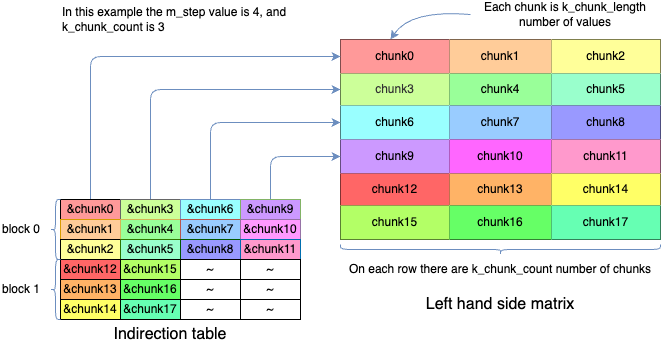 |
| 67 |
|
| 68 |
The indirection table can use two types of pointers, chunk pointers and padding |
| 69 |
pointers. The difference between these two pointers is that the function |
| 70 |
argument `lhs_ptr_offset` will not be added to padding pointers. The reason for |
| 71 |
this distinction is that padding chunks can live outside of the left hand side |
| 72 |
matrix, and you can use the base address of the left hand side matrix as |
| 73 |
`lhs_ptr_offset` with `lhs_ptrs` being a table of indices rather than pointers. |
| 74 |
|
| 75 |
A simple flow of invoking the left hand side packing could look like the |
| 76 |
following. |
| 77 |
|
| 78 |
The following values are used to describe the input data. |
| 79 |
|
| 80 |
```cpp |
| 81 |
/* Values used for the LHS packing */ |
| 82 |
size_t m, k_chunk_count, k_chunk_length; |
| 83 |
float16_t *lhs_ptr; // matrix of m * (k_chunk_count * k_chunk_length) values |
| 84 |
``` |
| 85 |
|
| 86 |
Using the symbols above you can populate the indirection table using something |
| 87 |
like the below code. |
| 88 |
|
| 89 |
```cpp |
| 90 |
/* Indirection table setup */ |
| 91 |
const size_t m_step = kai_get_m_step_lhs_imatmul_pack_x16p2vlx2_x16p_sme(); |
| 92 |
const size_t itable_rows = k_chunk_count * round_up_division(m, m_step); |
| 93 |
const size_t itable_cols = m_step; |
| 94 |
|
| 95 |
/* Allocate the indirection table */ |
| 96 |
float16_t **const itable = new float16_t *[itable_rows * itable_cols]; |
| 97 |
|
| 98 |
/* Populate the indirection table */ |
| 99 |
size_t chunk = 0; |
| 100 |
for (size_t itable_block = 0; itable_block < itable_rows; itable_block += k_chunk_count) { |
| 101 |
for (size_t block_col = 0; block_col < itable_cols; block_col += 1) { |
| 102 |
for (size_t block_row = 0; block_row < k_chunk_count; block_row += 1) { |
| 103 |
/* Note that this will set values for all entries, even unused entries */ |
| 104 |
const size_t idx = (itable_block + block_row) * itable_cols + block_col; |
| 105 |
itable[idx] = lhs_ptr + k_chunk_length * chunk++; |
| 106 |
} |
| 107 |
} |
| 108 |
} |
| 109 |
``` |
| 110 |
|
| 111 |
Using the indirection table above, you can then invoke the left hand side |
| 112 |
packing micro-kernel using. |
| 113 |
|
| 114 |
```cpp |
| 115 |
const size_t lhs_packed_size = kai_get_lhs_packed_size_lhs_imatmul_pack_x16p2vlx2_x16p_sme(m, k_chunk_count, k_chunk_length); |
| 116 |
std::byte *lhs_packed = new std::byte[lhs_packed_size]; |
| 117 |
kai_run_lhs_imatmul_pack_x16p2vlx2_x16p_sme(m, k_chunk_count, k_chunk_length, itable, 0, nullptr, lhs_packed); |
| 118 |
``` |
| 119 |
|
| 120 |
### Right hand side packing |
| 121 |
|
| 122 |
The right hand side packing for `imatmul` is very similar to the normal right |
| 123 |
hand side packing. The difference is that the resulting layout will be suitable |
| 124 |
for the layout used by the left hand side packing. Similar to the left hand side |
| 125 |
packing the right hand side packing also takes `k_chunk_count` and |
| 126 |
`k_chunk_length` arguments. |
| 127 |
|
| 128 |
Same as for left hand side, set up values describing the input data. |
| 129 |
|
| 130 |
```cpp |
| 131 |
size_t n, k_chunk_count, k_chunk_length; |
| 132 |
float16_t *rhs; // Matrix of (k_chunk_count * k_chunk_length) * n values |
| 133 |
float16_t *bias; // vector of n values |
| 134 |
``` |
| 135 |
|
| 136 |
Then allocate output buffer, and invoke the right hand side packing |
| 137 |
micro-kernel. |
| 138 |
|
| 139 |
```C++ |
| 140 |
const size_t rhs_packed_size = kai_get_rhs_packed_size_rhs_imatmul_pack_kxn_x16p2vlx2b_x16_x16_sme(n, k_chunk_count, k_chunk_length); |
| 141 |
std::byte *rhs_packed = new std::byte[rhs_packed_size]; |
| 142 |
kai_run_rhs_imatmul_pack_kxn_x16p2vlx2b_x16_x16_sme(n, k_chunk_count, k_chunk_length, n * sizeof(float16_t), bias, rhs_packed); |
| 143 |
``` |
| 144 |
|
| 145 |
## `imatmul` |
| 146 |
|
| 147 |
Once the input data has been pack, as per description above the next step is |
| 148 |
simply to invoke the `imatmul` micro-kernel. |
| 149 |
|
| 150 |
Similarly to the invocations above, you need some parameters representing your |
| 151 |
input. You need to allocate memory for output, and you need to invoke the |
| 152 |
`imatmul` micro-kernel. |
| 153 |
|
| 154 |
```cpp |
| 155 |
size_t m, n, k_chunk_count, k_chunk_length; |
| 156 |
|
| 157 |
const size_t dst_size = kai_get_dst_size_imatmul_clamp_f16_f16p2vlx2_f16p2vlx2_2vlx2vl_sme2_mopa(m, n); |
| 158 |
float16_t* dst = new float16_t[dst_size / sizeof(float16_t)]; |
| 159 |
|
| 160 |
kai_run_imatmul_clamp_f16_f16p2vlx2_f16p2vlx2_2vlx2vl_sme2_mopa(m, n, k_chunk_count, k_chunk_length, |
| 161 |
lhs_packed, rhs_packed, dst, |
| 162 |
m * sizeof(float16_t), -1.0f, 1.0f); |
| 163 |
``` |