| 1 |
Metadata-Version: 2.1 |
| 2 |
Name: hypothesis-auto |
| 3 |
Version: 1.1.5 |
| 4 |
Summary: Extends Hypothesis to add fully automatic testing of type annotated functions |
| 5 |
License: MIT |
| 6 |
Author: Timothy Crosley |
| 7 |
Author-email: [email protected] |
| 8 |
Requires-Python: >=3.6 |
| 9 |
Classifier: License :: OSI Approved :: MIT License |
| 10 |
Classifier: Programming Language :: Python :: 3 |
| 11 |
Classifier: Programming Language :: Python :: 3.6 |
| 12 |
Classifier: Programming Language :: Python :: 3.7 |
| 13 |
Classifier: Programming Language :: Python :: 3.8 |
| 14 |
Classifier: Programming Language :: Python :: 3.9 |
| 15 |
Classifier: Programming Language :: Python :: 3.10 |
| 16 |
Classifier: Programming Language :: Python :: 3.11 |
| 17 |
Provides-Extra: pytest |
| 18 |
Requires-Dist: hypothesis (>=4.36,<6.0.0) |
| 19 |
Requires-Dist: pydantic (>=0.32.2,<2.0.0) |
| 20 |
Requires-Dist: pytest (>=4.0.0); extra == "pytest" |
| 21 |
Description-Content-Type: text/markdown |
| 22 |
|
| 23 |
[](https://timothycrosley.github.io/hypothesis-auto/) |
| 24 |
_________________ |
| 25 |
|
| 26 |
[](http://badge.fury.io/py/hypothesis-auto) |
| 27 |
[](https://travis-ci.org/timothycrosley/hypothesis-auto) |
| 28 |
[](https://codecov.io/gh/timothycrosley/hypothesis-auto) |
| 29 |
[](https://gitter.im/timothycrosley/hypothesis-auto?utm_source=badge&utm_medium=badge&utm_campaign=pr-badge&utm_content=badge) |
| 30 |
[](https://pypi.python.org/pypi/hypothesis-auto/) |
| 31 |
[](https://pepy.tech/project/hypothesis-auto) |
| 32 |
_________________ |
| 33 |
|
| 34 |
[Read Latest Documentation](https://timothycrosley.github.io/hypothesis-auto/) - [Browse GitHub Code Repository](https://github.com/timothycrosley/hypothesis-auto/) |
| 35 |
_________________ |
| 36 |
|
| 37 |
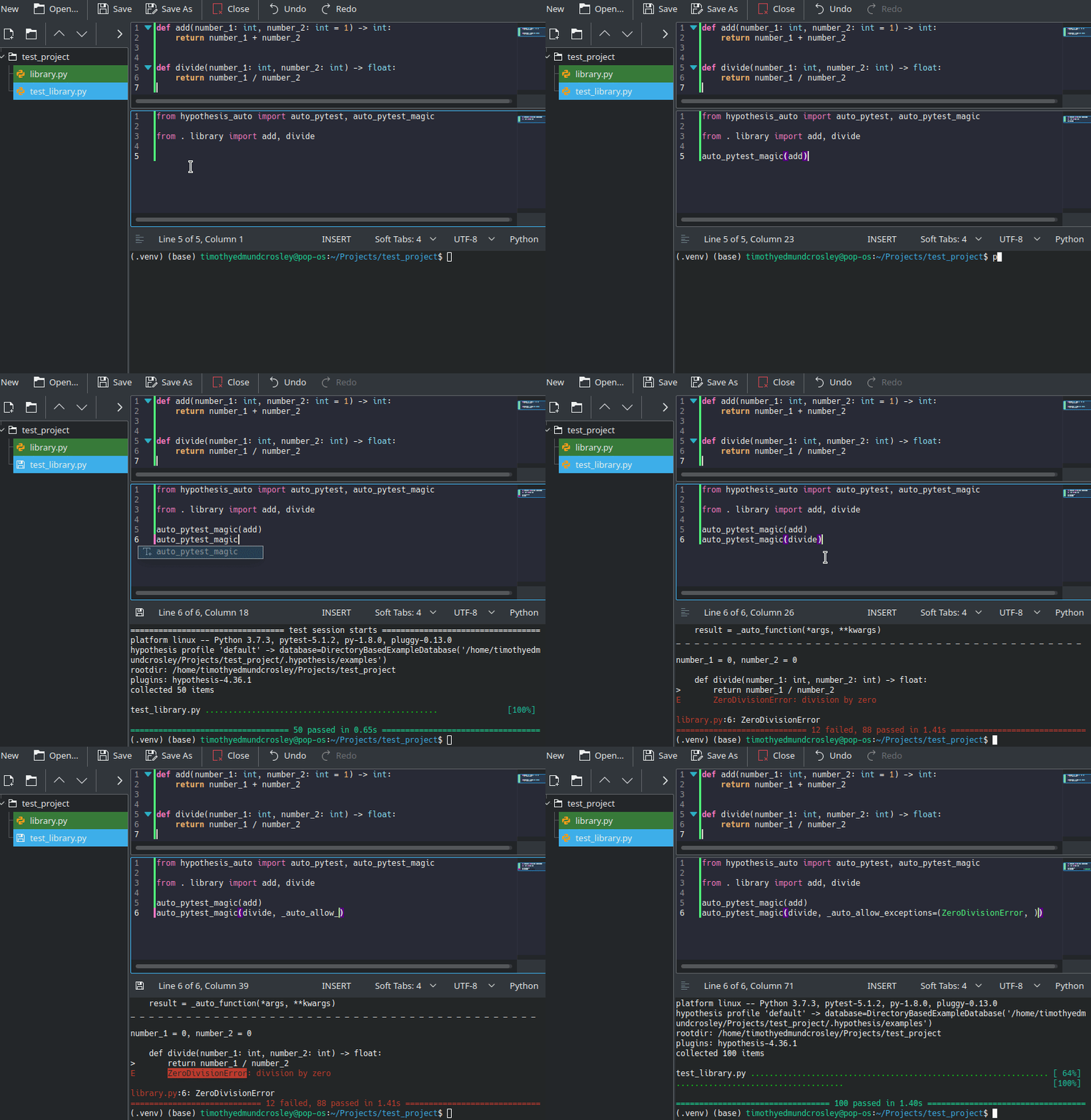
**hypothesis-auto** is an extension for the [Hypothesis](https://hypothesis.readthedocs.io/en/latest/) project that enables fully automatic tests for type annotated functions. |
| 38 |
|
| 39 |
[](https://github.com/timothycrosley/hypothesis-auto/blob/master/art/demo.gif) |
| 40 |
|
| 41 |
Key Features: |
| 42 |
|
| 43 |
* **Type Annotation Powered**: Utilize your function's existing type annotations to build dozens of test cases automatically. |
| 44 |
* **Low Barrier**: Start utilizing property-based testing in the lowest barrier way possible. Just run `auto_test(FUNCTION)` to run dozens of test. |
| 45 |
* **pytest Compatible**: Like Hypothesis itself, hypothesis-auto has built-in compatibility with the popular [pytest](https://docs.pytest.org/en/latest/) testing framework. This means that you can turn your automatically generated tests into individual pytest test cases with one line. |
| 46 |
* **Scales Up**: As you find your self needing to customize your auto_test cases, you can easily utilize all the features of [Hypothesis](https://hypothesis.readthedocs.io/en/latest/), including custom strategies per a parameter. |
| 47 |
|
| 48 |
## Installation: |
| 49 |
|
| 50 |
To get started - install `hypothesis-auto` into your projects virtual environment: |
| 51 |
|
| 52 |
`pip3 install hypothesis-auto` |
| 53 |
|
| 54 |
OR |
| 55 |
|
| 56 |
`poetry add hypothesis-auto` |
| 57 |
|
| 58 |
OR |
| 59 |
|
| 60 |
`pipenv install hypothesis-auto` |
| 61 |
|
| 62 |
## Usage Examples: |
| 63 |
|
| 64 |
!!! warning |
| 65 |
In old usage examples you will see `_` prefixed parameters like `_auto_verify=`. This was done to avoid conflicting with existing function parameters. |
| 66 |
Based on community feedback the project switched to `_` suffixes, such as `auto_verify_=` to keep the likely hood of conflicting low while |
| 67 |
avoiding the connotation of private parameters. |
| 68 |
|
| 69 |
### Framework independent usage |
| 70 |
|
| 71 |
#### Basic `auto_test` usage: |
| 72 |
|
| 73 |
```python3 |
| 74 |
from hypothesis_auto import auto_test |
| 75 |
|
| 76 |
|
| 77 |
def add(number_1: int, number_2: int = 1) -> int: |
| 78 |
return number_1 + number_2 |
| 79 |
|
| 80 |
|
| 81 |
auto_test(add) # 50 property based scenarios are generated and ran against add |
| 82 |
auto_test(add, auto_runs_=1_000) # Let's make that 1,000 |
| 83 |
``` |
| 84 |
|
| 85 |
#### Adding an allowed exception: |
| 86 |
|
| 87 |
```python3 |
| 88 |
from hypothesis_auto import auto_test |
| 89 |
|
| 90 |
|
| 91 |
def divide(number_1: int, number_2: int) -> int: |
| 92 |
return number_1 / number_2 |
| 93 |
|
| 94 |
auto_test(divide) |
| 95 |
|
| 96 |
-> 1012 raise the_error_hypothesis_found |
| 97 |
1013 |
| 98 |
1014 for attrib in dir(test): |
| 99 |
|
| 100 |
<ipython-input-2-65a3aa66e9f9> in divide(number_1, number_2) |
| 101 |
1 def divide(number_1: int, number_2: int) -> int: |
| 102 |
----> 2 return number_1 / number_2 |
| 103 |
3 |
| 104 |
|
| 105 |
0/0 |
| 106 |
|
| 107 |
ZeroDivisionError: division by zero |
| 108 |
|
| 109 |
|
| 110 |
auto_test(divide, auto_allow_exceptions_=(ZeroDivisionError, )) |
| 111 |
``` |
| 112 |
|
| 113 |
#### Using `auto_test` with a custom verification method: |
| 114 |
|
| 115 |
```python3 |
| 116 |
from hypothesis_auto import Scenario, auto_test |
| 117 |
|
| 118 |
|
| 119 |
def add(number_1: int, number_2: int = 1) -> int: |
| 120 |
return number_1 + number_2 |
| 121 |
|
| 122 |
|
| 123 |
def my_custom_verifier(scenario: Scenario): |
| 124 |
if scenario.kwargs["number_1"] > 0 and scenario.kwargs["number_2"] > 0: |
| 125 |
assert scenario.result > scenario.kwargs["number_1"] |
| 126 |
assert scenario.result > scenario.kwargs["number_2"] |
| 127 |
elif scenario.kwargs["number_1"] < 0 and scenario.kwargs["number_2"] < 0: |
| 128 |
assert scenario.result < scenario.kwargs["number_1"] |
| 129 |
assert scenario.result < scenario.kwargs["number_2"] |
| 130 |
else: |
| 131 |
assert scenario.result >= min(scenario.kwargs.values()) |
| 132 |
assert scenario.result <= max(scenario.kwargs.values()) |
| 133 |
|
| 134 |
|
| 135 |
auto_test(add, auto_verify_=my_custom_verifier) |
| 136 |
``` |
| 137 |
|
| 138 |
Custom verification methods should take a single [Scenario](https://timothycrosley.github.io/hypothesis-auto/reference/hypothesis_auto/tester/#scenario) and raise an exception to signify errors. |
| 139 |
|
| 140 |
For the full set of parameters, you can pass into auto_test see its [API reference documentation](https://timothycrosley.github.io/hypothesis-auto/reference/hypothesis_auto/tester/). |
| 141 |
|
| 142 |
### pytest usage |
| 143 |
|
| 144 |
#### Using `auto_pytest_magic` to auto-generate dozens of pytest test cases: |
| 145 |
|
| 146 |
```python3 |
| 147 |
from hypothesis_auto import auto_pytest_magic |
| 148 |
|
| 149 |
|
| 150 |
def add(number_1: int, number_2: int = 1) -> int: |
| 151 |
return number_1 + number_2 |
| 152 |
|
| 153 |
|
| 154 |
auto_pytest_magic(add) |
| 155 |
``` |
| 156 |
|
| 157 |
#### Using `auto_pytest` to run dozens of test case within a temporary directory: |
| 158 |
|
| 159 |
```python3 |
| 160 |
from hypothesis_auto import auto_pytest |
| 161 |
|
| 162 |
|
| 163 |
def add(number_1: int, number_2: int = 1) -> int: |
| 164 |
return number_1 + number_2 |
| 165 |
|
| 166 |
|
| 167 |
@auto_pytest() |
| 168 |
def test_add(test_case, tmpdir): |
| 169 |
tmpdir.mkdir().chdir() |
| 170 |
test_case() |
| 171 |
``` |
| 172 |
|
| 173 |
#### Using `auto_pytest_magic` with a custom verification method: |
| 174 |
|
| 175 |
```python3 |
| 176 |
from hypothesis_auto import Scenario, auto_pytest |
| 177 |
|
| 178 |
|
| 179 |
def add(number_1: int, number_2: int = 1) -> int: |
| 180 |
return number_1 + number_2 |
| 181 |
|
| 182 |
|
| 183 |
def my_custom_verifier(scenario: Scenario): |
| 184 |
if scenario.kwargs["number_1"] > 0 and scenario.kwargs["number_2"] > 0: |
| 185 |
assert scenario.result > scenario.kwargs["number_1"] |
| 186 |
assert scenario.result > scenario.kwargs["number_2"] |
| 187 |
elif scenario.kwargs["number_1"] < 0 and scenario.kwargs["number_2"] < 0: |
| 188 |
assert scenario.result < scenario.kwargs["number_1"] |
| 189 |
assert scenario.result < scenario.kwargs["number_2"] |
| 190 |
else: |
| 191 |
assert scenario.result >= min(scenario.kwargs.values()) |
| 192 |
assert scenario.result <= max(scenario.kwargs.values()) |
| 193 |
|
| 194 |
|
| 195 |
auto_pytest_magic(add, auto_verify_=my_custom_verifier) |
| 196 |
``` |
| 197 |
|
| 198 |
Custom verification methods should take a single [Scenario](https://timothycrosley.github.io/hypothesis-auto/reference/hypothesis_auto/tester/#scenario) and raise an exception to signify errors. |
| 199 |
|
| 200 |
For the full reference of the pytest integration API see the [API reference documentation](https://timothycrosley.github.io/hypothesis-auto/reference/hypothesis_auto/pytest/). |
| 201 |
|
| 202 |
## Why Create hypothesis-auto? |
| 203 |
|
| 204 |
I wanted a no/low resistance way to start incorporating property-based tests across my projects. Such a solution that also encouraged the use of type hints was a win/win for me. |
| 205 |
|
| 206 |
I hope you too find `hypothesis-auto` useful! |
| 207 |
|
| 208 |
~Timothy Crosley |
| 209 |
|