| 1 |
--- |
| 2 |
layout: default |
| 3 |
title: Graphite technical overview |
| 4 |
nav_order: 20 |
| 5 |
parent: About Graphite |
| 6 |
--- |
| 7 |
|
| 8 |
# Graphite technical overview |
| 9 |
|
| 10 |
* [Introduction](graphite_techAbout#introduction) |
| 11 |
* [Graphite font tables](graphite_techAbout#graphite-font-tables) |
| 12 |
* [Graphite engine implementations](#graphite-engine-implementations) |
| 13 |
* [Graphite and OpenType](graphite_techAbout#graphite-and-opentype) |
| 14 |
|
| 15 |
## Introduction |
| 16 |
|
| 17 |
The Graphite system consists of: |
| 18 |
|
| 19 |
* Graphite Description Language (GDL) - a rule-based programming language that is used to describe the behavior of a writing system |
| 20 |
* the Graphite compiler - used to compile the GDL program along with a font to generate the Graphite-enabled version of the font |
| 21 |
* the Graphite engine - uses the Graphite font to assist a text-processing application in performing text layout |
| 22 |
|
| 23 |
{: .image-tight } |
| 24 |
 |
| 25 |
|
| 26 |
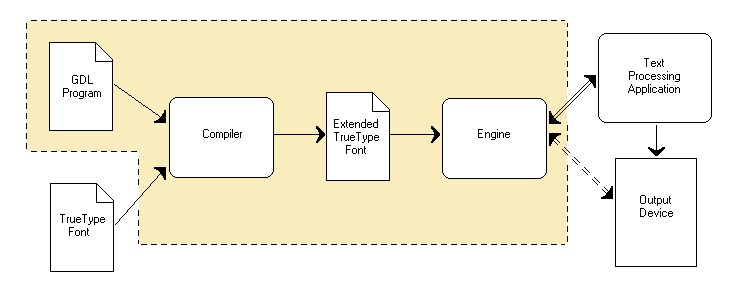
<figcaption>Graphite system architecture</figcaption> |
| 27 |
|
| 28 |
The compiler takes as input a TrueType font and a GDL program that has been written to correspond to it. The output of the compiler is a font that has been extended by including several tables used by the Graphite engine (see [Graphite font tables below](graphite_techAbout#graphite-font-tables)). |
| 29 |
|
| 30 |
An application makes use of Graphite by hooking the Graphite engine into its text layout module. The Graphite engine uses the font, particularly the Graphite-specific tables, to perform text layout. |
| 31 |
|
| 32 |
The dotted arrow between the engine and the output device indicates a difference between the original Graphite engine (SilGraphite) and the Graphite2 rework. The original engine contains a module that actually performs output by communicating with the output device. This is not included in Graphite2; the engine returns glyph and positioning information to the application, which performs the actual drawing. |
| 33 |
|
| 34 |
## Graphite font tables |
| 35 |
|
| 36 |
To create a Graphite-enabled font, the compiler adds several TrueType tables to the font file. These tables include: |
| 37 |
|
| 38 |
* **Silf** - contains the main logic, including finite state machine for rule matching, constraints, and rule action code |
| 39 |
* **Glat** - glyph attributes table |
| 40 |
* **Gloc** - indexes for Glat table |
| 41 |
* **Feat** - feature table, similar to Apple's feat table |
| 42 |
* **Sill** - language table, containing mappings between language codes and features |
| 43 |
|
| 44 |
The [↗ compiler package](https://github.org/silnrsi/grcompiler){:target="_blank"} contains more complete documentation of these tables and their formats. |
| 45 |
|
| 46 |
## Graphite engine implementations |
| 47 |
|
| 48 |
There are two existing implementations of the Graphite engine. The original engine is packaged under the name "SilGraphite"; the initial implementation was done in 2000. The Graphite2 engine implementation began in 2010. |
| 49 |
|
| 50 |
The [↗ SilGraphite engine](https://sourceforge.net/projects/silgraphite){:target="_blank"} is currently used by OpenOffice, XeTeX, FieldWorks, and WorldPad. It includes some features not included in Graphite2, but is considerably slower. [↗ Graphite2](https://projects.palaso.org/projects/graphitedev){:target="_blank"} represents a significant (10x) optimization in terms of speed and greatly improved robustness, but does not include a few features such a ligature component handling and cross-line-boundary contextualization. Graphite2 is used by LibreOffice and Firefox. |
| 51 |
|
| 52 |
The two engines support different APIs. The Graphite2 API was specifically developed to be more compatible with the approach to text layout used by most commercial software. See the [application development page](graphite_devApp) for API documentation. |
| 53 |
|
| 54 |
## Graphite and OpenType |
| 55 |
|
| 56 |
OpenType is the most prevalent smart font technology. Given the extra costs of supporting Graphite in addition to OpenType, what are the gains? |
| 57 |
|
| 58 |
Graphite and OpenType are not competing technologies. Applications may support both Graphite and OpenType rendering and fonts may be developed that work with both Graphite and OpenType. |
| 59 |
|
| 60 |
[Read more...](graphite_aboutOT) |