| 1 |
# Code Review Comments |
| 2 |
|
| 3 |
This is a collection of frequent code review comments, collected here for |
| 4 |
reference and discussed in more depth than a typical code review would allow. |
| 5 |
|
| 6 |
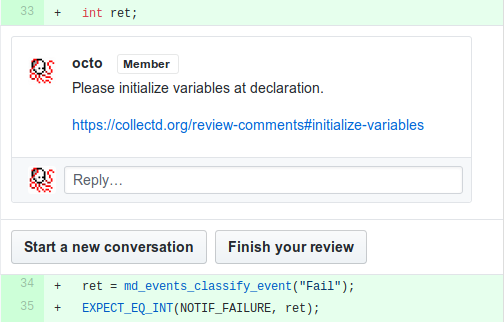
The intended use for this document is to point to it from a code review to make |
| 7 |
a point quickly while still providing the contributor with enough information |
| 8 |
to resolve the issue. For example, a good review comment would be: |
| 9 |
|
| 10 |
 |
| 11 |
|
| 12 |
A link to each paragraph is provided at the beginning for easy copy'n'pasting. |
| 13 |
|
| 14 |
## Initialize variables |
| 15 |
|
| 16 |
→ [https://collectd.org/review-comments#initialize-variables](https://collectd.org/review-comments#initialize-variables) |
| 17 |
|
| 18 |
Initialize variables when declaring them. By default, C does not initialize |
| 19 |
local variables when they are defined. If a code path ends up reading the |
| 20 |
variable before it is initialized, for example because a loop body is never |
| 21 |
executed, it will read random data, causing undefined behavior. Worst case, |
| 22 |
pointers will point to random memory causing a segmentation fault. |
| 23 |
|
| 24 |
**Examples:** |
| 25 |
|
| 26 |
```c |
| 27 |
/* Initialize scalar with to literal: */ |
| 28 |
int status = 0; |
| 29 |
|
| 30 |
/* Initialize pointer with function call: */ |
| 31 |
char *buffer = calloc(1, buffer_size); |
| 32 |
|
| 33 |
/* Initialize struct with struct initializer: */ |
| 34 |
struct addrinfo ai = { |
| 35 |
.ai_family = AF_UNSPEC, |
| 36 |
.ai_flags = AI_ADDRCONFIG, |
| 37 |
.ai_socktype = SOCK_STREAM, |
| 38 |
}; |
| 39 |
|
| 40 |
/* Initialize struct with zero: */ |
| 41 |
struct stat statbuf = {0}; |
| 42 |
``` |
| 43 |
|
| 44 |
In the last example, `{0}` is the universal struct initializer that, in theory, |
| 45 |
should be able to zero-initialize any struct. In practise, however, some |
| 46 |
compilers don't implement this correctly and will get confused when the first |
| 47 |
member is a struct or a union. Our *continuous integration* framework will |
| 48 |
catch these cases. |
| 49 |
|
| 50 |
## Define variables on first use |
| 51 |
|
| 52 |
→ [https://collectd.org/review-comments#define-variables-on-first-use](https://collectd.org/review-comments#define-variables-on-first-use) |
| 53 |
|
| 54 |
Local variables should be defined when they are first used, ideally when they |
| 55 |
can be initialized. For example: |
| 56 |
|
| 57 |
```c |
| 58 |
struct foo *f = calloc(1, sizeof(*f)); |
| 59 |
if (f == NULL) { |
| 60 |
return ENOMEM; |
| 61 |
} |
| 62 |
|
| 63 |
/* GOOD: status defiened and initialized late. */ |
| 64 |
int status = function_call(f); |
| 65 |
``` |
| 66 |
|
| 67 |
Sometimes variables are initialized by passing a pointer to them to a function. |
| 68 |
In that case define them as close to the function call as you can and |
| 69 |
zero-initialize them. The function may only partially initialize a struct or |
| 70 |
not initialize a struct at all in some circumstances. |
| 71 |
|
| 72 |
**Example:** |
| 73 |
|
| 74 |
```c |
| 75 |
char const *path = determine_path(); |
| 76 |
|
| 77 |
struct stat s = {0}; |
| 78 |
int status = stat(path, &s); |
| 79 |
``` |
| 80 |
|
| 81 |
Old C standards (C89 and ealier) required variables to be defined at the |
| 82 |
beginning of a scope block. The following *bad* style is still frequently |
| 83 |
found: |
| 84 |
|
| 85 |
```c |
| 86 |
/* BAD: local variables defined at beginning of block. */ |
| 87 |
struct foo *f; |
| 88 |
int status; |
| 89 |
|
| 90 |
f = calloc(1, sizeof(*f)); |
| 91 |
if (f == NULL) { |
| 92 |
return ENOMEM; |
| 93 |
} |
| 94 |
|
| 95 |
status = function_call(f); |
| 96 |
``` |