| 1 |
# tlsio |
| 2 |
|
| 3 |
## Overview |
| 4 |
|
| 5 |
This specification defines generic behavior for tlsio adapters, which operate primarily through the `xio` |
| 6 |
interface and provide communication to remote systems over a TLS-conformant secure channel. |
| 7 |
|
| 8 |
## References |
| 9 |
|
| 10 |
[TLS Protocol (RFC2246)](https://www.ietf.org/rfc/rfc2246.txt) |
| 11 |
|
| 12 |
[TLS Protocol (generic information)](https://en.wikipedia.org/wiki/Transport_Layer_Security) |
| 13 |
|
| 14 |
[xio.h](https://github.com/Azure/azure-c-shared-utility/blob/master/inc/azure_c_shared_utility/xio.h) |
| 15 |
|
| 16 |
|
| 17 |
## Exposed API |
| 18 |
|
| 19 |
**SRS_TLSIO_30_001: [** The tlsio shall implement and export all the Concrete functions in the VTable IO_INTERFACE_DESCRIPTION defined in the `xio.h`. |
| 20 |
```c |
| 21 |
typedef OPTIONHANDLER_HANDLE (*IO_RETRIEVEOPTIONS)(CONCRETE_IO_HANDLE concrete_io); |
| 22 |
typedef CONCRETE_IO_HANDLE(*IO_CREATE)(void* io_create_parameters); |
| 23 |
typedef void(*IO_DESTROY)(CONCRETE_IO_HANDLE concrete_io); |
| 24 |
typedef int(*IO_OPEN)(CONCRETE_IO_HANDLE concrete_io, ON_IO_OPEN_COMPLETE on_io_open_complete, |
| 25 |
void* on_io_open_complete_context, ON_BYTES_RECEIVED on_bytes_received, |
| 26 |
void* on_bytes_received_context, ON_IO_ERROR on_io_error, void* on_io_error_context); |
| 27 |
typedef int(*IO_CLOSE)(CONCRETE_IO_HANDLE concrete_io, ON_IO_CLOSE_COMPLETE on_io_close_complete, |
| 28 |
void* callback_context); |
| 29 |
typedef int(*IO_SEND)(CONCRETE_IO_HANDLE concrete_io, const void* buffer, size_t size, |
| 30 |
ON_SEND_COMPLETE on_send_complete, void* callback_context); |
| 31 |
typedef void(*IO_DOWORK)(CONCRETE_IO_HANDLE concrete_io); |
| 32 |
typedef int(*IO_SETOPTION)(CONCRETE_IO_HANDLE concrete_io, const char* optionName, |
| 33 |
const void* value); |
| 34 |
|
| 35 |
|
| 36 |
typedef struct IO_INTERFACE_DESCRIPTION_TAG |
| 37 |
{ |
| 38 |
IO_RETRIEVEOPTIONS concrete_io_retrieveoptions; |
| 39 |
IO_CREATE concrete_io_create; |
| 40 |
IO_DESTROY concrete_io_destroy; |
| 41 |
IO_OPEN concrete_io_open; |
| 42 |
IO_CLOSE concrete_io_close; |
| 43 |
IO_SEND concrete_io_send; |
| 44 |
IO_DOWORK concrete_io_dowork; |
| 45 |
IO_SETOPTION concrete_io_setoption; |
| 46 |
} IO_INTERFACE_DESCRIPTION; |
| 47 |
``` |
| 48 |
**]** |
| 49 |
|
| 50 |
The following types from `xio.h` are also referenced in individual requirements. |
| 51 |
```c |
| 52 |
|
| 53 |
typedef enum IO_OPEN_RESULT_TAG |
| 54 |
{ |
| 55 |
IO_OPEN_OK, |
| 56 |
IO_OPEN_ERROR, |
| 57 |
IO_OPEN_CANCELLED |
| 58 |
} IO_OPEN_RESULT; |
| 59 |
|
| 60 |
typedef enum IO_SEND_RESULT_TAG |
| 61 |
{ |
| 62 |
IO_SEND_OK, |
| 63 |
IO_SEND_ERROR, |
| 64 |
IO_SEND_CANCELLED |
| 65 |
} IO_SEND_RESULT; |
| 66 |
|
| 67 |
typedef void(*ON_BYTES_RECEIVED)(void* context, const unsigned char* buffer, size_t size); |
| 68 |
typedef void(*ON_SEND_COMPLETE)(void* context, IO_SEND_RESULT send_result); |
| 69 |
typedef void(*ON_IO_OPEN_COMPLETE)(void* context, IO_OPEN_RESULT open_result); |
| 70 |
typedef void(*ON_IO_CLOSE_COMPLETE)(void* context); |
| 71 |
typedef void(*ON_IO_ERROR)(void* context); |
| 72 |
|
| 73 |
typedef struct TLSIO_CONFIG_TAG |
| 74 |
{ |
| 75 |
const char* hostname; |
| 76 |
int port; |
| 77 |
const IO_INTERFACE_DESCRIPTION* underlying_io_interface; |
| 78 |
void* underlying_io_parameters; |
| 79 |
} TLSIO_CONFIG; |
| 80 |
``` |
| 81 |
|
| 82 |
## External State |
| 83 |
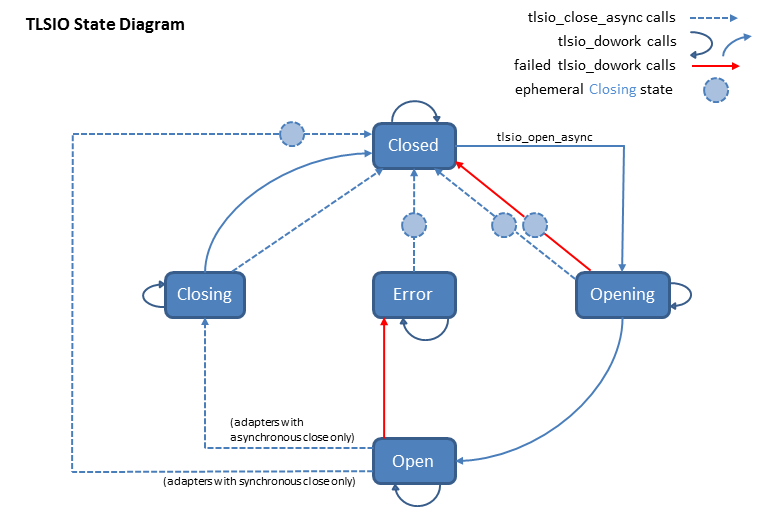
The external state of the tlsio adapter is determined by which of the adapter's interface functions have been called and which callbacks have been performed. The adapter's internal state should map cleanly to its external state, but the mapping is not necessarily 1:1. The external states are defined as follows: |
| 84 |
|
| 85 |
* TLSIO_STATE_EXT_CLOSED means either that the module is newly constructed by `tlsio_create`, that the `tlsio_close_async` complete callback has been received, or that the `on_tlsio_open_complete` callback has returned with `IO_OPEN_ERROR`. |
| 86 |
* TLSIO_STATE_EXT_OPENING means that the `tlsio_open_async` call has completed successfully but the `on_tlsio_open_complete` callback has not been performed. |
| 87 |
* TLSIO_STATE_EXT_OPEN means that the `on_tlsio_open_complete` callback has returned with `IO_OPEN_OK`. |
| 88 |
* TLSIO_STATE_EXT_CLOSING means that either the `tlsio_close_async` call has completed successfully but the `on_tlsio_close_complete` callback has not yet been performed, or that the `on_tlsio_open_complete` callback has returned with `IO_OPEN_CANCELLED`. |
| 89 |
* TLSIO_STATE_EXT_ERROR means that `on_io_error` has been called from `tlsio_dowork`. |
| 90 |
|
| 91 |
## State Transitions |
| 92 |
This list shows the effect of the calls as a function of state with happy internal functionality. Unhappy functionality is not shown. The `tlsio_setoption` and `tlsio_getoptions` calls are not shown because they have no effect on state and are always allowed. Calls to `tlsio_send_async` also do not affect state, and are allowed only during TLSIO_STATE_EXT_OPEN. |
| 93 |
|
| 94 |
All transitions into TLSIO_STATE_EXT_CLOSED are understood to pass through TLSIO_STATE_EXT_CLOSING. |
| 95 |
|
| 96 |
|
| 97 |
<table> |
| 98 |
<tr>From state <b>TLSIO_STATE_EXT_CLOSED</b></tr> |
| 99 |
<tr> |
| 100 |
<td>tlsio_destroy</td> |
| 101 |
<td>ok (destroyed)</td> |
| 102 |
</tr> |
| 103 |
<tr> |
| 104 |
<td>tlsio_open_async</td> |
| 105 |
<td>ok, enter TLSIO_STATE_EXT_OPENING</td> |
| 106 |
</tr> |
| 107 |
<tr> |
| 108 |
<td>tlsio_close_async</td> |
| 109 |
<td>ok, remain in TLSIO_STATE_EXT_CLOSED</td> |
| 110 |
</tr> |
| 111 |
<tr> |
| 112 |
<td>tlsio_dowork</td> |
| 113 |
<td>ok (does nothing), remain in TLSIO_STATE_EXT_CLOSED</td> |
| 114 |
</tr> |
| 115 |
</table> |
| 116 |
|
| 117 |
<table> |
| 118 |
<tr>From state <b>TLSIO_STATE_EXT_OPENING</b></tr> |
| 119 |
<tr> |
| 120 |
<td>tlsio_destroy</td> |
| 121 |
<td>log error, force immediate close, destroy (destroyed)</td> |
| 122 |
</tr> |
| 123 |
<tr> |
| 124 |
<td>tlsio_open_async</td> |
| 125 |
<td>fail, log error, remain in TLSIO_STATE_EXT_OPENING (usage error)</td> |
| 126 |
</tr> |
| 127 |
<tr> |
| 128 |
<td>tlsio_close_async</td> |
| 129 |
<td>ok, force immediate close, enter TLSIO_STATE_EXT_CLOSED</td> |
| 130 |
</tr> |
| 131 |
<tr> |
| 132 |
<td>tlsio_dowork</td> |
| 133 |
<td>ok (continue opening), remain in TLSIO_STATE_EXT_OPENING or enter TLSIO_STATE_EXT_OPEN</td> |
| 134 |
</tr> |
| 135 |
</table> |
| 136 |
|
| 137 |
<table> |
| 138 |
<tr>From state <b>TLSIO_STATE_EXT_OPEN</b></tr> |
| 139 |
<tr> |
| 140 |
<td>tlsio_destroy</td> |
| 141 |
<td>(a possible normal SDK behavior) force immediate close, destroy (destroyed)</td> |
| 142 |
</tr> |
| 143 |
<tr> |
| 144 |
<td>tlsio_open_async</td> |
| 145 |
<td>fail, log error, remain in TLSIO_STATE_EXT_OPEN (usage error)</td> |
| 146 |
</tr> |
| 147 |
<tr> |
| 148 |
<td>tlsio_close_async</td> |
| 149 |
<td>adapters with internal async close: ok, enter TLSIO_STATE_EXT_CLOSING<br/>adatpers without internal async close: ok, enter TLSIO_STATE_EXT_CLOSING, then <br/>immediately enter TLSIO_STATE_EXT_CLOSED</td> |
| 150 |
</tr> |
| 151 |
<tr> |
| 152 |
<td>tlsio_dowork</td> |
| 153 |
<td>ok (send and receive as necessary), remain in TLSIO_STATE_EXT_OPEN</td> |
| 154 |
</tr> |
| 155 |
</table> |
| 156 |
|
| 157 |
<table> |
| 158 |
<tr>From state <b>TLSIO_STATE_EXT_CLOSING</b></tr> |
| 159 |
<tr> |
| 160 |
<td>tlsio_destroy</td> |
| 161 |
<td>log error, force immediate close, destroy (destroyed)</td> |
| 162 |
</tr> |
| 163 |
<tr> |
| 164 |
<td>tlsio_open_async</td> |
| 165 |
<td>fail, log error, remain in TLSIO_STATE_EXT_CLOSING (usage error)</td> |
| 166 |
</tr> |
| 167 |
<tr> |
| 168 |
<td>tlsio_close_async</td> |
| 169 |
<td>ok, force immediate close, enter TLSIO_STATE_EXT_CLOSED</td> |
| 170 |
</tr> |
| 171 |
<tr> |
| 172 |
<td>tlsio_dowork</td> |
| 173 |
<td>ok (continue graceful closing) , remain in TLSIO_STATE_EXT_CLOSING or <br/>enter TLSIO_STATE_EXT_CLOSED</td> |
| 174 |
</tr> |
| 175 |
</table> |
| 176 |
|
| 177 |
<table> |
| 178 |
<tr>From state <b>TLSIO_STATE_EXT_ERROR</b></tr> |
| 179 |
<tr> |
| 180 |
<td>tlsio_destroy</td> |
| 181 |
<td>log error, force immediate close, destroy (destroyed)</td> |
| 182 |
</tr> |
| 183 |
<tr> |
| 184 |
<td>tlsio_open_async</td> |
| 185 |
<td>fail, log error, remain in TLSIO_STATE_EXT_ERROR (usage error)</td> |
| 186 |
</tr> |
| 187 |
<tr> |
| 188 |
<td>tlsio_close_async</td> |
| 189 |
<td>ok, force immediate close, enter TLSIO_STATE_EXT_CLOSED</td> |
| 190 |
</tr> |
| 191 |
<tr> |
| 192 |
<td>tlsio_dowork</td> |
| 193 |
<td>ok (does nothing), remain in TLSIO_STATE_EXT_ERROR</td> |
| 194 |
</tr> |
| 195 |
</table> |
| 196 |
|
| 197 |
 |
| 198 |
|
| 199 |
## Definitions |
| 200 |
|
| 201 |
#### Explicit state transitions |
| 202 |
|
| 203 |
Throughout this document, state transitions only occur as explicitly specified. If no state transition is called out, then none is allowed. (So "do nothing" is always understood as the default.) |
| 204 |
|
| 205 |
#### Specified state transitions |
| 206 |
|
| 207 |
Requirements in this document use the phrase "shall enter TLSIO_STATE_EXT_XXXX" to specify behavior. Here are the definitions of the state transition phrases: |
| 208 |
|
| 209 |
##### "enter TLSIO_STATE_EXT_ERROR" |
| 210 |
**SRS_TLSIO_30_005: [** The phrase "enter TLSIO_STATE_EXT_ERROR" means the adapter shall call the `on_io_error` function and pass the `on_io_error_context` that was supplied in `tlsio_open_async`. **]** |
| 211 |
|
| 212 |
##### "enter TLSIO_STATE_EXT_CLOSING" |
| 213 |
**SRS_TLSIO_30_009: [** The phrase "enter TLSIO_STATE_EXT_CLOSING" means the adapter shall iterate through any unsent messages in the queue and shall delete each message after calling its `on_send_complete` with the associated `callback_context` and `IO_SEND_CANCELLED`. **]** |
| 214 |
|
| 215 |
##### "enter TLSIO_STATE_EXT_CLOSED" |
| 216 |
**SRS_TLSIO_30_006: [** The phrase "enter TLSIO_STATE_EXT_CLOSED" means the adapter shall forcibly close any existing connections then call the `on_io_close_complete` function and pass the `on_io_close_complete_context` that was supplied in `tlsio_close_async`. **]** |
| 217 |
|
| 218 |
##### "enter TLSIO_STATE_EXT_OPENING" |
| 219 |
The phrase "enter TLSIO_STATE_EXT_OPENING" means the adapter will continute the process of opening the TSL connection to the host on the next `tlsio_dowork` call, but no other externally visible action is being specified. |
| 220 |
|
| 221 |
##### "enter TLSIO_STATE_EXT_OPEN" |
| 222 |
**SRS_TLSIO_30_007: [** The phrase "enter TLSIO_STATE_EXT_OPEN" means the adapter shall call the `on_io_open_complete` function and pass IO_OPEN_OK and the `on_io_open_complete_context` that was supplied in `tlsio_open_async`. **]** |
| 223 |
|
| 224 |
##### "destroy the failed message" |
| 225 |
**SRS_TLSIO_30_002: [** The phrase "destroy the failed message" means that the adapter shall remove the message from the queue and destroy it after calling the message's `on_send_complete` along with its associated `callback_context` and `IO_SEND_ERROR`. **]** |
| 226 |
|
| 227 |
|
| 228 |
|
| 229 |
|
| 230 |
## API Calls |
| 231 |
|
| 232 |
### tlsio_get_interface_description |
| 233 |
```c |
| 234 |
const IO_INTERFACE_DESCRIPTION* tlsio_get_interface_description(void); |
| 235 |
``` |
| 236 |
|
| 237 |
**SRS_TLSIO_30_008: [** The tlsio_get_interface_description shall return the VTable IO_INTERFACE_DESCRIPTION. **]** |
| 238 |
|
| 239 |
|
| 240 |
### tlsio_create |
| 241 |
Implementation of `concrete_io_create`. |
| 242 |
```c |
| 243 |
CONCRETE_IO_HANDLE tlsio_create(void* io_create_parameters); |
| 244 |
``` |
| 245 |
|
| 246 |
##### _Direct_ versus _chained_ tlsio adapters |
| 247 |
|
| 248 |
Tlsio adapters have two different styles of implementation: _direct_, and _chained_. A _direct_ |
| 249 |
tlsio adapter communicates directly with the remote host using a TCP port that the tlsio adapter |
| 250 |
owns. A _chained_ tlsio adapter does not own a TCP port, and instead owns another xio adapter -- |
| 251 |
typically a `socketio` as explained |
| 252 |
[here](https://github.com/Azure/azure-c-shared-utility/blob/master/devdoc/porting_guide.md#socketio-adapter-overview) |
| 253 |
which it uses to communicate with the remote host. |
| 254 |
|
| 255 |
For the purposes of this spec, an _owned xio resource_ is an xio adapter created by the tlsio |
| 256 |
adapter to communicate with the remote host, and whose lifetime is managed by the tlsio |
| 257 |
adapter according to standard programming practices. Its lifetime management is covered by the |
| 258 |
"all necessary resources" clauses of the `tlsio_create` and `tlsio_destroy` requirements. |
| 259 |
|
| 260 |
For _chained_ tlsio adapters, the _owned xio resource_ type may be specifed in the |
| 261 |
`underlying_io_interface` member of `io_create_parameters`. If it is not, then it is |
| 262 |
understood that the tlsio adapter will need to create a `socketio` |
| 263 |
using the supplied `hostname` and `port` via the global |
| 264 |
`socketio_get_interface_description` function defined in |
| 265 |
[socketio.h](https://github.com/Azure/azure-c-shared-utility/blob/master/inc/azure_c_shared_utility/socketio.h). |
| 266 |
This practical necessity is not specified in this document as a requirement because it is |
| 267 |
considered an internal implementation detail. |
| 268 |
|
| 269 |
|
| 270 |
**SRS_TLSIO_30_010: [** The `tlsio_create` shall allocate and initialize all necessary resources and return an instance of the `tlsio` in TLSIO_STATE_EXT_CLOSED. **]** |
| 271 |
|
| 272 |
**SRS_TLSIO_30_011: [** If any resource allocation fails, `tlsio_create` shall return NULL. **]** |
| 273 |
|
| 274 |
**SRS_TLSIO_30_012: [** The `tlsio_create` shall receive the connection configuration as a `TLSIO_CONFIG*` in `io_create_parameters`. **]** |
| 275 |
|
| 276 |
**SRS_TLSIO_30_013: [** If the `io_create_parameters` value is NULL, `tlsio_create` shall log an error and return NULL. **]** |
| 277 |
|
| 278 |
**SRS_TLSIO_30_014: [** If the `hostname` member of `io_create_parameters` value is NULL, `tlsio_create` shall log an error and return NULL. **]** |
| 279 |
|
| 280 |
**SRS_TLSIO_30_015: [** If the `port` member of `io_create_parameters` value is less than 0 or greater than 0xffff, `tlsio_create` shall log an error and return NULL. **]** |
| 281 |
|
| 282 |
**SRS_TLSIO_30_016: [** `tlsio_create` shall make a copy of the `hostname` member of `io_create_parameters` to allow deletion of `hostname` immediately after the call. This copy may be delegated to an underlying `xio`. **]** |
| 283 |
|
| 284 |
**SRS_TLSIO_30_017: [** For _direct_ designs, if either the `underlying_io_interface` or `underlying_io_parameters` of `io_create_parameters` is non-NULL, `tlsio_create` shall log an error and return NULL. **]** |
| 285 |
|
| 286 |
**SRS_TLSIO_30_018: [** For _chained_ designs, if the `underlying_io_interface` member of `io_create_parameters` is non-NULL, `tlsio_create` shall use `underlying_io_interface` to create an _owned xio resource_ for remote host communication. **]** |
| 287 |
|
| 288 |
**SRS_TLSIO_30_019: [** For _chained_ designs with a non-NULL `underlying_io_interface` parameter, `tlsio_create` shall pass the `underlying_io_parameters` to `underlying_io_interface->xio_create` when creating the _owned xio resource_. **]** |
| 289 |
|
| 290 |
|
| 291 |
### tlsio_destroy |
| 292 |
Implementation of `concrete_io_destroy` |
| 293 |
```c |
| 294 |
void tlsio_destroy(CONCRETE_IO_HANDLE tlsio_handle); |
| 295 |
``` |
| 296 |
|
| 297 |
**SRS_TLSIO_30_020: [** If `tlsio_handle` is NULL, `tlsio_destroy` shall do nothing. **]** |
| 298 |
|
| 299 |
**SRS_TLSIO_30_021: [** The `tlsio_destroy` shall release all allocated resources and then release `tlsio_handle`. **]** |
| 300 |
|
| 301 |
**SRS_TLSIO_30_022: [** If the adapter is in any state other than TLSIO_STATE_EXT_CLOSED when `tlsio_destroy` is called, the adapter shall [enter TLSIO_STATE_EXT_CLOSING](#enter-TLSIO_STATE_EXT_CLOSING "Iterate through any unsent messages in the queue and delete each message after calling its `on_send_complete` with the associated `callback_context` and `IO_SEND_CANCELLED`.") and then [enter TLSIO_STATE_EXT_CLOSED](#enter-TLSIO_STATE_EXT_CLOSED "Forcibly close any existing connections then call the `on_io_close_complete` function and pass the `on_io_close_complete_context` that was supplied in `tlsio_close_async`.") before completing the destroy process. **]** |
| 302 |
|
| 303 |
|
| 304 |
### tlsio_open_async |
| 305 |
Implementation of `concrete_io_open` |
| 306 |
|
| 307 |
```c |
| 308 |
int tlsio_open_async( |
| 309 |
CONCRETE_IO_HANDLE tlsio_handle, |
| 310 |
ON_IO_OPEN_COMPLETE on_io_open_complete, |
| 311 |
void* on_io_open_complete_context, |
| 312 |
ON_BYTES_RECEIVED on_bytes_received, |
| 313 |
void* on_bytes_received_context, |
| 314 |
ON_IO_ERROR on_io_error, |
| 315 |
void* on_io_error_context); |
| 316 |
``` |
| 317 |
|
| 318 |
**SRS_TLSIO_30_030: [** If the `tlsio_handle` parameter is NULL, `tlsio_open_async` shall log an error and return `_FAILURE_`. **]** |
| 319 |
|
| 320 |
**SRS_TLSIO_30_031: [** If the on_io_open_complete parameter is NULL, `tlsio_open_async` shall log an error and return `_FAILURE_`. **]** |
| 321 |
|
| 322 |
**SRS_TLSIO_30_032: [** If the on_bytes_received parameter is NULL, `tlsio_open_async` shall log an error and return `_FAILURE_`. **]** |
| 323 |
|
| 324 |
**SRS_TLSIO_30_033: [** If the on_io_error parameter is NULL, `tlsio_open_async` shall log an error and return `_FAILURE_`. **]** |
| 325 |
|
| 326 |
**SRS_TLSIO_30_037: [** If the adapter is in any state other than TLSIO_STATE_EXT_CLOSED when `tlsio_open_async` is called, it shall log an error, and return `_FAILURE_`. **]** |
| 327 |
|
| 328 |
**SRS_TLSIO_30_038: [** If `tlsio_open_async` fails to [enter TLSIO_STATE_EXT_OPENING](#enter-TLSIO_STATE_EXT_OPENING "Continute the process of opening the TSL connection to the host on the next `tlsio_dowork` call") it shall return `_FAILURE_`. **]** |
| 329 |
|
| 330 |
**SRS_TLSIO_30_039: [** On failure, `tlsio_open_async` shall not call `on_io_open_complete`. **]** |
| 331 |
|
| 332 |
**SRS_TLSIO_30_034: [** On success, `tlsio_open_async` shall store the provided `on_bytes_received`, `on_bytes_received_context`, `on_io_error`, `on_io_error_context`, `on_io_open_complete`, and `on_io_open_complete_context` parameters for later use as specified and tested per other line entries in this document. **]** |
| 333 |
|
| 334 |
**SRS_TLSIO_30_035: [** On success, `tlsio_open_async` shall cause the adapter to [enter TLSIO_STATE_EXT_OPENING](#enter-TLSIO_STATE_EXT_OPENING "Continute the process of opening the TSL connection to the host on the next `tlsio_dowork` call") and return 0. **]** |
| 335 |
|
| 336 |
|
| 337 |
### tlsio_close_async |
| 338 |
Implementation of `concrete_io_close` |
| 339 |
```c |
| 340 |
int tlsio_close_async(CONCRETE_IO_HANDLE tlsio_handle, |
| 341 |
ON_IO_CLOSE_COMPLETE on_io_close_complete, void* callback_context); |
| 342 |
``` |
| 343 |
|
| 344 |
**SRS_TLSIO_30_050: [** If the `tlsio_handle` parameter is NULL, `tlsio_close_async` shall log an error and return `_FAILURE_`. **]** |
| 345 |
|
| 346 |
**SRS_TLSIO_30_055: [** If the `on_io_close_complete` parameter is NULL, `tlsio_close_async` shall log an error and return `_FAILURE_`. **]** |
| 347 |
|
| 348 |
**SRS_TLSIO_30_054: [** On failure, the adapter shall not call `on_io_close_complete`. **]** |
| 349 |
|
| 350 |
**SRS_TLSIO_30_053: [** If the adapter is in any state other than TLSIO_STATE_EXT_OPEN or TLSIO_STATE_EXT_ERROR then `tlsio_close_async` shall log that `tlsio_close_async` has been called and then continue normally. **]** |
| 351 |
|
| 352 |
**SRS_TLSIO_30_057: [** On success, if the adapter is in TLSIO_STATE_EXT_OPENING, it shall call `on_io_open_complete` with the `on_io_open_complete_context` supplied in `tlsio_open_async` and `IO_OPEN_CANCELLED`. This callback shall be made before changing the internal state of the adapter. **]** |
| 353 |
|
| 354 |
**SRS_TLSIO_30_056: [** On success the adapter shall [enter TLSIO_STATE_EXT_CLOSING](#enter-TLSIO_STATE_EXT_CLOSING "Iterate through any unsent messages in the queue and delete each message after calling its `on_send_complete` with the associated `callback_context` and `IO_SEND_CANCELLED`."). **]** |
| 355 |
|
| 356 |
**SRS_TLSIO_30_051: [** On success, if the underlying TLS does not support asynchronous closing or if the adapter is not in TLSIO_STATE_EXT_OPEN, then the adapter shall [enter TLSIO_STATE_EXT_CLOSED](#enter-TLSIO_STATE_EXT_CLOSED "Forcibly close any existing connections then call the `on_io_close_complete` function and pass the `on_io_close_complete_context` that was supplied in `tlsio_close_async`.") immediately after entering TLSIO_STATE_EXT_CLOSING. **]** |
| 357 |
|
| 358 |
**SRS_TLSIO_30_052: [** On success `tlsio_close_async` shall return 0. **]** |
| 359 |
|
| 360 |
|
| 361 |
### tlsio_send_async |
| 362 |
Implementation of `concrete_io_send` |
| 363 |
```c |
| 364 |
int tlsio_send_async(CONCRETE_IO_HANDLE tlsio_handle, const void* buffer, |
| 365 |
size_t size, ON_SEND_COMPLETE on_send_complete, void* callback_context); |
| 366 |
``` |
| 367 |
|
| 368 |
**SRS_TLSIO_30_060: [** If the `tlsio_handle` parameter is NULL, `tlsio_send_async` shall log an error and return `_FAILURE_`. **]** |
| 369 |
|
| 370 |
**SRS_TLSIO_30_061: [** If the `buffer` is NULL, `tlsio_send_async` shall log the error and return `_FAILURE_`. **]** |
| 371 |
|
| 372 |
**SRS_TLSIO_30_062: [** If the `on_send_complete` is NULL, `tlsio_send_async` shall log the error and return `_FAILURE_`. **]** |
| 373 |
|
| 374 |
**SRS_TLSIO_30_067: [** If the `size` is 0, `tlsio_send_async` shall log the error and return `_FAILURE_`. **]** |
| 375 |
|
| 376 |
**SRS_TLSIO_30_065: [** If the adapter state is not TLSIO_STATE_EXT_OPEN, `tlsio_send_async` shall log an error and return `_FAILURE_`. **]** |
| 377 |
|
| 378 |
**SRS_TLSIO_30_064: [** If the supplied message cannot be enqueued for transmission, `tlsio_send_async` shall log an error and return `_FAILURE_`. **]** |
| 379 |
|
| 380 |
**SRS_TLSIO_30_066: [** On failure, `on_send_complete` shall not be called. **]** |
| 381 |
|
| 382 |
**SRS_TLSIO_30_063: [** On success, `tlsio_send_async` shall enqueue for transmission the `on_send_complete`, the `callback_context`, the `size`, and the contents of `buffer` and then return 0. **]** |
| 383 |
|
| 384 |
|
| 385 |
### tlsio_dowork |
| 386 |
Implementation of `concrete_io_dowork` |
| 387 |
```c |
| 388 |
void tlsio_dowork(CONCRETE_IO_HANDLE tlsio_handle); |
| 389 |
``` |
| 390 |
The `tlsio_dowork` call executes async jobs for the tlsio. This includes connection completion, sending to the TLS connection, and checking the TLS connection for available bytes to read. |
| 391 |
|
| 392 |
**SRS_TLSIO_30_070: [** If the `tlsio_handle` parameter is NULL, `tlsio_dowork` shall do nothing except log an error. **]** |
| 393 |
|
| 394 |
|
| 395 |
#### Behavior selection |
| 396 |
|
| 397 |
**SRS_TLSIO_30_071: [** If the adapter is in TLSIO_STATE_EXT_ERROR then `tlsio_dowork` shall do nothing. **]** |
| 398 |
|
| 399 |
**SRS_TLSIO_30_075: [** If the adapter is in TLSIO_STATE_EXT_CLOSED then `tlsio_dowork` shall do nothing. **]** |
| 400 |
|
| 401 |
**SRS_TLSIO_30_077: [** If the adapter is in TLSIO_STATE_EXT_OPENING then `tlsio_dowork` shall perform only the [TLSIO_STATE_EXT_OPENING behaviors](#TLSIO_STATE_EXT_OPENING-behaviors). **]** |
| 402 |
|
| 403 |
**SRS_TLSIO_30_077: [** If the adapter is in TLSIO_STATE_EXT_OPEN then `tlsio_dowork` shall perform only the [Data transmission behaviors](#data-transmission-behaviors) and the [Data reception behaviors](#data-reception-behaviors). **]** |
| 404 |
|
| 405 |
**SRS_TLSIO_30_078: [** If the adapter is in TLSIO_STATE_EXT_CLOSING then `tlsio_dowork` shall perform only the [TLSIO_STATE_EXT_CLOSING behaviors](#TLSIO_STATE_EXT_CLOSING-behaviors). **]** |
| 406 |
|
| 407 |
#### TLSIO_STATE_EXT_OPENING behaviors |
| 408 |
|
| 409 |
Transitioning from TLSIO_STATE_EXT_OPENING to TLSIO_STATE_EXT_OPEN may require multiple calls to `tlsio_dowork`. The number of calls required is not specified. |
| 410 |
|
| 411 |
**SRS_TLSIO_30_080: [** The `tlsio_dowork` shall establish a TLS connection using the `hostName` and `port` provided during `tlsio_open_async`. **]** |
| 412 |
|
| 413 |
**SRS_TLSIO_30_082: [** If the connection process fails for any reason, `tlsio_dowork` shall log an error, call `on_io_open_complete` with the `on_io_open_complete_context` parameter provided in `tlsio_open_async` and `IO_OPEN_ERROR`, and [enter TLSIO_STATE_EXT_CLOSED](#enter-TLSIO_STATE_EXT_CLOSED "Forcibly close any existing connections then call the `on_io_close_complete` function and pass the `on_io_close_complete_context` that was supplied in `tlsio_close_async`."). **]** |
| 414 |
|
| 415 |
**SRS_TLSIO_30_083: [** If `tlsio_dowork` successfully opens the TLS connection it shall [enter TLSIO_STATE_EXT_OPEN](#enter-TLSIO_STATE_EXT_OPEN "Call the `on_io_open_complete` function and pass IO_OPEN_OK and the `on_io_open_complete_context` that was supplied in `tlsio_open_async`."). **]** |
| 416 |
|
| 417 |
#### Data transmission behaviors |
| 418 |
|
| 419 |
|
| 420 |
**SRS_TLSIO_30_091: [** If `tlsio_dowork` is able to send all the bytes in an enqueued message, it shall first dequeue the message then call the messages's `on_send_complete` along with its associated `callback_context` and `IO_SEND_OK`. **]**<br/> |
| 421 |
The message needs to be dequeued before calling the callback because the callback may trigger a re-entrant |
| 422 |
`tlsio_close` call which will need a consistent message queue. |
| 423 |
|
| 424 |
**SRS_TLSIO_30_093: [** If the TLS connection was not able to send an entire enqueued message at once, subsequent calls to `tlsio_dowork` shall continue to send the remaining bytes. **]** |
| 425 |
|
| 426 |
**SRS_TLSIO_30_095: [** If the send process fails before sending all of the bytes in an enqueued message, `tlsio_dowork` shall [destroy the failed message](#destroy-the-failed-message "Remove the message from the queue and destroy it after calling the message's `on_send_complete` along with its associated `callback_context` and `IO_SEND_ERROR`.") and [enter TLSIO_STATE_EXT_ERROR](#enter-TLSIO_STATE_EXT_ERROR "Call the `on_io_error` function and pass the `on_io_error_context` that was supplied in `tlsio_open_async`."). **]** |
| 427 |
|
| 428 |
**SRS_TLSIO_30_096: [** If there are no enqueued messages available, `tlsio_dowork` shall do nothing. **]** |
| 429 |
|
| 430 |
#### Data reception behaviors |
| 431 |
|
| 432 |
**SRS_TLSIO_30_100: [** As long as the TLS connection is able to provide received data, `tlsio_dowork` shall repeatedly read this data and call `on_bytes_received` with the pointer to the buffer containing the data, the number of bytes received, and the `on_bytes_received_context`. **]** |
| 433 |
|
| 434 |
**SRS_TLSIO_30_102: [** If the TLS connection receives no data then `tlsio_dowork` shall not call the `on_bytes_received` callback. **]** |
| 435 |
|
| 436 |
#### TLSIO_STATE_EXT_CLOSING behaviors |
| 437 |
|
| 438 |
Adapters whose underlying TLS connection does not have an asynchronous 'closing' state will not have an externally visible TLSIO_STATE_EXT_CLOSING state and so their `tlsio_dowork` will not perform these behaviors. |
| 439 |
|
| 440 |
**SRS_TLSIO_30_106: [** If the closing process fails to end gracefully, `tlsio_dowork` shall log an error and [enter TLSIO_STATE_EXT_CLOSED](#enter-TLSIO_STATE_EXT_CLOSED "Forcibly close any existing connections then call the `on_io_close_complete` function and pass the `on_io_close_complete_context` that was supplied in `tlsio_close_async`."). **]** |
| 441 |
|
| 442 |
**SRS_TLSIO_30_107: [** If the closing process ends gracefully, `tlsio_dowork` shall [enter TLSIO_STATE_EXT_CLOSED](#enter-TLSIO_STATE_EXT_CLOSED "Forcibly close any existing connections then call the `on_io_close_complete` function and pass the `on_io_close_complete_context` that was supplied in `tlsio_close_async`."). **]** |
| 443 |
|
| 444 |
### tlsio_setoption |
| 445 |
Implementation of `concrete_io_setoption`. Specific tlsio implementations must define the behavior of successful `tlsio_setoption` calls. |
| 446 |
|
| 447 |
The options are conceptually part of `tlsio_create` in that options which are set persist until the instance is destroyed. |
| 448 |
```c |
| 449 |
int tlsio_setoption(CONCRETE_IO_HANDLE tlsio_handle, const char* optionName, const void* value); |
| 450 |
``` |
| 451 |
**SRS_TLSIO_30_120: [** If the `tlsio_handle` parameter is NULL, `tlsio_setoption` shall do nothing except log an error and return `_FAILURE_`. **]** |
| 452 |
|
| 453 |
**SRS_TLSIO_30_121: [** If the `optionName` parameter is NULL, `tlsio_setoption` shall do nothing except log an error and return `_FAILURE_`. **]** |
| 454 |
|
| 455 |
**SRS_TLSIO_30_122: [** If the `value` parameter is NULL, `tlsio_setoption` shall do nothing except log an error and return `_FAILURE_`. **]** |
| 456 |
|
| 457 |
**SRS_TLSIO_30_124 [** Adapters which implement options shall store the option value until `tlsio_destroy` is called. **]** |
| 458 |
|
| 459 |
|
| 460 |
### tlsio_retrieveoptions |
| 461 |
Implementation of `concrete_io_retrieveoptions` Specific tlsio implementations must define the behavior of successful `tlsio_retrieveoptions` calls. |
| 462 |
|
| 463 |
```c |
| 464 |
OPTIONHANDLER_HANDLE tlsio_retrieveoptions(CONCRETE_IO_HANDLE tlsio_handle); |
| 465 |
``` |
| 466 |
|
| 467 |
**SRS_TLSIO_30_160: [** If the `tlsio_handle` parameter is NULL, `tlsio_retrieveoptions` shall do nothing except log an error and return `_FAILURE_`. **]** |
| 468 |
|
| 469 |
### Error Recovery Testing |
| 470 |
Error recovery for tlsio adapters is performed by the higher level modules that own the tlsio. There are a very large |
| 471 |
number of error recovery sequences which might be performed, and performing all of the possible retry sequences |
| 472 |
is out-of-scope for this document. However, the two tests here represent a minimal test suite to mimic the retry |
| 473 |
sequences that the higher level modules might perform. |
| 474 |
|
| 475 |
The test conditions in this section are deliberately underspecified and left to the judgement of the implementer, and code commenting |
| 476 |
in the unit tests themselves will be considered sufficient documentation for any further detail. Any of a number of possible |
| 477 |
specific call sequences is acceptable as long as the unit test meets the criteria of the test requirement. |
| 478 |
|
| 479 |
The words "high-level retry sequence" as used in this section means that: |
| 480 |
1. A failure has been injected at some specified point |
| 481 |
2. `tlsio_close_async` has been called and the `on_io_close_complete` callback has been received. |
| 482 |
3. `tlsio_open_async` has been called successfully. |
| 483 |
4. `tlsio_dowork` has been called as necessary to permit this sequence of events. |
| 484 |
5. The `on_io_open_complete` callback has been received with `IO_OPEN_OK`. |
| 485 |
|
| 486 |
Note that the requirements in this section have corresponding entries in the unit test files, but do not |
| 487 |
appear in the implementation code. |
| 488 |
|
| 489 |
**SRS_TLSIO_30_200: [** The "high-level retry sequence" shall succeed after an injected fault which causes `on_io_open_complete` to return with `IO_OPEN_ERROR`. **]** |
| 490 |
|
| 491 |
**SRS_TLSIO_30_201: [** The "high-level retry sequence" shall succeed after an injected fault which causes |
| 492 |
`on_io_error` to be called. **]** |
| 493 |
|
| 494 |
## API Call Sequence Examples |
| 495 |
|
| 496 |
### Connect example |
| 497 |
|
| 498 |
First `IoTHubDeviceClient_LL_SetOption` will call: |
| 499 |
1. `tlsio_openssl_create` |
| 500 |
1. `tlsio_openssl_setoption` |
| 501 |
|
| 502 |
Each subsequent `IoTHubDeviceClient_LL_SetOption` |
| 503 |
1. `tlsio_openssl_setoption` |
| 504 |
|
| 505 |
First IoTHubDeviceClient_LL_DoWork: |
| 506 |
1. `tlsio_openssl_open` |
| 507 |
|
| 508 |
### Telemetry Send example |
| 509 |
|
| 510 |
Looping over: |
| 511 |
1. `tlsio_openssl_dowork` |
| 512 |
1. `tlsio_openssl_send` |
| 513 |
|
| 514 |
### Close example |
| 515 |
|
| 516 |
Application calls `IoTHubDeviceClient_LL_Destroy` (`DisconnectFromClient` in MQTT): |
| 517 |
1. `tlsio_openssl_close` |
| 518 |
1. `tlsio_openssl_destroy` |
| 519 |
|
| 520 |
### Retry example |
| 521 |
|
| 522 |
I/O failure leads to retry (`ResetConnectionIfNecessary` for MQTT): |
| 523 |
1. `tlsio_openssl_retrieveoptions` |
| 524 |
1. `tlsio_openssl_destroy` |
| 525 |
1. `tlsio_openssl_create` |
| 526 |
1. `tlsio_openssl_setoption` - Repeats multiple times as it clones all configuration options. |
| 527 |
1. `tlsio_openssl_open` |