[]> subscribers;
@SuppressWarnings("rawtypes")
static final ReplaySubscription[] EMPTY = new ReplaySubscription[0];
@SuppressWarnings("rawtypes")
static final ReplaySubscription[] TERMINATED = new ReplaySubscription[0];
/**
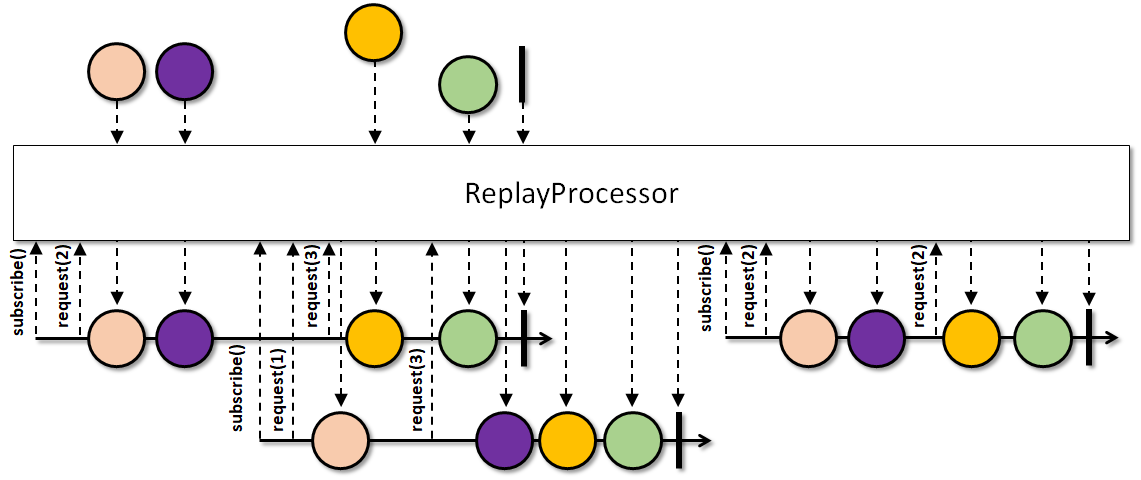
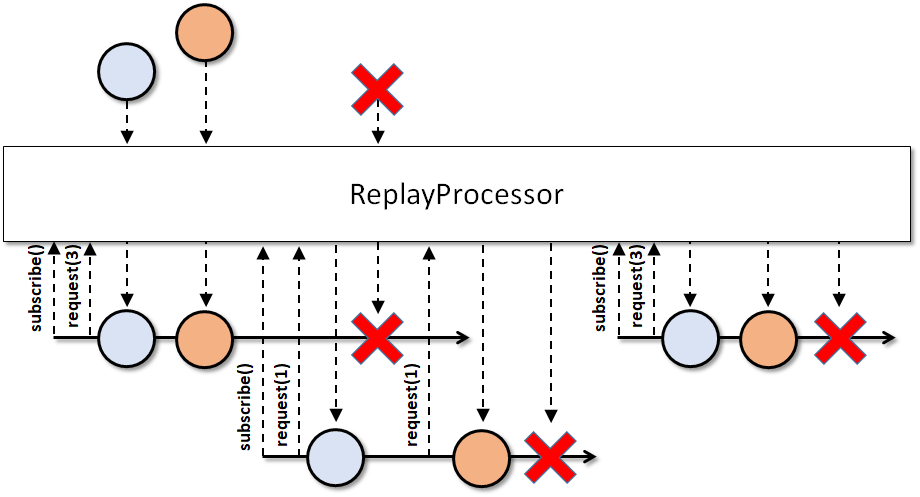
* Creates an unbounded ReplayProcessor.
*
* The internal buffer is backed by an {@link ArrayList} and starts with an initial capacity of 16. Once the
* number of items reaches this capacity, it will grow as necessary (usually by 50%). However, as the
* number of items grows, this causes frequent array reallocation and copying, and may hurt performance
* and latency. This can be avoided with the {@link #create(int)} overload which takes an initial capacity
* parameter and can be tuned to reduce the array reallocation frequency as needed.
*
* @param
* the type of items observed and emitted by the ReplayProcessor
* @return the created ReplayProcessor
*/
@CheckReturnValue
@NonNull
public static ReplayProcessor create() {
return new ReplayProcessor<>(new UnboundedReplayBuffer<>(16));
}
/**
* Creates an unbounded ReplayProcessor with the specified initial buffer capacity.
*
* Use this method to avoid excessive array reallocation while the internal buffer grows to accommodate new
* items. For example, if you know that the buffer will hold 32k items, you can ask the
* {@code ReplayProcessor} to preallocate its internal array with a capacity to hold that many items. Once
* the items start to arrive, the internal array won't need to grow, creating less garbage and no overhead
* due to frequent array-copying.
*
* @param
* the type of items observed and emitted by this type of processor
* @param capacityHint
* the initial buffer capacity
* @return the created processor
* @throws IllegalArgumentException if {@code capacityHint} is non-positive
*/
@CheckReturnValue
@NonNull
public static ReplayProcessor create(int capacityHint) {
ObjectHelper.verifyPositive(capacityHint, "capacityHint");
return new ReplayProcessor<>(new UnboundedReplayBuffer<>(capacityHint));
}
/**
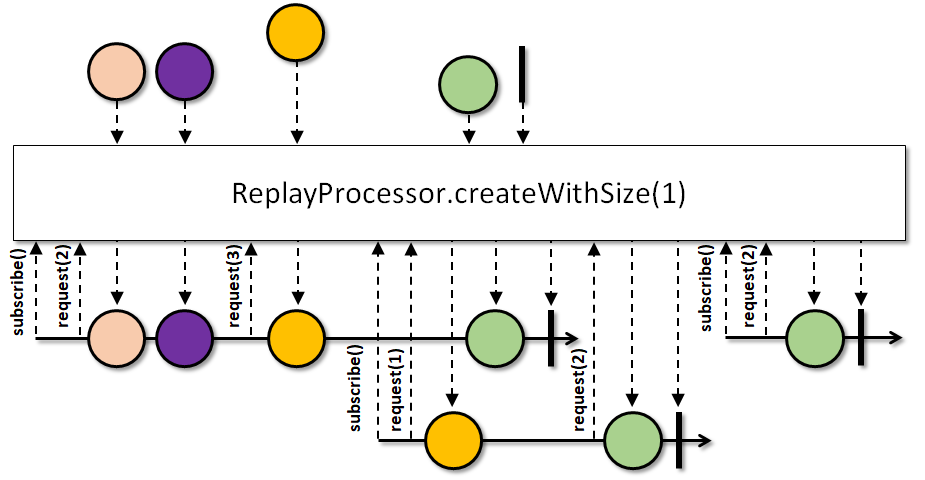
* Creates a size-bounded ReplayProcessor.
*
* In this setting, the {@code ReplayProcessor} holds at most {@code size} items in its internal buffer and
* discards the oldest item.
*
* When {@code Subscriber}s subscribe to a terminated {@code ReplayProcessor}, they are guaranteed to see at most
* {@code size} {@code onNext} events followed by a termination event.
*
* If a {@code Subscriber} subscribes while the {@code ReplayProcessor} is active, it will observe all items in the
* buffer at that point in time and each item observed afterwards, even if the buffer evicts items due to
* the size constraint in the mean time. In other words, once a {@code Subscriber} subscribes, it will receive items
* without gaps in the sequence.
*
* @param
* the type of items observed and emitted by this type of processor
* @param maxSize
* the maximum number of buffered items
* @return the created processor
* @throws IllegalArgumentException if {@code maxSize} is non-positive
*/
@CheckReturnValue
@NonNull
public static ReplayProcessor createWithSize(int maxSize) {
ObjectHelper.verifyPositive(maxSize, "maxSize");
return new ReplayProcessor<>(new SizeBoundReplayBuffer<>(maxSize));
}
/**
* Creates an unbounded ReplayProcessor with the bounded-implementation for testing purposes.
*
* This variant behaves like the regular unbounded {@code ReplayProcessor} created via {@link #create()} but
* uses the structures of the bounded-implementation. This is by no means intended for the replacement of
* the original, array-backed and unbounded {@code ReplayProcessor} due to the additional overhead of the
* linked-list based internal buffer. The sole purpose is to allow testing and reasoning about the behavior
* of the bounded implementations without the interference of the eviction policies.
*
* @param
* the type of items observed and emitted by this type of processor
* @return the created processor
*/
@CheckReturnValue
/* test */ static ReplayProcessor createUnbounded() {
return new ReplayProcessor<>(new SizeBoundReplayBuffer<>(Integer.MAX_VALUE));
}
/**
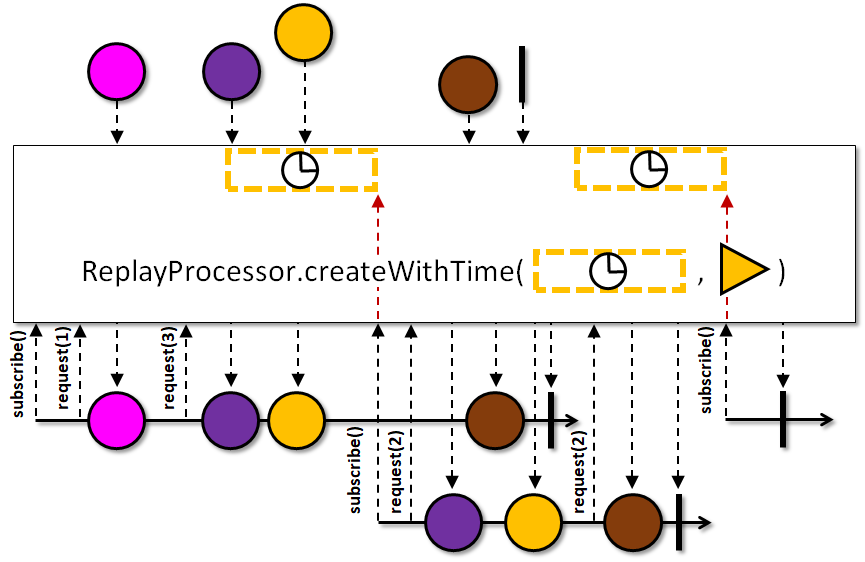
* Creates a time-bounded ReplayProcessor.
*
* In this setting, the {@code ReplayProcessor} internally tags each observed item with a timestamp value
* supplied by the {@link Scheduler} and keeps only those whose age is less than the supplied time value
* converted to milliseconds. For example, an item arrives at T=0 and the max age is set to 5; at T>=5
* this first item is then evicted by any subsequent item or termination event, leaving the buffer empty.
*
* Once the processor is terminated, {@code Subscriber}s subscribing to it will receive items that remained in the
* buffer after the terminal event, regardless of their age.
*
* If a {@code Subscriber} subscribes while the {@code ReplayProcessor} is active, it will observe only those items
* from within the buffer that have an age less than the specified time, and each item observed thereafter,
* even if the buffer evicts items due to the time constraint in the mean time. In other words, once a
* {@code Subscriber} subscribes, it observes items without gaps in the sequence except for any outdated items at the
* beginning of the sequence.
*
* Note that terminal notifications ({@code onError} and {@code onComplete}) trigger eviction as well. For
* example, with a max age of 5, the first item is observed at T=0, then an {@code onComplete} notification
* arrives at T=10. If a {@code Subscriber} subscribes at T=11, it will find an empty {@code ReplayProcessor} with just
* an {@code onComplete} notification.
*
* @param
* the type of items observed and emitted by this type of processor
* @param maxAge
* the maximum age of the contained items
* @param unit
* the time unit of {@code time}
* @param scheduler
* the {@link Scheduler} that provides the current time
* @return the created processor
* @throws NullPointerException if {@code unit} or {@code scheduler} is {@code null}
* @throws IllegalArgumentException if {@code maxAge} is non-positive
*/
@CheckReturnValue
@NonNull
public static ReplayProcessor createWithTime(long maxAge, @NonNull TimeUnit unit, @NonNull Scheduler scheduler) {
ObjectHelper.verifyPositive(maxAge, "maxAge");
Objects.requireNonNull(unit, "unit is null");
Objects.requireNonNull(scheduler, "scheduler is null");
return new ReplayProcessor<>(new SizeAndTimeBoundReplayBuffer<>(Integer.MAX_VALUE, maxAge, unit, scheduler));
}
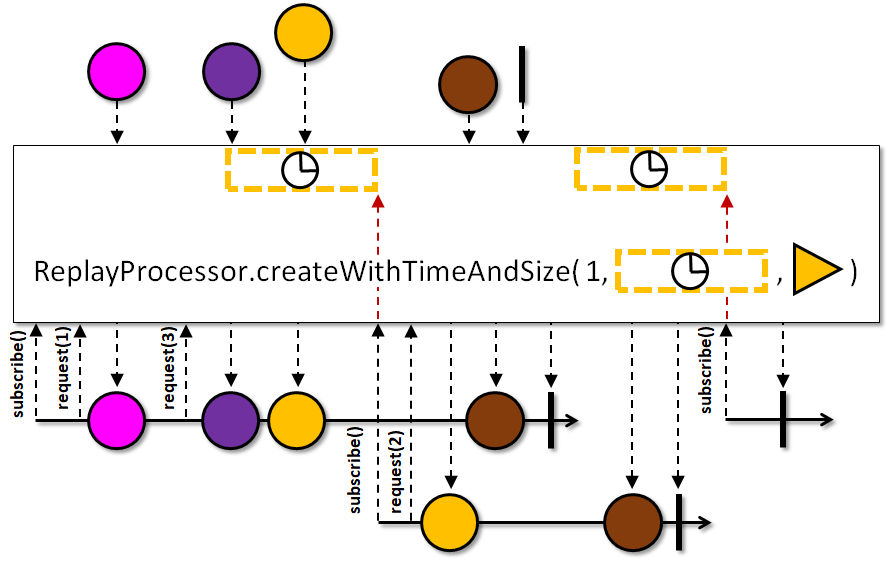
/**
* Creates a time- and size-bounded ReplayProcessor.
*
* In this setting, the {@code ReplayProcessor} internally tags each received item with a timestamp value
* supplied by the {@link Scheduler} and holds at most {@code size} items in its internal buffer. It evicts
* items from the start of the buffer if their age becomes less-than or equal to the supplied age in
* milliseconds or the buffer reaches its {@code size} limit.
*
* When {@code Subscriber}s subscribe to a terminated {@code ReplayProcessor}, they observe the items that remained in
* the buffer after the terminal notification, regardless of their age, but at most {@code size} items.
*
* If a {@code Subscriber} subscribes while the {@code ReplayProcessor} is active, it will observe only those items
* from within the buffer that have age less than the specified time and each subsequent item, even if the
* buffer evicts items due to the time constraint in the mean time. In other words, once a {@code Subscriber}
* subscribes, it observes items without gaps in the sequence except for the outdated items at the beginning
* of the sequence.
*
* Note that terminal notifications ({@code onError} and {@code onComplete}) trigger eviction as well. For
* example, with a max age of 5, the first item is observed at T=0, then an {@code onComplete} notification
* arrives at T=10. If a {@code Subscriber} subscribes at T=11, it will find an empty {@code ReplayProcessor} with just
* an {@code onComplete} notification.
*
* @param
* the type of items observed and emitted by this type of processor
* @param maxAge
* the maximum age of the contained items
* @param unit
* the time unit of {@code time}
* @param maxSize
* the maximum number of buffered items
* @param scheduler
* the {@link Scheduler} that provides the current time
* @return the created processor
* @throws NullPointerException if {@code unit} or {@code scheduler} is {@code null}
* @throws IllegalArgumentException if {@code maxAge} or {@code maxSize} is non-positive
*/
@CheckReturnValue
@NonNull
public static ReplayProcessor createWithTimeAndSize(long maxAge, @NonNull TimeUnit unit, @NonNull Scheduler scheduler, int maxSize) {
ObjectHelper.verifyPositive(maxSize, "maxSize");
ObjectHelper.verifyPositive(maxAge, "maxAge");
Objects.requireNonNull(unit, "unit is null");
Objects.requireNonNull(scheduler, "scheduler is null");
return new ReplayProcessor<>(new SizeAndTimeBoundReplayBuffer<>(maxSize, maxAge, unit, scheduler));
}
/**
* Constructs a ReplayProcessor with the given custom ReplayBuffer instance.
* @param buffer the ReplayBuffer instance, not null (not verified)
*/
@SuppressWarnings("unchecked")
ReplayProcessor(ReplayBuffer buffer) {
this.buffer = buffer;
this.subscribers = new AtomicReference<>(EMPTY);
}
@Override
protected void subscribeActual(Subscriber s) {
ReplaySubscription rs = new ReplaySubscription<>(s, this);
s.onSubscribe(rs);
if (add(rs)) {
if (rs.cancelled) {
remove(rs);
return;
}
}
buffer.replay(rs);
}
@Override
public void onSubscribe(Subscription s) {
if (done) {
s.cancel();
return;
}
s.request(Long.MAX_VALUE);
}
@Override
public void onNext(T t) {
ExceptionHelper.nullCheck(t, "onNext called with a null value.");
if (done) {
return;
}
ReplayBuffer b = buffer;
b.next(t);
for (ReplaySubscription rs : subscribers.get()) {
b.replay(rs);
}
}
@SuppressWarnings("unchecked")
@Override
public void onError(Throwable t) {
ExceptionHelper.nullCheck(t, "onError called with a null Throwable.");
if (done) {
RxJavaPlugins.onError(t);
return;
}
done = true;
ReplayBuffer b = buffer;
b.error(t);
for (ReplaySubscription rs : subscribers.getAndSet(TERMINATED)) {
b.replay(rs);
}
}
@SuppressWarnings("unchecked")
@Override
public void onComplete() {
if (done) {
return;
}
done = true;
ReplayBuffer b = buffer;
b.complete();
for (ReplaySubscription rs : subscribers.getAndSet(TERMINATED)) {
b.replay(rs);
}
}
@Override
@CheckReturnValue
public boolean hasSubscribers() {
return subscribers.get().length != 0;
}
@CheckReturnValue
/* test */ int subscriberCount() {
return subscribers.get().length;
}
@Override
@Nullable
@CheckReturnValue
public Throwable getThrowable() {
ReplayBuffer b = buffer;
if (b.isDone()) {
return b.getError();
}
return null;
}
/**
* Makes sure the item cached by the head node in a bounded
* ReplayProcessor is released (as it is never part of a replay).
*
* By default, live bounded buffers will remember one item before
* the currently receivable one to ensure subscribers can always
* receive a continuous sequence of items. A terminated ReplayProcessor
* automatically releases this inaccessible item.
*
* The method must be called sequentially, similar to the standard
* {@code onXXX} methods.
*
History: 2.1.11 - experimental
* @since 2.2
*/
public void cleanupBuffer() {
buffer.trimHead();
}
/**
* Returns the latest value this processor has or null if no such value exists.
*
The method is thread-safe.
* @return the latest value this processor currently has or null if no such value exists
*/
@CheckReturnValue
public T getValue() {
return buffer.getValue();
}
/**
* Returns an Object array containing snapshot all values of this processor.
*
The method is thread-safe.
* @return the array containing the snapshot of all values of this processor
*/
@CheckReturnValue
public Object[] getValues() {
@SuppressWarnings("unchecked")
T[] a = (T[])EMPTY_ARRAY;
T[] b = getValues(a);
if (b == EMPTY_ARRAY) {
return new Object[0];
}
return b;
}
/**
* Returns a typed array containing a snapshot of all values of this processor.
*
The method follows the conventions of Collection.toArray by setting the array element
* after the last value to null (if the capacity permits).
*
The method is thread-safe.
* @param array the target array to copy values into if it fits
* @return the given array if the values fit into it or a new array containing all values
*/
@CheckReturnValue
public T[] getValues(T[] array) {
return buffer.getValues(array);
}
@Override
@CheckReturnValue
public boolean hasComplete() {
ReplayBuffer b = buffer;
return b.isDone() && b.getError() == null;
}
@Override
@CheckReturnValue
public boolean hasThrowable() {
ReplayBuffer b = buffer;
return b.isDone() && b.getError() != null;
}
/**
* Returns true if this processor has any value.
* The method is thread-safe.
* @return true if the processor has any value
*/
@CheckReturnValue
public boolean hasValue() {
return buffer.size() != 0; // NOPMD
}
@CheckReturnValue
/* test*/ int size() {
return buffer.size();
}
boolean add(ReplaySubscription rs) {
for (;;) {
ReplaySubscription[] a = subscribers.get();
if (a == TERMINATED) {
return false;
}
int len = a.length;
@SuppressWarnings("unchecked")
ReplaySubscription[] b = new ReplaySubscription[len + 1];
System.arraycopy(a, 0, b, 0, len);
b[len] = rs;
if (subscribers.compareAndSet(a, b)) {
return true;
}
}
}
@SuppressWarnings("unchecked")
void remove(ReplaySubscription rs) {
for (;;) {
ReplaySubscription[] a = subscribers.get();
if (a == TERMINATED || a == EMPTY) {
return;
}
int len = a.length;
int j = -1;
for (int i = 0; i < len; i++) {
if (a[i] == rs) {
j = i;
break;
}
}
if (j < 0) {
return;
}
ReplaySubscription[] b;
if (len == 1) {
b = EMPTY;
} else {
b = new ReplaySubscription[len - 1];
System.arraycopy(a, 0, b, 0, j);
System.arraycopy(a, j + 1, b, j, len - j - 1);
}
if (subscribers.compareAndSet(a, b)) {
return;
}
}
}
/**
* Abstraction over a buffer that receives events and replays them to
* individual Subscribers.
*
* @param the value type
*/
interface ReplayBuffer<@NonNull T> {
void next(T value);
void error(Throwable ex);
void complete();
void replay(ReplaySubscription rs);
int size();
@Nullable
T getValue();
T[] getValues(T[] array);
boolean isDone();
Throwable getError();
/**
* Make sure an old inaccessible head value is released
* in a bounded buffer.
*/
void trimHead();
}
static final class ReplaySubscription<@NonNull T> extends AtomicInteger implements Subscription {
private static final long serialVersionUID = 466549804534799122L;
final Subscriber downstream;
final ReplayProcessor state;
Object index;
final AtomicLong requested;
volatile boolean cancelled;
long emitted;
ReplaySubscription(Subscriber actual, ReplayProcessor state) {
this.downstream = actual;
this.state = state;
this.requested = new AtomicLong();
}
@Override
public void request(long n) {
if (SubscriptionHelper.validate(n)) {
BackpressureHelper.add(requested, n);
state.buffer.replay(this);
}
}
@Override
public void cancel() {
if (!cancelled) {
cancelled = true;
state.remove(this);
}
}
}
static final class UnboundedReplayBuffer
implements ReplayBuffer {
final List buffer;
Throwable error;
volatile boolean done;
volatile int size;
UnboundedReplayBuffer(int capacityHint) {
this.buffer = new ArrayList<>(capacityHint);
}
@Override
public void next(T value) {
buffer.add(value);
size++;
}
@Override
public void error(Throwable ex) {
error = ex;
done = true;
}
@Override
public void complete() {
done = true;
}
@Override
public void trimHead() {
// not applicable for an unbounded buffer
}
@Override
@Nullable
public T getValue() {
int s = size;
if (s == 0) {
return null;
}
return buffer.get(s - 1);
}
@Override
@SuppressWarnings("unchecked")
public T[] getValues(T[] array) {
int s = size;
if (s == 0) {
if (array.length != 0) {
array[0] = null;
}
return array;
}
List b = buffer;
if (array.length < s) {
array = (T[])Array.newInstance(array.getClass().getComponentType(), s);
}
for (int i = 0; i < s; i++) {
array[i] = b.get(i);
}
if (array.length > s) {
array[s] = null;
}
return array;
}
@Override
public void replay(ReplaySubscription rs) {
if (rs.getAndIncrement() != 0) {
return;
}
int missed = 1;
final List b = buffer;
final Subscriber a = rs.downstream;
Integer indexObject = (Integer)rs.index;
int index;
if (indexObject != null) {
index = indexObject;
} else {
index = 0;
rs.index = 0;
}
long e = rs.emitted;
for (;;) {
long r = rs.requested.get();
while (e != r) {
if (rs.cancelled) {
rs.index = null;
return;
}
boolean d = done;
int s = size;
if (d && index == s) {
rs.index = null;
rs.cancelled = true;
Throwable ex = error;
if (ex == null) {
a.onComplete();
} else {
a.onError(ex);
}
return;
}
if (index == s) {
break;
}
a.onNext(b.get(index));
index++;
e++;
}
if (e == r) {
if (rs.cancelled) {
rs.index = null;
return;
}
boolean d = done;
int s = size;
if (d && index == s) {
rs.index = null;
rs.cancelled = true;
Throwable ex = error;
if (ex == null) {
a.onComplete();
} else {
a.onError(ex);
}
return;
}
}
rs.index = index;
rs.emitted = e;
missed = rs.addAndGet(-missed);
if (missed == 0) {
break;
}
}
}
@Override
public int size() {
return size;
}
@Override
public boolean isDone() {
return done;
}
@Override
public Throwable getError() {
return error;
}
}
static final class Node extends AtomicReference> {
private static final long serialVersionUID = 6404226426336033100L;
final T value;
Node(T value) {
this.value = value;
}
}
static final class TimedNode extends AtomicReference> {
private static final long serialVersionUID = 6404226426336033100L;
final T value;
final long time;
TimedNode(T value, long time) {
this.value = value;
this.time = time;
}
}
static final class SizeBoundReplayBuffer<@NonNull T>
implements ReplayBuffer {
final int maxSize;
int size;
volatile Node head;
Node tail;
Throwable error;
volatile boolean done;
SizeBoundReplayBuffer(int maxSize) {
this.maxSize = maxSize;
Node h = new Node<>(null);
this.tail = h;
this.head = h;
}
void trim() {
if (size > maxSize) {
size--;
Node h = head;
head = h.get();
}
}
@Override
public void next(T value) {
Node n = new Node<>(value);
Node t = tail;
tail = n;
size++;
t.set(n); // releases both the tail and size
trim();
}
@Override
public void error(Throwable ex) {
error = ex;
trimHead();
done = true;
}
@Override
public void complete() {
trimHead();
done = true;
}
@Override
public void trimHead() {
if (head.value != null) {
Node n = new Node<>(null);
n.lazySet(head.get());
head = n;
}
}
@Override
public boolean isDone() {
return done;
}
@Override
public Throwable getError() {
return error;
}
@Override
public T getValue() {
Node h = head;
for (;;) {
Node n = h.get();
if (n == null) {
return h.value;
}
h = n;
}
}
@Override
@SuppressWarnings("unchecked")
public T[] getValues(T[] array) {
int s = 0;
Node h = head;
Node h0 = h;
for (;;) {
Node next = h0.get();
if (next == null) {
break;
}
s++;
h0 = next;
}
if (array.length < s) {
array = (T[])Array.newInstance(array.getClass().getComponentType(), s);
}
for (int j = 0; j < s; j++) {
h = h.get();
array[j] = h.value;
}
if (array.length > s) {
array[s] = null;
}
return array;
}
@Override
@SuppressWarnings("unchecked")
public void replay(ReplaySubscription rs) {
if (rs.getAndIncrement() != 0) {
return;
}
int missed = 1;
final Subscriber a = rs.downstream;
Node index = (Node)rs.index;
if (index == null) {
index = head;
}
long e = rs.emitted;
for (;;) {
long r = rs.requested.get();
while (e != r) {
if (rs.cancelled) {
rs.index = null;
return;
}
boolean d = done;
Node next = index.get();
boolean empty = next == null;
if (d && empty) {
rs.index = null;
rs.cancelled = true;
Throwable ex = error;
if (ex == null) {
a.onComplete();
} else {
a.onError(ex);
}
return;
}
if (empty) {
break;
}
a.onNext(next.value);
e++;
index = next;
}
if (e == r) {
if (rs.cancelled) {
rs.index = null;
return;
}
boolean d = done;
if (d && index.get() == null) {
rs.index = null;
rs.cancelled = true;
Throwable ex = error;
if (ex == null) {
a.onComplete();
} else {
a.onError(ex);
}
return;
}
}
rs.index = index;
rs.emitted = e;
missed = rs.addAndGet(-missed);
if (missed == 0) {
break;
}
}
}
@Override
public int size() {
int s = 0;
Node h = head;
while (s != Integer.MAX_VALUE) {
Node next = h.get();
if (next == null) {
break;
}
s++;
h = next;
}
return s;
}
}
static final class SizeAndTimeBoundReplayBuffer
implements ReplayBuffer {
final int maxSize;
final long maxAge;
final TimeUnit unit;
final Scheduler scheduler;
int size;
volatile TimedNode head;
TimedNode tail;
Throwable error;
volatile boolean done;
SizeAndTimeBoundReplayBuffer(int maxSize, long maxAge, TimeUnit unit, Scheduler scheduler) {
this.maxSize = maxSize;
this.maxAge = maxAge;
this.unit = unit;
this.scheduler = scheduler;
TimedNode h = new TimedNode<>(null, 0L);
this.tail = h;
this.head = h;
}
void trim() {
if (size > maxSize) {
size--;
TimedNode h = head;
head = h.get();
}
long limit = scheduler.now(unit) - maxAge;
TimedNode h = head;
for (;;) {
if (size <= 1) {
head = h;
break;
}
TimedNode next = h.get();
if (next.time > limit) {
head = h;
break;
}
h = next;
size--;
}
}
void trimFinal() {
long limit = scheduler.now(unit) - maxAge;
TimedNode h = head;
for (;;) {
TimedNode next = h.get();
if (next == null) {
if (h.value != null) {
head = new TimedNode<>(null, 0L);
} else {
head = h;
}
break;
}
if (next.time > limit) {
if (h.value != null) {
TimedNode n = new TimedNode<>(null, 0L);
n.lazySet(h.get());
head = n;
} else {
head = h;
}
break;
}
h = next;
}
}
@Override
public void trimHead() {
if (head.value != null) {
TimedNode n = new TimedNode<>(null, 0L);
n.lazySet(head.get());
head = n;
}
}
@Override
public void next(T value) {
TimedNode n = new TimedNode<>(value, scheduler.now(unit));
TimedNode t = tail;
tail = n;
size++;
t.set(n); // releases both the tail and size
trim();
}
@Override
public void error(Throwable ex) {
trimFinal();
error = ex;
done = true;
}
@Override
public void complete() {
trimFinal();
done = true;
}
@Override
@Nullable
public T getValue() {
TimedNode h = head;
for (;;) {
TimedNode next = h.get();
if (next == null) {
break;
}
h = next;
}
long limit = scheduler.now(unit) - maxAge;
if (h.time < limit) {
return null;
}
return h.value;
}
@Override
@SuppressWarnings("unchecked")
public T[] getValues(T[] array) {
TimedNode h = getHead();
int s = size(h);
if (s == 0) {
if (array.length != 0) {
array[0] = null;
}
} else {
if (array.length < s) {
array = (T[])Array.newInstance(array.getClass().getComponentType(), s);
}
int i = 0;
while (i != s) {
TimedNode next = h.get();
array[i] = next.value;
i++;
h = next;
}
if (array.length > s) {
array[s] = null;
}
}
return array;
}
TimedNode getHead() {
TimedNode index = head;
// skip old entries
long limit = scheduler.now(unit) - maxAge;
TimedNode next = index.get();
while (next != null) {
long ts = next.time;
if (ts > limit) {
break;
}
index = next;
next = index.get();
}
return index;
}
@Override
@SuppressWarnings("unchecked")
public void replay(ReplaySubscription rs) {
if (rs.getAndIncrement() != 0) {
return;
}
int missed = 1;
final Subscriber a = rs.downstream;
TimedNode index = (TimedNode)rs.index;
if (index == null) {
index = getHead();
}
long e = rs.emitted;
for (;;) {
long r = rs.requested.get();
while (e != r) {
if (rs.cancelled) {
rs.index = null;
return;
}
boolean d = done;
TimedNode next = index.get();
boolean empty = next == null;
if (d && empty) {
rs.index = null;
rs.cancelled = true;
Throwable ex = error;
if (ex == null) {
a.onComplete();
} else {
a.onError(ex);
}
return;
}
if (empty) {
break;
}
a.onNext(next.value);
e++;
index = next;
}
if (e == r) {
if (rs.cancelled) {
rs.index = null;
return;
}
boolean d = done;
if (d && index.get() == null) {
rs.index = null;
rs.cancelled = true;
Throwable ex = error;
if (ex == null) {
a.onComplete();
} else {
a.onError(ex);
}
return;
}
}
rs.index = index;
rs.emitted = e;
missed = rs.addAndGet(-missed);
if (missed == 0) {
break;
}
}
}
@Override
public int size() {
return size(getHead());
}
int size(TimedNode h) {
int s = 0;
while (s != Integer.MAX_VALUE) {
TimedNode next = h.get();
if (next == null) {
break;
}
s++;
h = next;
}
return s;
}
@Override
public Throwable getError() {
return error;
}
@Override
public boolean isDone() {
return done;
}
}
}
 *
 *
 *
 *
 *