 *
*
*
* When the upstream terminates, the {@code ConnectableFlowable} remains in this terminated state and, * depending on the actual underlying implementation, relays cached events to late {@code Subscriber}s. * In order to reuse and restart this {@code ConnectableFlowable}, the {@link #reset()} method has to be called. * When called, this {@code ConnectableFlowable} will appear as fresh, unconnected source to new {@code Subscriber}s. * Disposing the connection will reset the {@code ConnectableFlowable} to its fresh state and there is no need to call * {@code reset()} in this case. *
* Note that although {@link #connect()} and {@link #reset()} are safe to call from multiple threads, it is recommended * a dedicated thread or business logic manages the connection or resetting of a {@code ConnectableFlowable} so that * there is no unwanted signal loss due to early {@code connect()} or {@code reset()} calls while {@code Subscriber}s are * still being subscribed to to this {@code ConnectableFlowable} to receive signals from the get go. *
* @see RxJava Wiki: Connectable Observable Operators
* @param
* Calling this method on a fresh or active {@code ConnectableFlowable} has no effect.
*
* To disconnect from a synchronous source, use the {@link #connect(io.reactivex.rxjava3.functions.Consumer)} method.
* History: 2.1.14 - experimental
* @param subscriberCount the number of subscribers required to connect to the upstream
* @return the new {@link Flowable} instance
* @throws IllegalArgumentException if {@code subscriberCount} is non-positive
* @since 2.2
*/
@CheckReturnValue
@SchedulerSupport(SchedulerSupport.NONE)
@BackpressureSupport(BackpressureKind.PASS_THROUGH)
@NonNull
public final Flowable History: 2.1.14 - experimental
* @param timeout the time to wait before disconnecting after all subscribers unsubscribed
* @param unit the time unit of the timeout
* @return the new {@link Flowable} instance
* @throws NullPointerException if {@code unit} is {@code null}
* @see #refCount(long, TimeUnit, Scheduler)
* @since 2.2
*/
@CheckReturnValue
@SchedulerSupport(SchedulerSupport.COMPUTATION)
@BackpressureSupport(BackpressureKind.PASS_THROUGH)
@NonNull
public final Flowable History: 2.1.14 - experimental
* @param timeout the time to wait before disconnecting after all subscribers unsubscribed
* @param unit the time unit of the timeout
* @param scheduler the target scheduler to wait on before disconnecting
* @return the new {@link Flowable} instance
* @throws NullPointerException if {@code unit} or {@code scheduler} is {@code null}
* @since 2.2
*/
@CheckReturnValue
@SchedulerSupport(SchedulerSupport.CUSTOM)
@BackpressureSupport(BackpressureKind.PASS_THROUGH)
@NonNull
public final Flowable History: 2.1.14 - experimental
* @param subscriberCount the number of subscribers required to connect to the upstream
* @param timeout the time to wait before disconnecting after all subscribers unsubscribed
* @param unit the time unit of the timeout
* @return the new {@link Flowable} instance
* @throws NullPointerException if {@code unit} is {@code null}
* @throws IllegalArgumentException if {@code subscriberCount} is non-positive
* @see #refCount(int, long, TimeUnit, Scheduler)
* @since 2.2
*/
@CheckReturnValue
@SchedulerSupport(SchedulerSupport.COMPUTATION)
@BackpressureSupport(BackpressureKind.PASS_THROUGH)
@NonNull
public final Flowable History: 2.1.14 - experimental
* @param subscriberCount the number of subscribers required to connect to the upstream
* @param timeout the time to wait before disconnecting after all subscribers unsubscribed
* @param unit the time unit of the timeout
* @param scheduler the target scheduler to wait on before disconnecting
* @return the new {@link Flowable} instance
* @throws NullPointerException if {@code unit} or {@code scheduler} is {@code null}
* @throws IllegalArgumentException if {@code subscriberCount} is non-positive
* @since 2.2
*/
@CheckReturnValue
@SchedulerSupport(SchedulerSupport.CUSTOM)
@BackpressureSupport(BackpressureKind.PASS_THROUGH)
@NonNull
public final Flowable
*
* The connection happens after the first subscription and happens at most once
* during the lifetime of the returned {@code Flowable}. If this {@code ConnectableFlowable}
* terminates, the connection is never renewed, no matter how {@code Subscriber}s come
* and go. Use {@link #refCount()} to renew a connection or dispose an active
* connection when all {@code Subscriber}s have cancelled their {@link Subscription}s.
*
* This overload does not allow disconnecting the connection established via
* {@link #connect(Consumer)}. Use the {@link #autoConnect(int, Consumer)} overload
* to gain access to the {@link Disposable} representing the only connection.
*
*
* The connection happens after the given number of subscriptions and happens at most once
* during the lifetime of the returned {@code Flowable}. If this {@code ConnectableFlowable}
* terminates, the connection is never renewed, no matter how {@code Subscriber}s come
* and go. Use {@link #refCount()} to renew a connection or dispose an active
* connection when all {@code Subscriber}s have cancelled their {@link Subscription}s.
*
*
*
* @param connection
* the action that receives the connection subscription before the subscription to source happens
* allowing the caller to synchronously disconnect a synchronous source
* @throws NullPointerException if {@code connection} is {@code null}
* @see ReactiveX documentation: Connect
*/
@SchedulerSupport(SchedulerSupport.NONE)
public abstract void connect(@NonNull Consumer connection);
/**
* Resets this {@code ConnectableFlowable} into its fresh state if it has terminated.
*
*
* @since 3.0.0
*/
@SchedulerSupport(SchedulerSupport.NONE)
public abstract void reset();
/**
* Instructs the {@code ConnectableFlowable} to begin emitting the items from its underlying
* {@link Flowable} to its {@link Subscriber}s.
*
*
*
* @return the subscription representing the connection
* @see ReactiveX documentation: Connect
*/
@NonNull
@SchedulerSupport(SchedulerSupport.NONE)
public final Disposable connect() {
ConnectConsumer cc = new ConnectConsumer();
connect(cc);
return cc.disposable;
}
/**
* Returns a {@link Flowable} that stays connected to this {@code ConnectableFlowable} as long as there
* is at least one subscription to this {@code ConnectableFlowable}.
*
*
* @return the new {@code Flowable} instance
* @see ReactiveX documentation: RefCount
* @see #refCount(int)
* @see #refCount(long, TimeUnit)
* @see #refCount(int, long, TimeUnit)
*/
@NonNull
@CheckReturnValue
@SchedulerSupport(SchedulerSupport.NONE)
@BackpressureSupport(BackpressureKind.PASS_THROUGH)
public Flowable
*
*
*
*
*
*
*
*
*
* 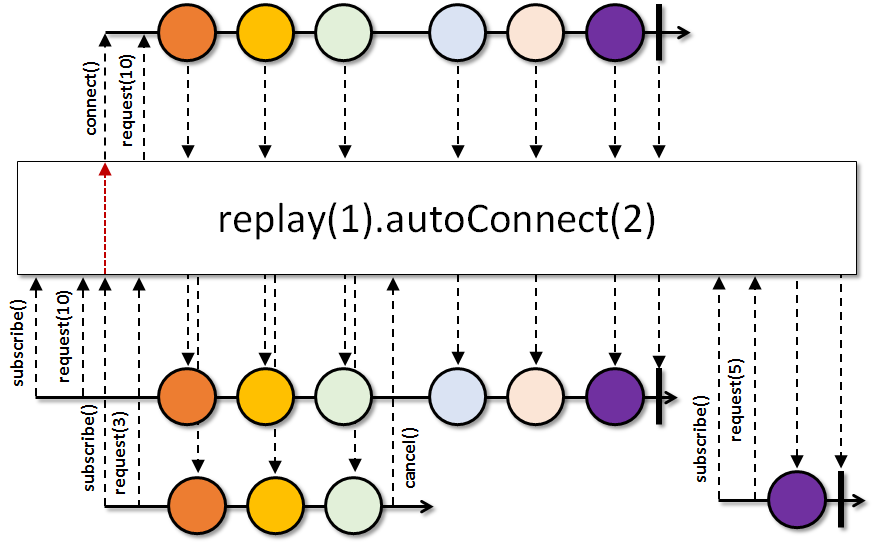 *
*
*
* @return a new {@code Flowable} instance that automatically connects to this {@code ConnectableFlowable}
* when the first {@code Subscriber} subscribes
* @see #refCount()
* @see #autoConnect(int, Consumer)
*/
@NonNull
@CheckReturnValue
@BackpressureSupport(BackpressureKind.PASS_THROUGH)
@SchedulerSupport(SchedulerSupport.NONE)
public Flowable
*
*
*
* @param numberOfSubscribers the number of subscribers to await before calling connect
* on the {@code ConnectableFlowable}. A non-positive value indicates
* an immediate connection.
* @return a new {@code Flowable} instance that automatically connects to this {@code ConnectableFlowable}
* when the specified number of {@code Subscriber}s subscribe to it
*/
@NonNull
@CheckReturnValue
@BackpressureSupport(BackpressureKind.PASS_THROUGH)
@SchedulerSupport(SchedulerSupport.NONE)
public Flowable
*
*
*
* @param numberOfSubscribers the number of subscribers to await before calling connect
* on the {@code ConnectableFlowable}. A non-positive value indicates
* an immediate connection.
* @param connection the callback {@link Consumer} that will receive the {@code Disposable} representing the
* established connection
* @return a new {@code Flowable} instance that automatically connects to this {@code ConnectableFlowable}
* when the specified number of {@code Subscriber}s subscribe to it and calls the
* specified callback with the {@code Disposable} associated with the established connection
* @throws NullPointerException if {@code connection} is {@code null}
*/
@NonNull
@CheckReturnValue
@BackpressureSupport(BackpressureKind.PASS_THROUGH)
@SchedulerSupport(SchedulerSupport.NONE)
public Flowable