Nanotube water capillary system
=============================
### Images



 #### Video
https://www.youtube.com/watch?v=U_-KUIuttfM
### Details
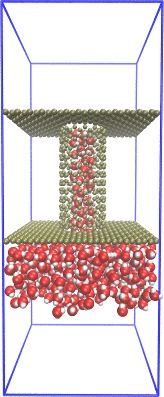
This is a small version of a carbon-nanotube, water capillary system, inspired by this paper:
[Laurent Joly, J. Chem. Phys. 135(21):214705 (2011)](https://doi.org/10.1063/1.3664622)
To investigate the behavior from that paper, it might be a good idea to increase the size of the water reservoir, the spacing between the walls, and the size of the system in the X and Y directions.
Note that there are two ways to run this simulation,
at constant volume or at constant pressure.
(In the video above the simulation was run at constant volume.)
#### Hexagonal vs Rectangular
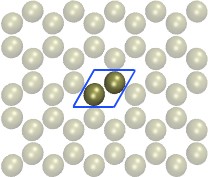
Note: The "graphene.lt" file used here generates *hexagonal* crystals.
If you prefer to create rectangular crystals, a rectangular version
of that file is available
[here](https://github.com/jewettaij/moltemplate/blob/master/moltemplate/force_fields/graphene_rectangular.lt).
(Instructions are included in the comments in that file.)
### Requirements
*To run this system at constant pressure,
LAMMPS must be compiled with the "RIGID" package enabled.
So if LAMMPS generates the following error:
"rigid: Unknown fix", then you must follow
[these instructions](https://docs.lammps.org/Build_package.html),
and recompile LAMMPS.
(Running simulations containing immobile objects at constant pressure in
LAMMPS is complicated. See the "run.in.npt" file for details.)*
### Notes:
#### Explicit carbon-carbon bonds:
In the graphene and nanotube structures, I did not try to connect the carbon atoms together with bonds. Instead we will hold these structures rigid by not integrating their equations of motion. (If you want to simulate movement of the carbon atoms at high temperatures or tension, LAMMPS has 3-body/many-body LAMMPS force-fields available for simulating the behaviour of carbon in graphite. I know that you don't need to specify bonds to use these force fields. I do not know know if these force fields work for nanotubes or graphene.)
#### Other modeling tools:
If you need explicit bonds between carbon atoms, then you must add them yourself or use a different tool. Currently (2012-10-20), moltemplate does not generate bonds automatically. The "Nanotube Builder" and "topotools" plugins for for VMD can generate a nanotube with bonds in LAMMPS data format. You can then convert this data file to .LT format using the ltemplify.py utility and then import it into another .LT file and play with it later. (In the "cnad-cnt" example, the carbon nanotube was built using "Nanotube Builder" and topotools, and processed with ltemplify.py)
### WARNING: This is not a realistic graphene-nanotube junction
A real junction would be curved and deformed near the boundary, (not 90 degrees) and it would not be built entirely from hexagons. (This is not a problem in this example because the carbon atoms are immobilized.) If you want to simulate the behavior of real graphene or nanotube junctions, you must be more careful.
To solve this problem, moltemplate allows you to move, customize or delete individual atoms near the boundary. You can move atoms by overwriting their coordinates using additional write("Data Atoms") statements (after the walls and tube are created). You can also change their charge. Alternately, you could start with the structure provided here, and relax/minimize the coordinates of the carbon atoms using LAMMPS before using it in other simulations. Or you could do both (customization & minimization).